
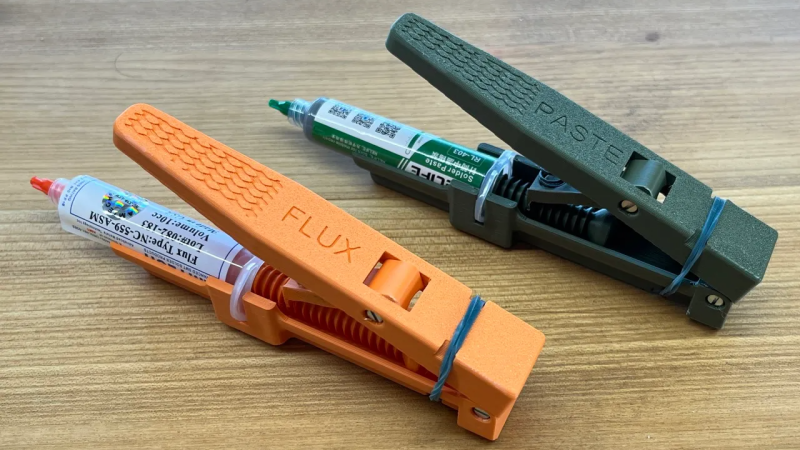
Syringes are pretty ergonomic, but when manually dispensing flux and solder paste it doesn’t take long before one wants a better way. [Elektroarzt]’s flux and solder paste dispenser design uses 3D-printed parts and minimal hardware (mostly M3x20 screws, and an optional spring) to improve handling and control.
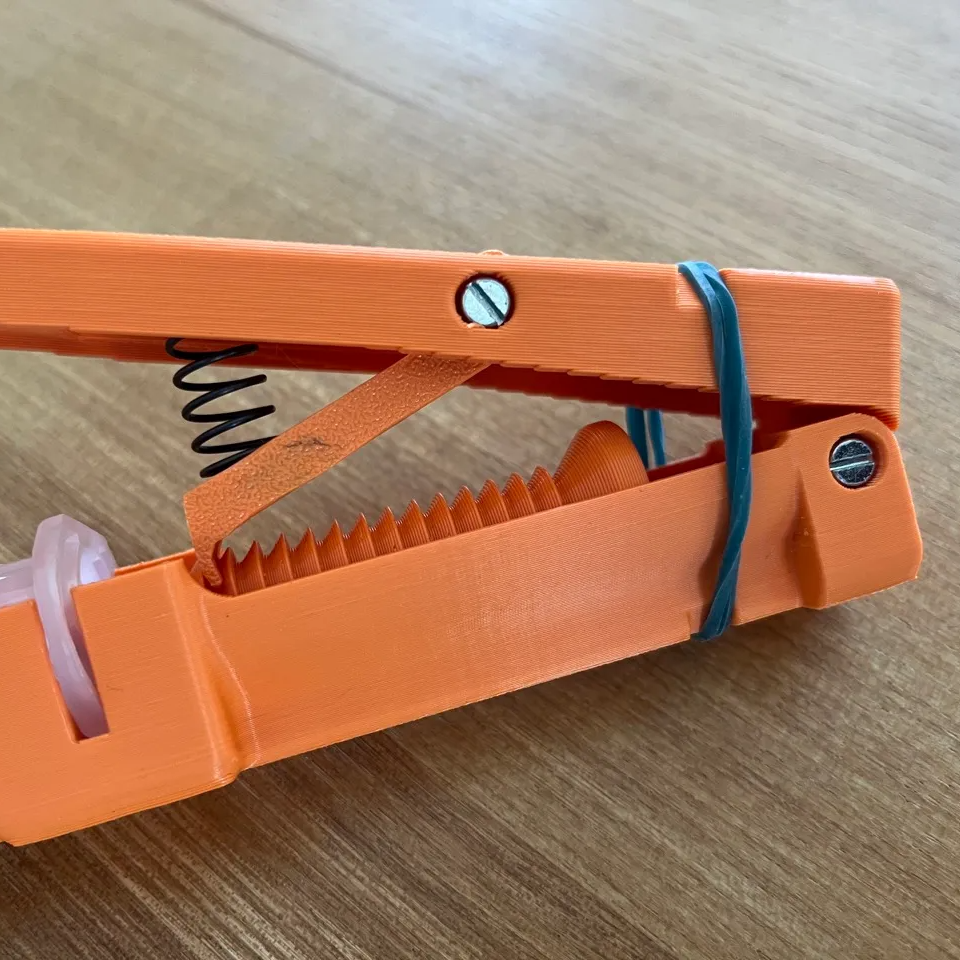
How does it work? The ratcheting lever mechanism is similar to that of a hot glue gun, where an arm slips into notches in a rod when pressed down, driving it forward and never backward. In the process, a larger lever movement is translated into a shorter plunger travel, enhancing control.
The types of syringes this tool is meant to be used with have a plunger tip or piston (the rubber stopper-looking part, in contact with the liquid) inside the loaded syringe, but no plunger shaft attached to it. This is common with syringes meant to be loaded into tools or machines, and [Elektroarzt]’s tool can be used with any such syringe in a 10 cc size.
It’s an attractive design, and we like the way syringes top-load as well as the way the tool is made to lay flat on a tabletop, with the lever pointed up.
Want truly fine-grained control over your extrusions? Then check out this dispenser which really lets one dial in small amounts. You can also go motorized, and let a small PCB and stepper motor do the work.










(Title typo: paster s/b paste)
admins feel free to delete this comment
Whoops! Eyes slid right off that one! Thanks!
Shut up and take my money!
Geez, you guys did it again. I was just scratching my head thinking about how to design something like this after not liking the price of Henkel’s (Loctite) offerings. I was stuck on using a metal pushrod.
Now reconsidering.
Thanks!
I’d have described the mechanism more as a caulk gun than hot glue gun based on the rest of the description.
Either way great post and project. Now if I could just find some flux that didn’t expire between projects.
Nicely done pieces.
Agreed on the characterization, given the notched mechanism.
I wonder if, with multiple notches on the pawl, if a finer feed resolution could be implemented.
I have a “no drip”, (okay, it actually says “no-drir” which I assume to be a Chinglish translation) super fine resolution caulking gun with no notches, but that uses a sharp edge to bite into the metal rod. So, I wonder if a notchless, continuous feed like a glue gun could be implemented purely as a 3D print. I’ve made some close-ish tolerance press fit parts in PETG that do not want to come apart once pressed together.
With big layer lines on the rod ratchet and pawl, maybe a really fine push mechanism could be made to work. I’d be happy with “almost completely” 3D printed”. Maybe just a long screw could work for the rod with the threads standing in for notches? Or not.
Learn something new, I didn’t know there was any other kind. I have a good collection of the darn things and only recently got rid of a heap of excess ones as surely I’ll never need that many acquired from various project and often helping other people and they are all that kind. I wonder if its a location thing, as in the UK I’ve never seen one, or if they do exist here but are just not common.
When i got my first house I had one, hated it as it tended to slip a lot
Maybe it was that specific one maybe cause I was using construction adhesive either way it it the recycling bin pretty quick
I will use it, I have concerns over the strength of the plastic though
In winters my “lab” drops to 14C (no heating or insulation) and hence the flux becomes less liquid, I have to push the plunger hard to get it out.