
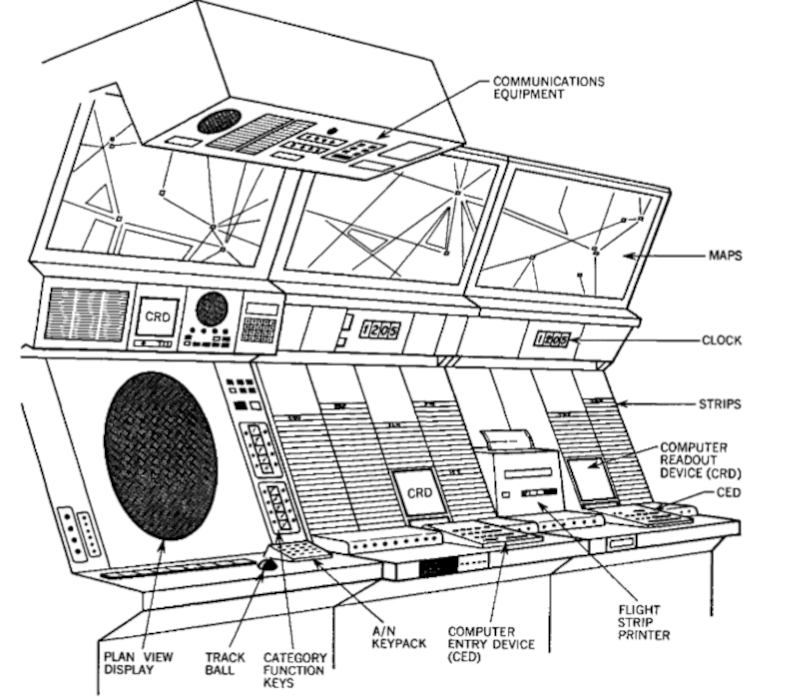
It is a movie staple to see an overworked air traffic controller sweating over a radar display. Depending on the movie, they might realize they’ve picked the wrong week to stop some bad habit. But how does the system really work? [J. B. Crawford] has a meticulously detailed post about the origins of the computerized air traffic control system (building on an earlier post which is also interesting).
Like many early computer systems, the FAA started out with the Air Force SAGE defense system. It makes sense. SAGE had to identify and track radar targets. The 1959 SATIN (SAGE Air Traffic Integration) program was the result. Meanwhile, different parts of the air traffic system were installing computers piecemeal.
SAGE and its successors had many parents: MIT, MITRE, RAND, and IBM. When it was time to put together a single national air traffic system the FAA went straight to IBM, who glued together a handful of System 360 computers to form the IBM 9020. The computers had a common memory bus and formed redundant sets of computer elements to process the tremendous amount of data fed to the system. The shared memory devices were practically computers in their own right. Each main computing element had a private area of memory but could also allocate in the large shared pool.
The 9200 ran the skies for quite a while until IBM replaced it with the IBM 3083. The software was mostly the same, as were the display units. But the computer hardware, unsurprisingly, received many updates.
If you’re thinking that there’s no need to read the original post now that you’ve got the highlights from us, we’d urge you to click the link anyway. The post has a tremendous amount of detail and research. We’ve only scratched the surface.
There were earlier control systems, some with groovy light pens. These days, the control tower might be in the cloud.











Between the 1980s and 2008, the UK air traffic control radar was routed through a PDP-11/34 (basically a simplified 11/40).
The 11/34 is now installed at the computing museum at Bletchley. It’s kind of neat because for a bit my grandfather maintained the radar at WD whilst they had that machine.
IIRC the UK also aquired the Ex-FAA IBM 9200 for the larger ATC system around 2010/2011? I don’t know what’s in use now.
We’ve even still got nuclear power plants controlled by Ferranti Argus systems in the UK!
The UK (it’s complicated and this is a simplification) :
The UK started using the IBM 9020D (aka NAS) in 1974. It served all of English and some of Scottish ATC function (I know little about Scottish ATC ). It has been ‘re-hosted’ onto modern IBM hardware many times i.e. IBM 4381, IBM S/390 … etc etc. It is still operational today, the software being the same core from 1974 but with many many changes as requirements dictated. Up until 2002 the 9020D performed all of the Flight Data Processing (FDP) calculations, and Radar Data Processing and Tracking (RDP) calculations. Outputs went to various non-FAA/IBM systems, including the PDPs which displayed either the radar data from the radars or the tracking data from the 9020D. Other non IBM systems also provided ancillary funcions (such as code-callsign pairing).
Since 2002 it serves part of the Flight Data Processing (FDP) role, the other functions having been completely moved to newer hardware and software systems (for both radar data display and radar tracking and its display). The en-route RDP and the TMA RDP being separate and distinct from each other.
AFAIK 2008 is only relevant in that the TMA air traffic operation moved sites; whereupon any old hardware left lying about could be disposed of.
I have deliberately omitted any military info here.
Mostly correct, except for “Up until 2002 the 9020D performed all of the Flight Data Processing”. The 9020 was decommissioned on 1990. I know, I was responsible for disposing of it, to the precious metal reclamation scrappies.
Semi Automatic Ground Environment.
Back when rt 128 was America’s Technology Highway!
Looks like I picked the wrong week to stop sniffing glue
Start sniffing stroopwafels instead. :)
Surely you can’t be serious
Stop calling me shirley
I am serious… and don’t call me Shirley.
they might realize they’ve picked the wrong week to stop some bad habit.
So subtle. So awesome. For anyone who doesnt know what this whole thread means, go watch the movie from the 1980s: Airplane.
“SATIN (SAGE Air Traffic Integration)”
The FAA sure likes acronyms inside acronyms. My favorite is VOR, which stands for VHF Omnidirectional Range.
It’s a DVOR – Doppler is the bit you are missing.
Not necessarily, DVOR is a more modern version of the original VOR, which used an electric motor to produce the circulating signal.
My favorite pun is TLA, which stands for Three Letter Acronym.
And when you run out of letters you go to ETLAs, Extended Three Letter Acronyms!
_G_NU is _N_ot _U_nix
What wanders me is if they got the _NU part and then searched for something to fit.
What if they tried “MegaElectronic” …
Somebody has to say it:
It’s not an acronym it’s an initialisms.
(in reality it’s disputed if that is still so.)
This post only covers the old systems. The mainframe systems have been replaced long ago with distributed PC systems. Standard Terminal Automation Replacement System (STARS). That system is used in the US and in some overseas countries. It has large amounts of memory and redundant PCs doing individual tasks so it has much more capabilities than any of the mainframes ever did.
Think Tandems would be a nice addition.
Great blog, and a refreshing change from the endless string of YouTube links.
If you can get your hands on a copy, I highly recommend “AN/FSQ-7: the computer that shaped the Cold War”.
One fun detail of the big circular PPI displays was how they generated text. It wasn’t vector or raster, but a separate electron gun focused and deflected through a shadow mask of alphanumeric characters, then deflected again onto the phosphor surface. We made some bonkers clever machines back in the last century.
Yikes on Amazon Kindle ebook is $92.79 Hardcover $116.99!!!
Are they desperate to maximize piracy? It just doesn’t make sense.
Seems to be available on O”Reilly, for free if you can finish reading within their 10 day trial