
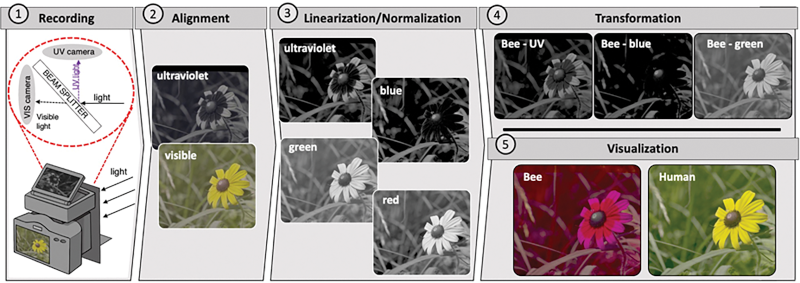
If you think about it, you can’t be sure that what you see for the color red, for example, is what anyone else in the world actually sees. All you can be sure of is that we’ve all been trained to identify whatever we do see as red just like everyone else. Now, think about animal vision. Most people know that dogs don’t see as many colors as we do. On the other hand, the birds and the bees can see into ultraviolet. What would the world look like with extra colors? That’s the question researchers want to answer with this system for duplicating different animals’ views of the world.
Of course, this would be easy if you were thinking about dogs or cats. They can’t see the difference between red and green, making them effectively colorblind by human standards. Researchers are using modified commercial cameras and sophisticated video processing to produce images that sense blue, green, red, and UV light. Then they modify the image based on knowledge of different animal photoreceptors.
We were somewhat surprised that the system didn’t pick up IR. As we know snakes, for example, can sense IR. You’d think more sophisticated animals would have better color vision, but that seems to be untrue. The mantis shrimp, for example, has 12-16 types of photoreceptors. Even male and female humans have different vision systems that make them see colors differently.
Maybe you need a photospectrometer. You wonder if animals dream in color, too.












Yes, but also: Snakes sense IR through specialized organs (pit organ) that function a bit as a micro bolometer at the floor of a pinhole camera (with a wide aperture). Very poor resolution and considered to be in another class of sensing organs compared to opsin-based ‘true’ visual organs. The opsins responsible for color vision are not triggered by anything with a wavelength much longer than red, and get damaged by anything shorter than near ultraviolet.
Interestingly those snake sensors are on their face below the eyes, and I found (personally) that humans also can sense heat radiation, with the part between the lips and nose. A stronger signal is needed though of course, but it has higher sensitivity than many other areas on the body I find.
It’s a peculiar thing. Maybe a vestigial fire warning from a million years ago?
The photoreceptors of mantises (I remember reading somewhere) are very narrow band, so while the number of different photoreceptors sound amazing (and they sense light polarization as well), they leave much of mantis world greyscale, highlighting only things that are relevant to mantises (such as nearby conspecifics).
As said, although Mantis Shrimp technically see a wide variety of different wavelengths, they don’t perceive them as a 12-to-16- dimensional color space. Instead, 1- they don’t perceive this light on two axes at all and have only a thin ribbon of this, and 2- they don’t even perceive is as multidimensional at all, instead perceiving only the brightest single photoreceptor.
House flies similarly don’t perceive a complex color space, likewise perceiving only the single brightest photoreceptor.
In other words, both of these perceive hue in a discrete/digital way – plus continuous/analog brightness.
Houseflies is a single word.
Just mention it since I bet you’ll share this knowledge somewhere in the future.
‘House finch’ has a space in it though, as does ‘house cricket’
English spelling is f*cked up.
Not as bad as german tho. Example: Alten Schlampe mit Fettschweinearsch in der Bundesligafickbol.
Well it does help to make Houseflies one word. Because when I read “House flies” I instantly thought about the movie up, where a bunch of balloons were tied to a house that than was ably to fly. This may sound silly to some, but I’m easily distracted, so my mind start to wonder on the silliest things.
I wonder if that’s a general principle: the wider the range of colors perceived the less likely the visual system focuses light into an image because our chromatic aberration issues.
That link after “Maybe you need” was probably meant to go to https://hackaday.com/tag/photospectrometer/ ?
Thanks! Fixed.
Al, a minor note: your photospectrometer link is to the admin panel.
Thanks! Got it.
“you can’t be sure that what you see for the color red, for example, is what anyone else in the world actually sees”
As one of the roughly 10% of the male population who is red/green colourblind, I can be pretty sure that I don’t see red the same as most people ;-) The whole concept of “bright red” just doesn’t make sense to me, as red is such a dark colour.
As a kid I couldn’t understand why in the world they made fire engines red. Why not make them bright yellow so that they stand out coming down the street – especially if the street is lined with green trees. You and out 10 percent friends understand what I mean.
That’s true, also, color coding, as much for maps as for programming, is absolutely confusing. I can’t distinguish fiften hues of blue or orange that one would find on maps, nor tell the difference between bright green and yellow… I have no idea how to distinguish that violet from this blue and this other blue that I should be seeing in my code’s palette. Yet on my own I very much enjoy visual arts, I have a deep love for colorful paintings. I actually am pretty sure I enjoy saturated hued becaude they’re easier to grasp. I just have a hard time comparing my worldview with the norm.
Ambulances are yellow in my area so I can see ambulances clearly. Where I live, almost everything is grass with some roads in between so I can see ambulances from far away. Red vehicles like firetrucks are more difficult to see but when they are in a hurry, they got those annoying blue lights with sirens going on, which is much more clear than anything else. And my phone goes off as well if an emergency vehicle comes close (I use the Dutch app Flitsmeister which has it built in).
Even if you know everything about the eyes you don’t know how the mind actually perceives the information coming from them.
Can’t you say that you know from a subjective point of view, because it’s part of your phenomenological experience? Or what did you mean?
Exhibit A: Scallops, with dozens of eyes and no brain. How does that work?
I see w/a reddish tinge in one eye, green in the other. Doctors are mute when I mention it. Ever run into this?