
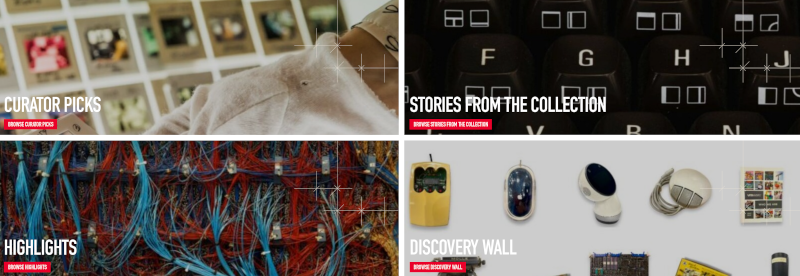
If your travels take you near Mountain View, California, you can have the pleasure of visiting the Computer History Museum. You can see everything from a PDP-1 to an Altair 8800 to a modern PC there. If you aren’t travelling, the museum has launched a digital portal that expands your ability to enjoy its collection remotely.
CEO Marc Etkind said, “OpenCHM is designed to inspire discovery, spark curiosity, and make the stories of the digital age more accessible to everyone, everywhere. We’re unlocking the collection for new audiences to explore.”
The portal features advanced search tools along with browsable curated collections and stories. There’s also an album feature so you can create and share your own custom collections. If you are a developer, the portal also allows access via an API.
As an example, we checked out the vintage marketing collection. Inside were a 1955 brochure for a Bendix computer you could lease for under $1,000 a month, and a 1969 brochure for the high-performance Hitachi HITEC 10. It had 4K words of 16-bit memory and a clock just a bit more than 700 kHz, among others.
If you are on the other side of the Atlantic, you might want to check out a very large museum there. There’s also a fine museum in the UK.












There is also a museum in Hungary: https://njszt.hu/hu/taxonomy/tag/443
https://ajovomultja.hu/exhibition
I suggest also the Piedmont Computer Museum https://mupin.it/ in Northern Italy, which organises a lot of cultural activities for schools. Here the gallery: https://mupin.it/galleria-mupin/
That’s cool, but the interim computer museum operated by the SDF (yes, named after the anime) has a rather large number of real vintage computers you can remotely connect into over serial, telnet, and SSH.
From their last monthly update, it looks like they’re rigging up a shared NSF drive among the machines that run some form of unix, and can maybe unify this with the regular SDF public access unix accounts (so you can save your work while fooling around on the ancient systems).
I was there when they had a demo of the Babbage Difference Engine. On long term loan from one of the Microsoft founders. They actually operated it. I have a video somewhere.
Can you play Doom on it?
Only problems aside from loss of physicality is that museums get some of their funding through entrance fees. Most on the internet already complain about paywalls.
The Mountain View museum is fine, but last time I checked it out, it was too much museum-like: “look, don’t touch”.
If you are passionate and want to interact with the technology, and live around/can go to Cambridge, UK, their “Centre for Computing History” has a large collection of PC and game console you can actually spend some quality time with.
The the Computer Museum at System Source in Maryland is also incredible and has many systems you are welcome to operate.
The National Museum of Computing has many exhibits you can play with, plus the world’s oldest operating computer, plus bits of Baby, plus working replica Colossus and Bombe, and computers going back to 1874(!) and maybe earlier It is right next to Bletchley Park, but very much separate from it.
Several times I’ve been there and, when the realised I had used one of the exhibits, whipped out the schematics so we could discuss them. That’s my kind of museum :)
Key Inflation Data (1955–2026)
Initial Amount: $1,000
Final Value: ~$12,094.10
Total Increase: ~$11,094.10
Cumulative Inflation: 1,109.41%
There’s also the Home Computer Museum in the Netherlands, in the town of Helmond, relatively close to the German and Belgian border. Best part of it is that it is an interactive museum; you are allowed to play on most of the displayed devices.
https://www.homecomputermuseum.nl/en/#intro
There’s also the science museum collection which can visit and tour digitally (500,000+ objects)
https://collection.sciencemuseumgroup.org.uk/
The Centre for Computing History is an amazing resource, it’s entire collection can be viewed online, and the galleries have over 80 machines to use.