
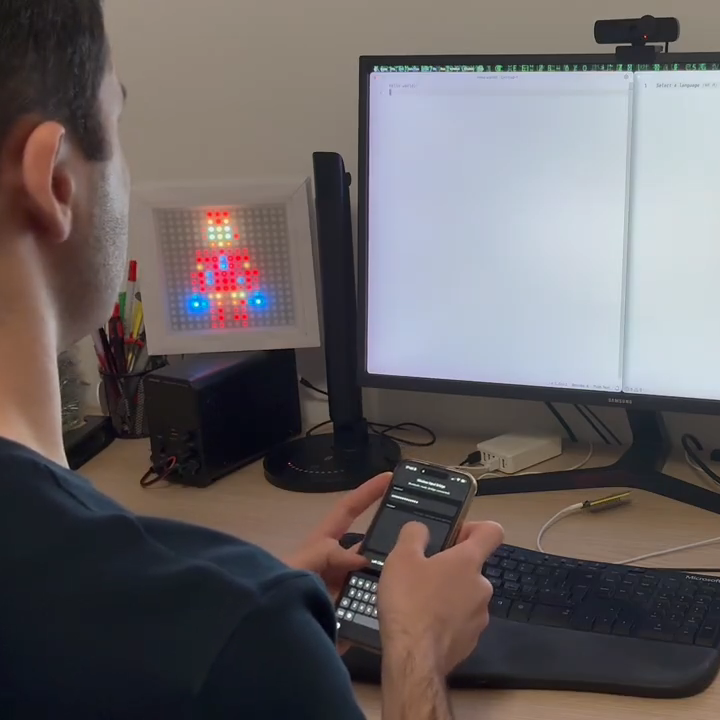
Sometimes you need to use a computer and you don’t have a spare keyboard and mouse on hand. [KoStard] figured an iPhone could serve as a passable replacement interface device. To that end, he built an adapter to let the phone act as a wireless keyboard and mouse on just about any modern machine.
To achieve this, [KoStard] grabbed an ESP32-S3 development board, and programmed it to act as a USB HID device to any machine attached over USB. It then listens out for Bluetooth LE communications from an iPhone equipped with the companion app. The app provides an on-screen keyboard on the iPhone that covers everything including special keys, symbols, and punctuation. You can also take advantage of the iPhone’s quality capacitive touchscreen, which emulates a nicely-responsive trackpad, with two-finger taps used for right clicking and two-finger drags for scroll. Latency is nice and low courtesy of the direct Bluetooth LE connection.
It’s a nifty build that is particularly useful in oddball situations where you might want a keyboard and mouse. For example, [KoStard] notes it’s a great way to control a Smart TV without having to do ugly slow “typing” on an infrared remote. We’ve seen his work before, too—previously building an adapter to provide Bluetooth capability to any old USB keyboard. Video after the break.












15 Years ago I used the App “Air Mouse” on an IPhone 3. Why should I use a solution that requires an additional piece of hardware.
Maybe your device doesnt have or support bluetooth HID but does have USB?
Exactly. Just use the BLE of the Iphone to send out HID events. It´s like pressing a button on the robotic finger that presses the switch. Useless, convoluted, but presented here as if it was a “solution”
The ineptitude of some writers here never cease to dismay…
Because the app Airmouse only works on Mac?
No, “Air Mouse” (not “Airmouse”) also worked on Windows. That was 15 years ago. Do you think the target system is a limitation if someone develops new apps anyway? Besides that, the video demo is on a Mac. An irony of fate!
Because mac nowdays use a standard USB keyboard/mouse?
Perhaps he thougth this was a fun project?
Never mind.
Or just use an app like “Bluetooth Keyboard & Mouse” https://play.google.com/store/apps/details?id=io.appground.blek
I keep trying to ‘just use’ this on my iPhone and it won’t install.
that’s the android playstation, we’re talking iphone here.
hmm playstore, thanks autocorrect
In that case, why not kdeconnect?
https://apps.apple.com/us/app/kde-connect/id1580245991
KDE connect is great. I didn’t know it supported IOS. I don’t really use the keyboard or mouse, but the multimedia controls are handy for controlling my music from another room.
Great idea. The USB HID dangle is essential for no fuss compatibility and would even work to change bios settings unlike the other commenters suggested alternatives.
Fun hack. It has me thinking about input problems differently.
Next logical stop, bluetooth keyboard becomes open source iPhone : -]
Surprised seeing all of the comments about apps doing the same thing when this project has the huge benefit of not needing a companion application on the target device – that’s huge for compatibility (and in my experience, avoiding signups or “bonus” context menu entries and other bloat).
The companion app is on the iPhone.
The “Bluetooth Keyboard & Mouse” I posted doesn’t require a companion app on the target device. I even use it with random Smart TV’s in hotels. And no need to carry a HW dongle, just my phone.
I have a couple old oculus go headsets someone gave me, both need the controller and my first thought was gee there should be a app you can run on an old smartphone. If someone out there is board and looking for a project…
As some have mentioned, the advantage of this approach over just using bluetooth HID is that the target doesn’t need to support bluetooth (and you don’t need any access to the target to do the pairing).
I just did a similar thing by mashing an ESP32-C3 mini together with a CH9329 UART-USB HID dongle together. An ESP32-S3 would probably be simpler, and require no soldering, as well as being more flexible.
This is not a new idea, of course. I have recollections of a Cambridge Silicon Radio USB-Bluetooth dongle that could be reflashed with firmware to act as a keyboard, so you could pair a bluetooth keyboard with the dongle to access pre-boot environments (BIOS, etc), or drive the dongle from a phone, etc.
This blog post (https://www.0xf8.org/2014/02/the-crux-of-finding-a-hid-proxy-capable-usb-bluetooth-adapter/) gives some more history (2003!), and details.
What a great idea.. ;-)
https://www.reddit.com/r/sysadmin/s/5klZnIbehD
Check out the InputStick if you need inspiration. It’s a $40 USB sized dongle that lets you emulate a wireless keyboard and mouse from your phone. Since no app is needed on the host computer, you can even use it to access the BIOS (assuming your PC isn’t too old to handle HID keyboards).
Oc you’ll need an app on your phone, but it’s a well made one, and supports useful stuff like macros (good for logins and and automated setup). When I was frequently on the road inspecting headless PCs, this device was a lifesaver. It meant I didn’t have to trek back to the car every time I needed a full-size keyboard for “Press F1 to continue”.
Thank you. I might have a go at this in future. I picked up the holyiot nrf device and it’s about half the size of them at inputstick.
Input stick app is not compatible with my galaxy s24 apparently, according to play store, but for inspiration it looks good, so thanks again.
There was an app that did this for my slide-out keyboard phone in like 2006