
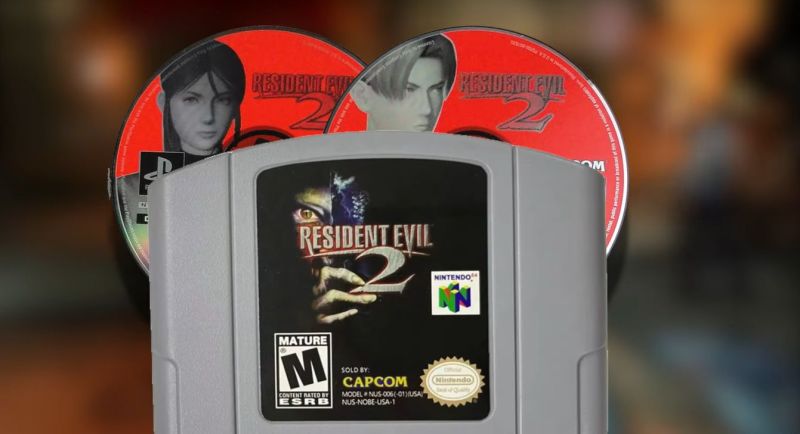
Originally released for the Sony PlayStation in 1998, Resident Evil 2 came on two CDs and used 1.2 GB in total. Of this, full-motion video (FMV) cutscenes took up most of the space, as was rather common for PlayStation games. This posed a bit of a challenge when ported to the Nintendo 64 with its paltry 64 MB of cartridge-based storage. Somehow the developers managed to do the impossible and retain the FMVs, as detailed in a recent video by [LorD of Nerds]. Toggle the English subtitles if German isn’t among your installed natural language parsers.
Instead of dropping the FMVs and replacing them with static screens, a technological improvement was picked. Because of the N64’s rather beefy hardware, it was possible to apply video compression that massively reduced the storage requirements, but this required repurposing the hardware for tasks it was never designed for.
The people behind this feat were developers at Angel Studios, who had 12 months to make it work. Ultimately they achieved a compression ratio of 165:1, with software decoding handling the decompressing and the Reality Signal Processor (RSP) that’s normally part of the graphics pipeline used for both audio tasks and things like upscaling.
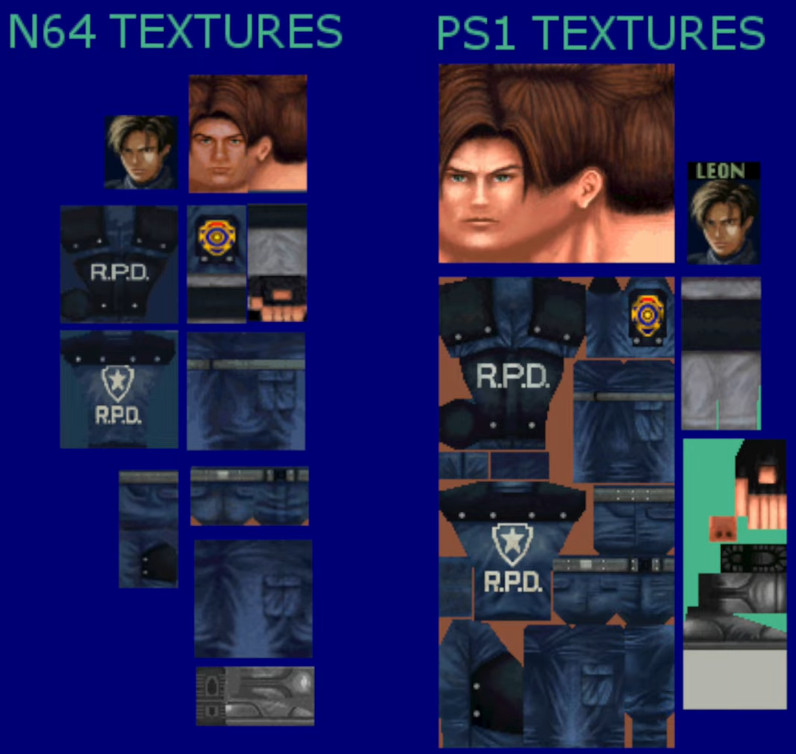
In the video you can see the side by side comparisons of the PS and N64 RE2 cutscenes, with differences clearly visible, but not necessarily for the worse. Uncompressed, the about fifteen minutes of FMVs in the game with a resolution of 320×160 pixels at 24 bits take up 4 GB. For the PS this was solved with some video compression and a dedicated video decoder, since its relatively weak hardware needed all the help it could get.
On the N64 port, however, only 24 MB was left on a 64 MB cartridge after the game’s code and in-game assets had been allocated. The first solution was chroma subsampling, counting on the human eye’s sensitivity to brightness rather than color. One complication was that the N64 didn’t implement color clamping, requiring brightness to be multiplied rather than simply added up before the result was passed on to the video hardware in RGB format.
Very helpful here was that the N64 relied heavily on DMA transfers, allowing the framebuffer to be filled without a lot of marshaling which would have tanked performance. In addition to this the RSP was used with custom microcode to enable upscaling as well as interpolation between frames and audio, with about half the frames of the original dropped and instead interpolated. All of this helped to reduce the FMVs to fit in 24 MB rather than many hundreds of MBs.
For the audio side of things the Angel Studios developers got a break, as the Factor 5 developers – famous for Star Wars titles on the N64 – had already done the heavy lifting here with their MusyX audio tools. This enables sample-based playback, saving a lot of memory for music, while for speech very strong compression was used.
Also argued in the video is that the N64 version is actually superior to the PS version, due to its superior Z-buffering and anti-aliasing feature, as well as new features such as randomized items. The programmable RSP is probably the real star on the N64, which preceded the introduction of programmable pipelines on PC videocards like the NVIDIA GeForce series.









I’m a simple man I see a video about RE2 on the N64 I watch it, I see an article about it and I comment.
Growing up deep in the console wars at school and being lucky to have any console at all and even never having owned the RE2 port. It was the Nintendo clans pride and joy when confronted by a Sony clan assault.
Modern vintage gamer also does a great video on it in his impossible ports series. The work the programmers put in is astonishing.
natural language parsers?
also joy another “hey look at this neat youtube video i found” article 🙄
Feel free to add one of your own projects to the tip-line, if it’s good enough (like a blinking LED the bar isn’t always that high) it could be shown here.
Regarding this post, I’m glad they mentioned it here, as I would never have encountered this channel by myself and the solution to the problem (along with the various comments (I’m hoping for) describing similar problems) is very interesting.
It’s worth pointed out that the modern SDK for N64 dev libdragon now supports h264 video playback and opus audio playback
Good game
Keep in mind, RE2 N64 had all those cutscenes as well as an in game randomizer, no load times, unique lore via the EX Files, analog controls, an art gallery, lime Jello and blue raspberry Kool-Aid blood, adjustable violence/gore levels, and higher resolutions.
I’d gladly watch the video in original language, but no, thanks. Not every piece has to be spoken as if nothing like this has been seen before, i.e. drop the sensationalist tone, please, pretty please. Even the ai voices are better.
Man, that’s cool. Props to Angel Studios. I remember playing RE2 with my friend on his N64 back in the late 90s; it was my first introduction to the RE series, and I loved it. As a preteen, I didn’t understand all the engineering that went into making the port possible, but even back then I was impressed with the fact that they managed to get a Playstation game that needed 2 CDs to fit on a single N64 cart.