
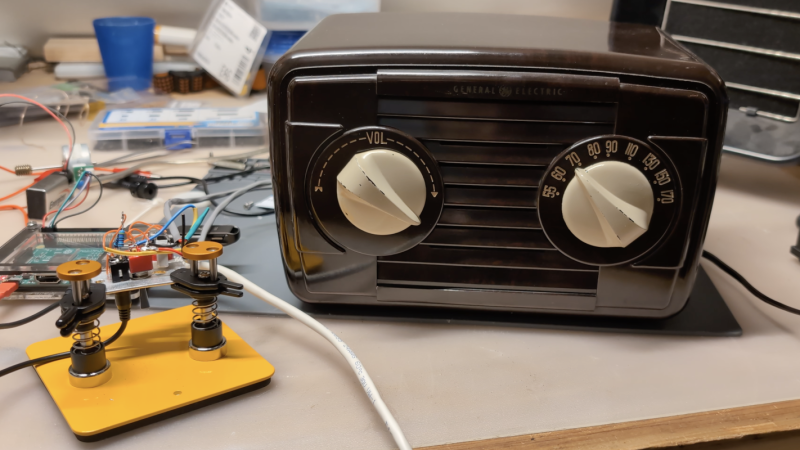
Although we do often see projects that take antiques and replace some or all of their components with modern equipment, we can also sympathize with the view that (when possible and practical) certain antique electronics should be restored rather than gutted. [David] has this inclination for his 1948 GE radio, but there are a few issues with it that prevented a complete, period-correct restoration.
The main (pun intended) issue at the start of this project was safety. The original radio had a chassis that was just as likely as not to become energized, with the only protection being the plastic housing. [David] set up an isolation transformer with a modern polarized power cable to help solve this issue, and then got to work replacing ancient capacitors. With a few other minor issues squared away this is all it took to get the radio working to receive AM radio, and he also was able to make a small modification to allow the radio to accept audio via a 3.5mm jack as well.
However, [David] also has the view that a period-correct AM transmission should accompany this radio as well and set about with the second bit of this project. It’s an adaptation of a project called FieldStation42 originally meant to replicate the experience of cable TV, but [Shane], the project’s creator, helped [David] get it set up for audio as well. A notable feature of this system is that when the user tunes away from one station, it isn’t simply paused, but instead allowed to continue playing as if real time is passing in the simulated radio world.
Although there are a few modern conveniences here for safety and for period-correct immersion, we think this project really hits the nail on the head for preserving everything possible while not rolling the dice with 40s-era safety standards. There’s also a GitHub page with some more info that [David] hopes to add to in the near future. This restoration of a radio only one year newer has a similar feel, and there are also guides for a more broad category of radio restorations as well.









” (…) with a modern polarized power cable (…)” : i’ve seen various power strips, and even extension cords (including known brand ones) inverting line and neutral, and you can also have incorrectly wired wall outlets, so this protection by correct polarization is not guaranteed at all.
Normally the case provides sufficient protection. The isolation transformer is necessary because of the audio input jack.
Even though you can’t rely on the outlet being wired correctly, it’s still good practice to install a polarized line cord the correct way when restoring vintage electronics.
Not quite – the antenna terminals can only have a small disc cap between hazardous live and the antenna wire. You also need isolation there.
I use a very low power AM transmitter connected to a modern music system (works within a couple of feet) to save adding an audio jack. Just tune the radio to the transmitter and listen to internet radio stations through unmodified vintage radio :-D
Just the other day was checking out DYI AM transmitter using Arduino Nano (with proper high bandpass obviously) and kept thinking “something like RJ45-ed Raspberry Pi could easily accomplish both at once”, then “usual WifiRouter already has enough computing power to do that too, read streams AND amplitude-modulate the sound”.
Makes me think at some point I should just look into forking open-sourced router ware. Imagine that, WiFi router in a 1930 radio shell that also transmits AM, news, weather … quite likely it can also stream multiple AM signals on different frequencies along with the usual DBA data, time ticks or weather icons … interesting thought …
Errata – Arduino Nano with LOW bandpass, not high bandpass. “LOW” as “within the targeted bandwdth”. You certainly don’t want it to be transmitting higher-frequencies harmonics.
Ideally you bandpass only the bandwidth you need, but that would be slightly more complicated to my (rather limited) mind. I’ll stick with “low bandpass”.
It’s the best way. However, the one from the article is more spectacular.
How coukd you manage to provide multiple stations with your approach?
Multiple streams, then calculated AM signals for each with its own allocated carrier frequency. Since the distance is local, there is no need for a dedicated RF out amplifier tuned to a particular frequency, brutal force summed up and transmitted as it is.
This is just a tad under 2Mhz output frequency, between 530 kHz and 1700 kHz, reasonably slow by the modern-day wares available for tinkering. Separating by 10 kHz as mandated by the FCC would make sure any $10 cheap radio would have reasonably good selectivity. Speech only, obviously.
On a mildly related note, I’ve seen unrelated examples summing up something like 12 different frequencies using rather slow microcontroller from the mid-2000 (Parallax Propeller 1), though, the target was ultrasound, but I see no reasons why, say RP2350, (or something more powerful, maybe ESP32-P4) couldn’t repeat the same; maybe not the entire AM spectrum, but the lower end, from 530 kHz to 1 mHz.
Now that I think of it, ordinary router may not have the right ware, it would probably be stattering and dropping things at all times; RP2040/RP2350 have state machines that can separate output stage from the processing stage, so one CPU can be dedicated to handling the output signal real-time, while the other one would be summing up the signal and cashing the chunks.
Something like that. Keeping the transmitting power under the limit is they key, so that it doesn’t impede other things.
Having rambled all that, low-power AM (or FM/FM-stereo) transmitters are quite cheap, and will be FCC-rated for domestic use. I own a dozen bought at some kind of surplus sale a decade ago, and they transmit speech with okay quality (certainly not hifi by any stretch), and given I can separate audio streams into dedicated RCA jacks, these can be transmitting simultaneously. I’ve done that out of curiosity (sending multiple FM-stereo signals on different frequencies simultaneously), so it is definitely doable, and if one can figure out how to DAC those channels out, this is even simpler than that.
(My project I was working on at the time was “sending 5 different FM stereo feeds to 5 stereo boomboxes”. It worked, and there was no computing involved, I simply used 5 walkmen to play 5 different tapes, mayhem ensued, but that was the target, random noise : – ] – if I’d figure out how to feed 5 x 2 = 10 channels out of a computer that would simplify synchronization : – ]).
It sounds like a FM radio being faked with all that hiss. Buzzing and whistles would be more realistic. TV horizontal buzz every 15.75kHz all up and down the dial. Transformer-less radios are at the bottom of the spectrum only battery-tube stuff is worse, the peak of cute plastic cabinets though.
I was so enthused. Then “a period-correct AM transmission”? Wouldn’t simply turning the radio on do that?
I hear people are working on getting 1940’s period-specific.
Wrong country though some would say. But you can’t expect perfection I guess.
The beauty of this software is that you can select media from whatever era and country you please. There are thousands of hours of free historical recordings online.