Restoring The Soul Of A 1940s Radio

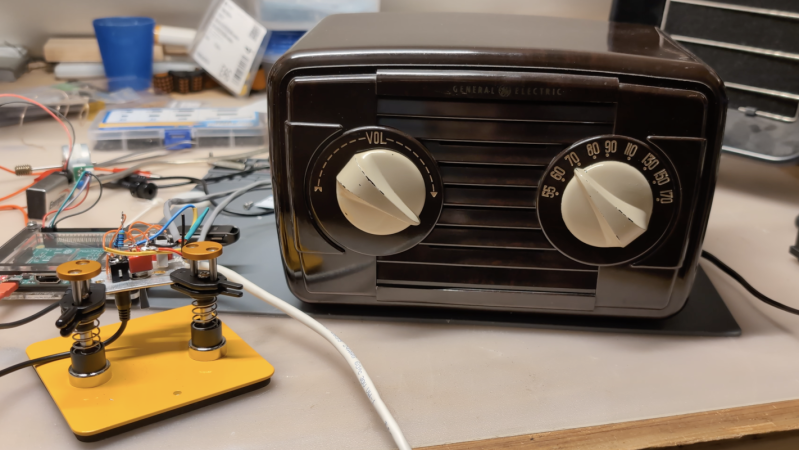
Although we do often see projects that take antiques and replace some or all of their components with modern equipment, we can also sympathize with the view that (when possible and practical) certain antique electronics should be restored rather than gutted. [David] has this inclination for his 1948 GE radio, but there are a few issues with it that prevented a complete, period-correct restoration.

The main (pun intended) issue at the start of this project was safety. The original radio had a chassis that was just as likely as not to become energized, with the only protection being the plastic housing. [David] set up an isolation transformer with a modern polarized power cable to help solve this issue, and then got to work replacing ancient capacitors. With a few other minor issues squared away this is all it took to get the radio working to receive AM radio, and he also was able to make a small modification to allow the radio to accept audio via a 3.5mm jack as well.

However, [David] also has the view that a period-correct AM transmission should accompany this radio as well and set about with the second bit of this project. It’s an adaptation of a project called FieldStation42 originally meant to replicate the experience of cable TV, but [Shane], the project’s creator, helped [David] get it set up for audio as well. A notable feature of this system is that when the user tunes away from one station, it isn’t simply paused, but instead allowed to continue playing as if real time is passing in the simulated radio world.

Although there are a few modern conveniences here for safety and for period-correct immersion, we think this project really hits the nail on the head for preserving everything possible while not rolling the dice with 40s-era safety standards. There’s also a GitHub page with some more info that [David] hopes to add to in the near future. This restoration of a radio only one year newer has a similar feel, and there are also guides for a more broad category of radio restorations as well.
Continue reading “Restoring The Soul Of A 1940s Radio”

Custom Case Lends Retro Look To Smart TV

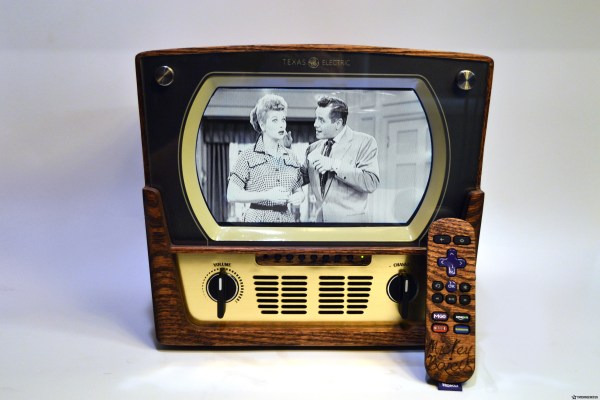
Refits of retro TVs and radios with the latest smart guts are a dime a dozen around Hackaday. And while a lot of these projects show a great deal of skill and respect for the original device, there’s something slightly sacrilegious about gutting an appliance that someone shelled out a huge portion of their paycheck to buy in the middle of the last century. That’s why this all-new retro-style case for a smart TV makes us smile.

GE 806 restored by Steve O'Bannon
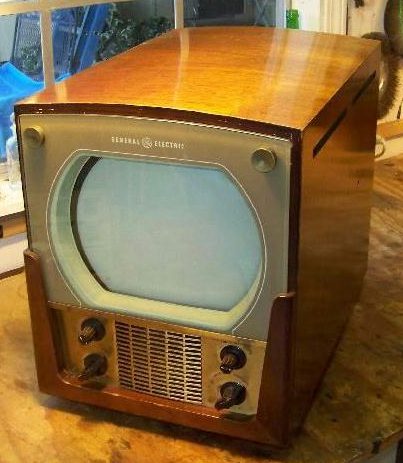
1940s GE 806 restored by Steve O’Bannon

Another reason to smile is the attention to detail paid by [ThrowingChicken]. His inspiration came from a GE 806 TV from the 1940s, and while his build isn’t an exact replica, we think he captured the spirit of the original perfectly. From the curved top to the deep rectangular bezel, the details really make this a special build. One may quibble about not using brass for the grille like the original and going with oak rather than mahogany. In the end though, you need to work with the materials and tooling you have. Besides, we think the laser cut birch ply grille is pretty snazzy. Don’t forget the pressure-formed acrylic dome over the screen – here’s hoping that our recent piece on pressure-forming helped inspire that nice little touch.

This project was clearly a labor of love – witness the bloodshed after a tangle with a tablesaw while building the matching remote – and brought some life to an otherwise soulless chunk of mass-produced electronics.

[via r/DIY]

Retrotechtacular: So You Want To Be A Weldor

Welding is one of those things that takes minutes to learn and years to master. It requires coordination, strength, and a good pair of eyes. This vocational guidance video from the early 1940s touches on these points and more for those considering careers in welding. The narrator jumps right in, discussing welding types, equipment operation, and employment opportunities in both the welding field itself and other fields that use welding techniques.

Oxy-acetylene welding is one of the oldest methods of fusing metal. A flame fueled by a specific mixture of pure oxygen and acetylene gas heats the metal welding rod and the work piece to plasticity, which allows them to join together. An oxy-acetylene setup can also be used to cut metal, though a special cutting torch with a kind of oxygen turbo boost lever is required. The work piece is heated to red-hot at the point along the edge where the cut will start. The oxygen-rich flame will cut right through the piece.

Continue reading “Retrotechtacular: So You Want To Be A Weldor”