
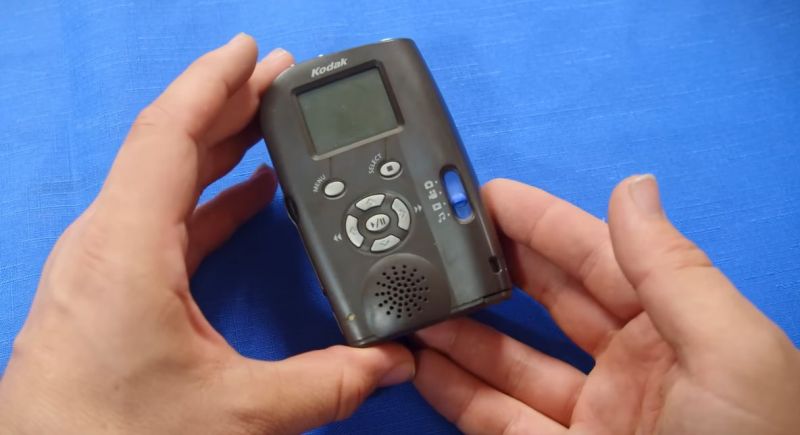
One of the constants in consumer electronics is that designers will try to put as many features into a single device as possible, whether it’s a Walkman with a radio tuner or a new class of devices that crams a photo and video camera in the same enclosure as a music player. At the time that the Kodak MC3 was released this made it a rather unique device, with it in hindsight being basically a smartphone without the phone, as [Tech Tangents] aptly notes in his recent video on the device.
Six years before Apple’s iPhone would be announced, and eight years before the first iPod with a video camera, the Kodak MC3 was in many respects bleeding edge technology targeted straight at tech enthusiasts. For less than $300 you got VGA-quality images, CompactFlash storage, and MP3 playback capability. The videos it produced were 320×240 resolution, h.263 encoded MOVs with a maximum length of 4 seconds at 20 FPS, or 4 minutes with a 64 MB CF card.
The unit that [Tech Tangents] got used came with a 128 MB CF card, but couldn’t use a 2 GB CF card, which is a shame. The screen on it got a lot of flak for not not having a backlight, but this was common for the era, as were the poor viewing angles. Ditto for the poor video quality, as anyone who invested in consumer digital cameras in the early 2000s can attest to. In that respect this Kodak device was probably a bit too ambitious with its features for the era, maybe to compensate for it completely missing the boat on the rise of digital camera technology around the time.












I owned an MC3 and used it for years and years. It was such a great idea, and the daylight pix always came out great. The video quality was just fine. One of my favorite gadgets. Even had a “dock”.
release the files
Is that “completely missing the boat” thing a referencing consumer market only? They did have Professional Digital SLR’s so I wouldnt say they completely missed the boat.
https://en.wikipedia.org/wiki/Kodak_DCS
The “Kodak missed digital” is a pet peeve of mine. They were an extremely specialized chemical, crystals, and plastic films company at massive scale and margins. They tried repeatedly, like this, to get into digital only for the electronics and consumer device companies to (understandably) cut them out of the middle. Regardless, there’s no role today for a “Kodak digital photography” in a world of smart phones and printers.
Once you appreciate what they had learned and did, it is amazing but also very specialized to photographic film and developing. Then suddenly no markets needed those skill sets and equipment especially at the volume and margins they previously had enjoyed. It’s a fascinating tale of an industry and way of business nearly instantly obsoleted.
https://youtube.com/playlist?list=PLodcM93D8-buDr1id2g98qsXBXK65Zcw3&si=4bcvG8yUN0jPK79p
Source: chemical engineer and general manufacturing nerd
Don’t they still manufacture CCDs, especially for medium format cameras ?
On Semiconductor took over that part of the business for a time out of a Kodak building on Lake Avenue in Rochester near the river. I don’t think they’re still there today though.
There’s no role for Kodak digital today, but the article claims they completely missed the boat in the early 2000’s. They produced the DCS range of professional digital cameras from 90’s to 2005 so I just found that statement a bit odd.
You know all the Japanese, and German, photocamera makers also had an expertise in making precise mechanical devices and when digital came they basically could toss much of that expertise.
But most of them still overcame that and are making digital cameras now.
And there are others too that switched to completely different stuff when time changed things.
Makes you wonder if Musk is actually smart when he announced Tesla was rolling back making cars and are moving into making robots. Not that there isn’t a market for electric cars, but there is so much competition now. That’s the thing about being a CEO of billion-dollar/euro/yen companies I suppose, you have to dare to drop what seems to be working before it’s too late and drags you down.
One of the unique device from the past was a Samsung Galaxy Camera with optical Zoom and Android. Everything, but a phone. I wish they will be still made.
The days before the iPhone were so fascinating and diverse.
Sony Vaio, Sony Clié, the many digicams, Pocket PCs and Palm PDAs..
Back then, everything came in different shapes and colors. Even Windows PCs.. ;)
Kodak even had a patent for a camera with a built-in phone. This patent, along with a slew of others was sold in the bankruptcy. They had hoped for a bidding war between the tech companies, but they formed a group and submitted one (low ball) bid then shared the patients. Apple, IBM, HP, etc.
I would personally point to the Garmin iQue. Even though it was 2 years later and lacked a camera, they made up for it with touch screen, GPS, wifi, apps, Microsoft Office, etc. You could browse the web, get turn-by-turn driving directions, play Myst, and check your email.
I remember thinking that if they added a cell radio they would have been a hit, year before the iphone.
https://www.cnet.com/reviews/garmin-ique-3600-review/
4 years* before the iPhone
My interest in electronics was really started when I was about 8 or 9. My dad brought me to work for take your kid to work day and I got to take a bunch of nonconforming pcbs from an assembly floor at the Kodak building on Verona Street (I think). If I remember correctly I had a few of what looked like rigid flex PCBs meant to go into some of the high end cameras, and some PC motherboards that ended up in the Kodak printing kiosks. I’d just stare at them for hours in my room and fantasize about making them into human sized robots. All of the computers we had in the house growing up were trash picked pentium 2 IBM machines from the Kodak offices and photo kiosks.
Though actually, the SymbianOS-based Nokia 7650 was announced in late 2001 and was available in mid-2002 and up until the arrival of the first iPhone, was the most popular SmartPhone platform in the world by an order of magnitude or more compared with Windows CE, Blackberry or Palm-based phones.
“The 7650’s significance for its time has been hailed in later years, with many considering it as being one of the most important mobile devices and one of Nokia’s most iconic products.”
The 7650 had a camera (its code name was Cameron, because it had a camera on it); it could also record video (via 3rd party apps) and send it via MMS. It supported an MMC memory card. It ran on a 104MHz ARM9TDMI, with most of the code being Thumb code (Java was also supported). Because it was a Smartphone it was possible to install third party applications, though the process was a bit clumsy.
https://en.wikipedia.org/wiki/Nokia_7650