
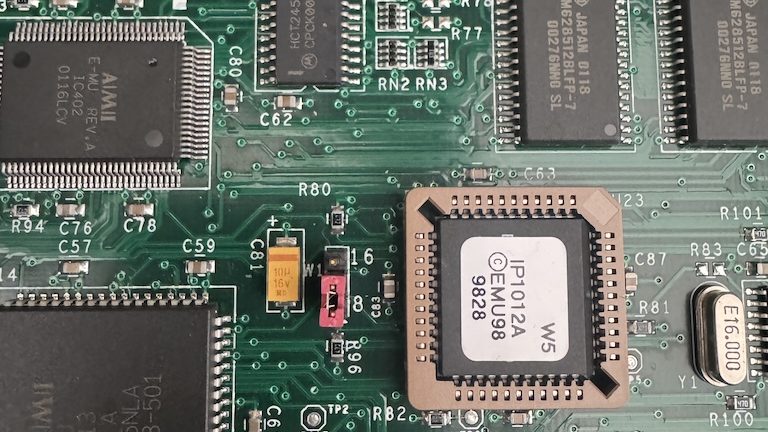
If you purchased an E-mu Audity 2000 ROMpler back in 1998, you almost certainly got a rig with the 1.00 firmware. It was fine, if a little limited, particularly where upgradability was concerned. E-mu would later offer firmware upgrades over MIDI with the 2.00 firmware, but to get the 2.00 firmware, you needed to ship the box back to E-mu. Or you did… until now.
Realizing that E-mu is long gone and they weren’t going to handle any further firmware upgrades, [Ray Bellis] set about finding another way to help aggrieved operators with gear stuck on v1.00. [Ray] had managed to lay hands on a Audity 2000 service manual as well as the official 2.00 upgrade kit in an estate sale, and set about reverse engineering it to help the community. It turned out that upgrading from 1.00 to 2.00 required the use of a special boot ROM and a flash device containing the upgraded firmware image. Booting from the special ROM required the use of a jumper, and when engaged, the ROM would copy the updated image to the device itself.
[Ray] didn’t want to duplicate the standard upgrade device, as that seemed a little difficult what with parts availability in 2026. Instead, he crafted his own ROM that, with compression, contained the necessary firmware upgrade image and could all be stuffed inside a single 512 KB chip. All you need to do is flash the custom upgrade ROM to an AM29F040B PLCC32 NOR flash chip, pop it in the empty PLCC32 socket on the mainboard, and away you go. This will get you a machine upgraded to the final v2.01 firmware delivered by E-mu before its demise.
It’s a finicky bit of work, but it’s a great way to get new functionality out of an old Audity 2000. We’ve featured similar work before regarding aging Yamaha synths, too. If you’ve got your own backdoor methods for giving older music hardware a new lease on life, don’t hesitate to notify the tipsline.












some HaD articles give zero context, so i then look things up. but the Wikipedia page I found seems to be describing something else — or did this “Rompler” go into a rare digital-controlled analog synth of which only one was ever made? https://en.wikipedia.org/wiki/E-mu_Audity
I know reading is hard, but come on now, the article literally says “Audity 2000” in the very first sentence. Don’t be That Guy.
seriously? i’m supposed to just know that Audity 2000 is some completely different thing? You’re being that OTHER GUY — the kind who made everyone flee StackOverflow for ChatGPT
Gonna go out on a limb here, and suggest that this article is only of interest to those who already know what an “E-mu Audity 2000 ROMpler” is? Yes, appending a link with more detailed information would have been nice, but Google is your friend.
correction DuckDuckGo is your friend. Startpage is your friend. Google is definitely NOT your friend. Not anymore.
Thats not true, and wouldn’t make for a very good blog post if it was. Its really easy for the author to drop in a link for context, and much easier and approachable for everyone.
What about the people who only know what E-MU is (or was)? I do, as any owner of a Soundblaster Live card should. But is Audity 2000 a card? Or a keyboard/synth (for which E-MU was also famous for)? What does it do? The only thing we know about it is that it has a firmware.
I’d argue that people don’t come here to look for a new firmware for their ROMpler but to read about interesting hacks. On the other hand, this might have been hacker-specific clickbait because it forced me to read the whole post and the article twicem AND write a comment. If it said at the beginning what it’s about, I would have skipped it :).
And hey, at least someone in the comments could have helped solve the mystery :). So here goes:
Audity 2000 is a digital synth module from 1998.
https://www.soundonsound.com/reviews/emu-audity-2000
A reasonable article should not require hours of research…
Just saying.
Thank you. I could only think of creatives various emu dsp architectures and this one link would’ve made life so much easier. Yes I could also find it on Wikipedia, but that’s duplicated efforts
Once again I am left befuddled until I read the source. The ‘flash module’ in question is where the upgrade is stored. This avoids the module. I assumed by the way it was written the module was only needed 1 time for performing the upgrade.
Yes, the rare and expensive ($250+) flash module is only needed the one time to perform the upgrade. My upgrade path achieves it with just a $1 flash IC.
looks like this is a bit newer than that but closer to 1978 than 2026 anyway
https://www.synthark.org/Archive/EmulatorArchive/Audity-2000.html
I have a couple EMU modules and my question is whether there is a way to clone the sound modules for the EMU modules. The sounds are great, but if you want one of the more beloved modules, you’ll need sell your first born (and maybe the second). Would love to know if anyone has been able to do this?
Yes, I’ve done it for Flash SIMMs, but for my personal use only. The primary issues these days are availability of suitable 5V Flash memory ICs, and the required thickness of the PCBs. 72 pin SIMMs were specced to be 1.27mm±, but pretty much every current PCB manufacturer only has metric based stock at 1.20mm±, and won’t guarantee that their margin of error will fall on the right side to keep within the specs. Apart from that, it’s not technically that hard, and all of the information is publicly available.
I tried upgrading the firmware on an ESI-32 (sampler, similar concept) once, put the ROM chips in backwards and destroyed them. Luckily it didn’t damage the board so I just put the old ROM chips back. It was a sad day.
Didn’t E-mu just release an updated SP-1200? I didn’t realize they were “long gone”.
Dave Rossum’s current company did that. E-mu itself was bought by Creative in the early 2000s and all but disappeared. They did release some E-mu branded headphones recently.