
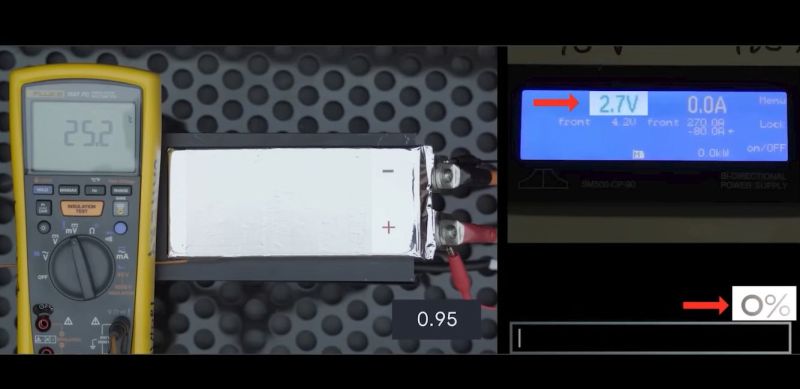
Earlier this year Donut Lab caused quite the furore when they unveiled what they claimed was the world’s first production-ready solid state battery, featuring some pretty stellar specifications. Since then many experts and enthusiasts in the battery space have raised concerns that this claimed battery may not be real, or even possible at all. After seeing the battery demonstrated at CES’26 and having his own concerns, [Ziroth] decided to do some investigating on what part of the stated claims actually hold up when subjected to known science.
On paper, the Donut Lab battery sounds amazing: full charge in less than 10 minutes, 400 Wh/kg energy density, 100,000 charge cycles, extremely safe and low cost. Basically it ticks every single box on a battery wish list, yet the problem is that this is all based on Donut’s own claims. Even aside from the concerns also raised in the video about the company itself, pinning down what internal chemistry and configuration would enable this feature set proves to be basically impossible.
In this summary of research done on Donut’s claimed battery as well as current battery research, a number of options were considered, including carbon nanotube-based super capacitors. Yet although this features 418 Wh/kg capacity, this pertains only to the basic material, not the entire battery which would hit something closer to 50 Wh/kg.
Other options include surface-redox sodium-ion chemistry with titanium oxide. This too would allow for fast charging and high endurance, but Donut has already come out to state that their battery is not capacitor-based and uses no lithium, so that gets shot down too.
Combined with the ‘cheap’ and ‘scalable’ claims this effectively shoots down any potential battery chemistry and architecture. Barring some amazing breakthrough this thus raises many red flags, especially when you consider Donut Lab’s major promises for investors that should make any reasonable person feel skittish about pouring money into the venture.
Sadly, it seems that this one too will not be the battery breakthrough that we’re all waiting for. Even new chemistries like sodium-ion are struggling to make much of inroads, although lithium-titanate shows real promise. Albeit it not with amazing power density increases that would make it better than plain lithium-ion for portable applications.












Errrr …. if it’s fake, why is Hackaday giving it exposure and wasting reader’s time with nonsense?
Maybe understanding why the claims are being considered false is important to open debate and discussion. Maybe because understanding the issue is a part of critical thinking. Discussion isn’t nonsense. Sharing ideas isn’t nonsense. If you are so concerned with wasting time, why waste yours on the comment above? Seems like you could have better spent your time just ignoring the article rather than discouraging the author and disrupting a discussion around the topic with a negative comment.
The entire company and their dealings are fishy enough that nobody should be taking it seriously.
The batteries are supposed to be sold through a motorcycle company that recently got caught by Estonian authorities for basically having no bookkeeping whatsoever. They were claiming millions of revenue and could not produce the invoices or receipts to match that, nor any inventory, none whatsoever. This company is to my memory run by the Donut Lab owner’s brother or some other close relative.
It is very very obviously a ploy to pump money out of investors and run away, except they went too far and got too much attention, and now they’re just dodging bullets until they can figure out an escape route.
“Maybe understanding why the claims are being considered false is important to open debate and discussion.”
Not to anyone who’s read them.
I agree with you on this subject, but if Mr Nobody had said it about religion though.. then I would have agreed with him.
This shows views can vary and Mr Nobody might be right from many other HaD visitor’s viewpoint.
Consider it a public service announcement.
To show its fake and save people time to confirm what we all knew ?
I didn’t know until now, for example. Take it in mind that not all HaD articles are for all HaD audience, hehe.
It is an interesting question to ponder, and still not conclusively false as far as I know nobody who has had hands on with a Donut battery has done or at least published their own testing. So it might just be a break though still, might even be one of those breakthroughs that seems so obvious in hindsight as the first time man made a wheel, or a stick throwing assistant (atlatl or bow) etc must have been.
So while it probably isn’t true, or at best the stated specs are cherrypicking the top end of the ranges they have created with varied blends of their battery construction methods or something for now at least it only smells bad. Cautious optimism is fine, keeping an eye on if this actually does come to something makes sense if you are at all interested, but certainly not investing money or real hope without being shown something to prove the claims – same way when Rumours of Framework or Rapsberry Pi computers started circulating it sounded rather too good to be true, and so far at least those have largely worked out.
Nobody has verifiably had their hands on these batteries, because all they’ve shown to the public is empty 3D printed cases.
You’re doing your usual thing of jumping a couple assumptions ahead and start arguing that it might be possible because the proverbial jury is still out, but in reality the jury hasn’t even seen the evidence because the defense hasn’t brought it up. We’re still debating whether the batteries even physically exist.
I really am not – I don’t expect they are anything but a scam, but there is so far no independent proof of anything, so it could still be genuine as stranger sources and more ceiling shattering discoveries have happened. It is when actually looking through history shockingly common to have a sudden leap from nowhere.
Besides the core point was this dive into battery tech as a comparison to the claims made is interesting and worthwhile if you have any interest in electronics at all.
What’s your opinion on Russel’s Teapot?
That is a shockingly common perspective error. Almost no invention actually came from “nowhere”, since most invention is incremental on existing and wide-spread knowledge.
It’s many people trying out many variations of a thing until someone gets the right answer, and then the history books remember that one guy instead of the two dozen other people who almost got it, or who would have gotten it just a short while later. If you erase the background, it looks like someone just whoops invented it, as if nobody else had any idea about what was possible or plausible.
That is true, and false – sudden leap forward in some novel way happens all the time through history, sometimes many times for the same discovery just in different places and periods… Yes there is also a great deal of slow building on wide-spread knowledge, whole library worth of communications between the ‘great thinkers’ advancing this or that corner of knowledge etc but that sudden twist of thinking, new material from distant lands etc… Yes it was still also built upon old knowledge as the two can’t really be separated anyway.
They are called donut because getting evidence from them will be an endless loop until they have enough investors to pull the plug on the whole thing.
Look, it might be fake. But I don’t see why they would do this. One of the main reasons so many people think this is fake, is they aren’t releasing third party testing. Why would they do that? They were supposed to release it roughly 3 months after their announcement. The release will be the proof. Why give any company a 3 to 4 month headstart. If they were to raise additional money, i’m sure they had to meet benchmarks, just like any Round of funding. Those would be kept private if everyone agreed. Not sure why everyone is saying “NO” it can’t be done. Maybe its taking a different approach. Or maybe its Redox active covalent Trizene framework. There are several other batteries on their way out, that make many of the same claims. Really, the only outlier, is the 100K cycles. The temperature range is pretty extreme, but Its doable. I think its possible…i’m 60/40 slightly leaning toward’s legitimate.
I’d think publishing the skepticism is a reasonable thing to do – otherwise people googling it are only going to find PR puff rather than the hard questions.
Didn’t certain Tom Bearden invent something similar in the past? I recall his solid-state battery was some kind of combination of coils and lead-acid batteries that he claimed worked better than just the lead-acid battery alone. Took me by surprise, btw, and I couldn’t figure out what was the trick other than the actual details back then were locked behind a paywall.
Bought his weighty tome, too, thinking it would provide some kind of technical background, sadly, not really, a lot of materiel turned out to be mishmash of well-known things one can read in wikipedia and mostly speculations how it an be rearranged differently. It was a used book from one of the destroyed public libraries, so no loss, good excuse to review the basics and move onto different subjects.
This sort of solid state battery tech is “real”, in that the technology exists and is being worked on by multiple legitimate organisations. At its simplest it’s just lithium ion but there’s no paste or liquid components inside the battery, it’s all solid. That has some big advantages for longetivity, stability and energy density, the problem is they’re much harder to manufacture which is why they’re not commercially available.
So the Donut labs claims aren’t as ridiculous as what you say, the technology they’re talking about is real (although they’re exaggerating a bit) but it’s exceedingly that this tiny company has managed what all the big battery manufacturers haven’t and made it commercially viable.
Tom Bearden was one of those “Free Energy Machine” cranks. So if this reminds you of that, it is probably because both are fraudulent nonsense.
The same guy claims to have invented “Super AI” and the parent company is apparently in financial problems and haven’t published financial statements for a while. So yeah, without even checking what’s it about, I’ll declare it as BS.
Extraordinary claims require extraordinary proof. An extraordinary claim while providing no evidence whatsoever is something to doubt. The only point Donut has in their favor is that no one can figure out what their end game would be for hyping a fake. Over the years I have become confortable wit hthe understanding that people do stupid things all the time.
Extraordinary claims don’t require any more evidence than other claims.
The problem? They didn’t provide any evidence.
The evidence for an extraordinary claim is, by definition, extraordinary.
If you don’t have time to watch the interesting and well-done technical analysis, start at 16:35 for the business shenanigans.
It is known that the bottleneck in electric vehicles is recharge time and the infrastructure to do it – if you have to go anywhere more than one charge away it will take significantly longer than other options, fixing the best-market-segment hedge currently at the hybrid model though it gets incrementally better. So what Marko Lehtimäki has figured out is a desperate target market and he has promised a step change in technology. My personal red flag is how they’d deal with waste heat in such a high charge/discharge system, but there are a bunch of others at the fundamental level that the video covers. This puts it into “The Flying Machine” territory:
https://www.eastoftheweb.com/short-stories/UBooks/FlyiMach.shtml
On a scale between electric lighting and Theranos, I’d put the battery probability somewhere around Hyperloop. Something interesting may come of it, but it will not be revolutionary.
The cold fusion of batteries.
Winner.
Honestly modern lithium ion in 800v architectures has largely eliminated the time penalty of a roadtrip unless you have an iron bladder.
The only remaining issue is sparsity of 800v charging stations causing misalignment of bladder needs with charging opportunities.
Being able to walk away from the vehicle while it is charging is the game changer. Yes you can fill up an ICE tank in 3-5 minutes, but you have to stand next to the vehicle with your hand on the handle in most jurisdictions now. After that you still have to go in, pee, and maybe get some caffeine.
With an EV you can do those in parallel.
“you still have to go in, pee, and maybe get some caffeine”
Do you really have to do any of those things? What is this “hand on the handle” bumbaclot?
People who have enough money for EVs also tend to have incontinence issues due to old age. Can’t hold it in for 5 minutes to pump the gas before they have to dash to the bathroom.
Yes:
I have to pee. Most humans do.
I don’t have to go into the petrol/service station to do that, but doing it in the open tends to get you arrested in a place where there’s people around – such as a service station.
I have to have my hand on the petrol pump to refuel my car. It’s got a deadman switch for a good reason. EVs don’t need that, as they don’t leak electricity all over the ground if the plug falls out.
I personally will need to stop for caffeine if the journey is long enough that I have to refuel my car. I probably also need to buy some food, stretch my legs, and probably walk the dog (as she’ll likely be with me on a long journey)
Amazing how you can take the biggest pain point of EV’s and try to turn it into a winner.
Maybe you’ll revitalize the forecourt shopping experience, tho I doubt it as it’s typically overpriced.
Much like EV’s and charging away from home.
I’d say Andrew is being very reasonable and realistic – the really fast charge capable vehicle/charger pairing on those long road trips where you actually want to get back on the road soon is likely to have ‘finished’ the charge by the time you have stretched out, ambled off to visit the bathroom and maybe picked up a sandwich and fresh beverage with the total break in journey time being quite possibly shorter than the ICE power options can be.
At least when everything aligns as you have that fast charger filled parking lot for the truckers cafe you are stopping at. As the nature of the EV refill being unattended means you’ll probably already be eating your snack before the petrol powered rest stop has finished filling up the fuel tank. And the EV is likely ready to resume before you are.
But when that pairing doesn’t exist at the point you wanted to stop so the charging would be slower, or you end up breaking the journey up in inconvenient chunks to match the faster chargers it is a problem. Which Andrew does point out “The only remaining issue is sparsity of 800v charging stations causing misalignment of bladder needs with charging opportunities.”. Though it does seem like the high speed chargers are rolling out everywhere so those problems are likely to go away.
Except that this range is no longer a practical limitation for most users. Anyone capable of plugging in their car overnight, even to a regular electrical socket, can have all the range they need for an entire day of driving.
The only time range is an issue is when travelling much further using that personal vehicle, which most people do not do. In a nutshell this is why entirely electric vehicles with a hybrid powerplant are the way forward. Even with a reduced electrical range due to space, they hardly burn any fuel, and have no range issues.
The big problem in the U.K. is that ~50% people don’t have a house they can plug in an EV to charge from. Due to parking on the road.
If we could have the other half covert to EV within the next 5 years (or whatever the average car replacement cycle is), then that’s a lot of oil that doesn’t need to be transported to gas stations and a lot of pollution that doesn’t end up in densely populated areas.
And that 5 years is probably enough for the street-level overnight charging to reach a further 20% at least.
While I do agree there are solutions some already becoming fairly common to that problem, Lamppost chargers, charging facilities at work, a frame that rotates out over the pavement at a safe height to drop the charge cable down above your car and let you plug in at home even through you are parked on the road (assuming its outside your own home of course).
I have a patent in the field. And had government grant money, too. I’ve done a deep dive into the science papers published by the people involved, as well as by suppliers and their science background.
There have been several grants from government agencies and also government matching funds. Does this mean Donut Lab has what they claim? Of course not. But there’s more here than meets the eye.
Also some of the science they’ve published overlaps my area of expertise, and what I’ve seen from the published papers is legitimate. So sit back and enjoy the show. It will be interesting.
They’ve said they’ll be shipping the motorcyles within months, so unless it becomes a never-ending series of delays (likely) we’ll find out one way or another soon enough.
I’m curious to see how they got past the “You really have to have a rear axle on a motorcycle” thing.
In 2009 a company, EEStor made almost the exact same claims. Even partnered with a small electric car company. They made a lot of headlines for most of a year before they faded quietly away…
Anyone remember Steorn – the Irish company that promised “free” energy. Motors and magnets; Oh My…
Donut Lab is a good name for a company whose marketing has a glaring hole.
… There’s nothing in the middle? A big zero? Yeah, it’s begging for jokes. But that’s bad marketing, not necessarily bad engineering. On the other hand, the fact that they haven’t made an effort to avoid those associations is not an encouraging sign. Worth watching because the fall out may be entertaining even if there is no there there.
Kinda like that one pyramid/MLM scheme that held their conventions in a literal pyramid shaped building. Can’t find the name of it anymore because of AI slop on the search engines.
They were dropping hints on purpose to weed out anyone who was too smart.
The Theranos of batteries?
the nice thing here is LiFePO4s are so excellent that innovations in other spheres (or donuts) almost don’t matter. they’re already low-cost (an 18650 LFP uses $0.05 worth of lithium or less; the material cost is not as big a deal as it’s sometimes made out to be), plenty-able to supply a house or a factory if scaled up, have very little complexity (see: things that will break), and are pretty safe. I do not feel much disappointment when other chemistries do not pan out. on the smaller side, there are a bunch of little <$25 USBC solar panels out now with an LFP integrated that gives clean 5V out, and they are phenomenal when paired with an efficiency-programmed MCU/sensors; winter storm Fern caused me no headaches despite snow-covered panels for 2 weeks — never bothered to clear the snow off.
I was watching a video on rust batteries earlier today, and you get a really long, low-current discharge cycle; all you need is a series of mechanical pumps near high voltage, a ton of petroleum-derived tubing, a few… dozen… TEU units to put them in, and an extra set of batteries to ensure the load can actually get as much current as it’ll want. recovery efficiency for all that complexity? don’t worry about it. electronics needed for the odd discharge curve, similar to na-ion’s issues? imagine they’re cheap and plentiful already and it’s a solved problem.
We should also examine the case that this is fake. What is the goal? It is not a stock pump and dump, they have no stock. There is no call for investors, not in their announcements, or web site. The deposit on the motorcycle is just $100, so its not to bilk customers. What’s the goal of a fake announcement? They put quite a bit of effort into the video of their battery charging, why did they do that if there is no money to be made, and a base business (making motors) to lose? Fraud makes no sense, a real battery makes no sense, where does that leave us?
They have investors who have put millions of euros into the business in recent years. Maybe it’s to pretend that they’re actually doing something, so they don’t get sued for fraud – just yet. Not before the CEO can take the golden parachute out.
I mean, that’s the Elon Musk tactic: business is going badly, you’re posting persistent losses year after year and your engineering is falling behind promised milestones and targets – announce even greater plans and branch out into more business for a distraction. If you do it on a grand enough scale, it can be decades before the whole house of card starts to fall over, or the investors just forget what you were supposed to be doing in the first place and eat the loss.
There’s plenty of “serial entrepreneurs” like that with whole wrecking yards of failed ventures behind them. Most of them just remain low impact and low profile because they’re not very good at what they’re doing.
Just read these announcements and close discussion:
https://www.eurekalert.org/news-releases/1082537
https://www.sciencedirect.com/science/article/pii/S1359836825000691
I think that Tesla’s (supposed) Aluminum-ion technology is significantly better in every way.
Even if Donut’s claims are true, Tesla’a new technology is an order of magnitude better in every metric.
This supposes that Tesla’s claims are any more true than Donut’s… given Elmo’s reputation for over-enthusiastic promises we should probably take both with a high degree of scepticism.
(https://elonmusk.today/ for those keeping track)
This article just confronts Hope Uncertainty and Boast with Fear Uncertainty and Doubt. You can’t debunk something by saying “I can’t imagine how it would work so it must not work.”
Obviously the burden of proof is on the vendor. If they can’t ship either a product or a design that can be replicated and tested by a third party, then they probably don’t have anything. But man, this FUD is exactly as uncompelling as the original too-good-to-be-true claim.
Ryan/Ziroth seems to have perfected the art of appearing like a well-produced science video while either just reading out a press release or saying almost nothing of any value or substance at all on the subject at hand.
The company does make motors which are quite advanced, not vaporware, so they are not complete schysters. Maybe they said “no capicitors” to mislead the competition. I’m hoping — but not investing. I’d like to see the Finns knock off the Chinese.
The traditional anode cathode is perhaps evolved? I remember batter wars of having to buy Joe’s charger for his battery and jim charger for his, etc or proprietary technology
To anyone who gave up on USB to use induction to charge a phone because those cables are annoying.
Make a battery with thin plates and use induction between each plate vs solutions and 2 messy poles in a slew of acid.
Did the math in my head, fast. Yes maybe 80% charger in 5 mins. Weight reduction would be a factor vs lithium or any other host of types.
All batteries degrade after time ie: trying to start the car one more time because change a battery is a pain.
So what could possibly super charge a plate and require less materials, that’s cheap and holds a charge.
S
From what I gather, it’s some kind of screen printed carbon nanotube forest with Titanium dioxide insulator, layered. Should be legit. I have one paper on atomic layer deposition, and it can easily create this kind of structure.
Got any source for this info? Because everyone else seems to be drawing a blank on them.
Go over to reddit and search for the donut lab community.
When I hear about the lack of company records, this fits with the secrecy behind the rollout. No one even knew Donut Labs was even in the battery business until now. They are wisely behaving like a small entity with a breakthrough by waiting until a production model is ready before announcement so the big boys cannot tangle them up with legal challenges. And they are not taking investment money now–not a good strategy for a hoax. In fact, I wonder if Donut Labs/Verge Motorcycles are even the originators of the tech. The “Indian Scientist” may be responsible for the breakthrough. He sought guidance from the billionaire investor and was introduced to a tech company married to an electric vehicle company, both located in tech friendly countries. My gut tells me not to get my hopes up, but the underlying story suggests a breakthrough.
See http://www.Idonutbelieve.com
Donut’s claims have not yet been proven to be true, but nor have they been proven to be false. But here’s what’s interesting: Donut is not looking to raise money, so why would they want to make false claims? Personally, I’m willing to wait and see what happens — speculation is futile.
Simple science insists that results must be independently repeatable – peer review. Why are we speculating, when we should be insisting Donut demonstrate that its prototype(s) meed their claimed specifications? Either Donut can do this now, or it can’t.