
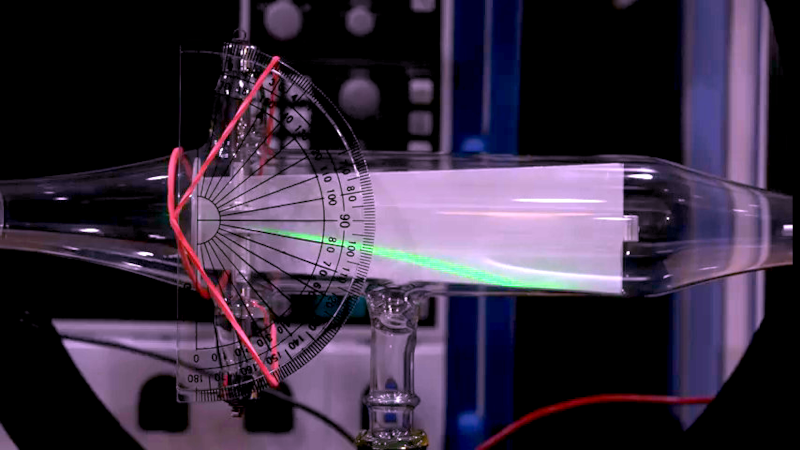
[The Signal Path] shows us how to recreate a classic science experiment to measure the weight of an electron. Things are easier for us, because unlike [J. J. Thomson] in 1897, we have ready sources of electrons and measuring equipment. Check it out in the video below.
The main idea is to trap an electron using a magnetic field into a circular path. You can then compute the forces required to keep it in that circle, along with some other equations, and combine them. The result lets you compute the charge to mass ratio using parameters you can either control or measure, like the radius of the circular path and the electric field.
Helmholtz coils create the magnetic field, and a cold cathode tube provides the electrons. Honestly, the equipment looks a bit like something out of an old monster movie.
Of course, the result is the charge to mass ratio, which means to get the mass, you need to know the charge of the electron. Today, you can look that up, but in 1897, no one knew what it was. [Robert Millikan] would conduct another experiment using oil drops about a decade later to determine that number, and then the world could know the mass of a single electron.
The resulting ratio was very close to the accepted value. It would be fun to see someone replicate the oil drop experiment, too. You could spend a lot of time recreating classic science experiments. Some of the experiments are easy with today’s gear.












We did the oil drop experiment in a lab course in college., ug ghd apparatus was bought from a scientific supply company, we didn’t make it ourselves.
“Millidrops Oil Can experiment” is what we called it in Grade 11 Physics lab. We had the benefit of using precise uniform-size plastic spheres (readily available for scale calibration in electron microscopy) instead of Millikan’s random-size oil drops, but it was still a moderately challenging experiment to make everything work. It certainly gave an appreciation for how much trouble it would have been for Millikan.
You’re officially old when your high school course material is in the history archives. In black and white even.
https://archive.org/details/TheMillikanExperiment
One thing I missed a bit is to rotate the whole test setup to show (average, compensate for) the earth magnetic field.
Yes, we did both the oil drop experiment and the charge-mass ratio (using a form of magnetron) at school circa 1974. I remember getting them within a factor of 2, which was considered good for a small number of experimental runs.