
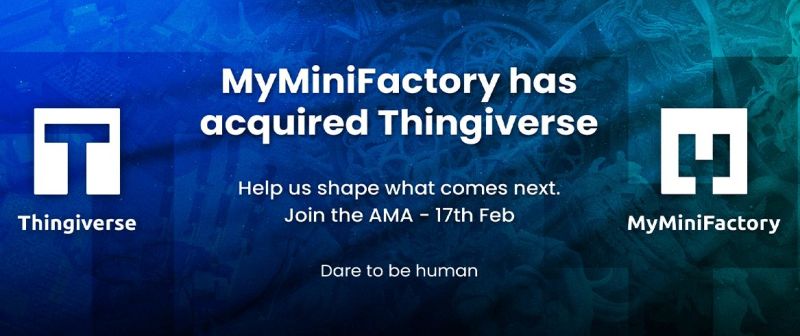
One of the best parts of 3D printing is that you can freely download the plans for countless models from sites like Thingiverse, Printables, and others. Yet with the veritable flood of models on these sites you also want to have some level of quality. Here recent news pertaining to Thingiverse is probably rather joyful, as with the acquisition of Thingiverse by MyMiniFactory, it should remain one of the most friendly sites for sharing 3D printing models.
Although Thingiverse as a concept probably doesn’t need much introduction, it’s important here to acknowledge the tumultuous times that it has gone through since its launch in 2008 as part of MakerBot. Both were acquired by Stratasys in 2013, and this has led to ups and downs in the relationship with Thingiverse’s user base.
MyMiniFactory was launched in 2013 as a similar kind of 3D printing object-sharing platform as Thingiverse, while also offering crowdsourcing and paid model options. In the MyMiniFactory blog post it’s stated that these features will not be added to Thingiverse, and that nothing should change for Thingiverse users in this regard.
What does change is its joining of the ‘SoulCrafted‘ initiative, which is an initiative against machine-generated content, including so-called ‘AI slop’. There will be a live Q & A on February 17th during which the community can pitch their questions and ideas, along with a dedicated Thingiverse group.












Nice. It’ll be refreshing to look through models that aren’t made by “AI”. This bubble can’t burst fast enough as far as I’m concerned.
Man I remember one user who uploaded nothing but AI models. He actually had a blurb to ask people to stop reporting his crap because it still fell under the guidelines even though none of it was realistically printable
Personally, I don’t care for it but I prefer the approach of good labelling so I can filter it, just like the brainrot political rubbish.
That’s my position: If you allow AI designs, you must allow users to actively filter out that content. AI designs must also be actually printable; mesh viewers on-site should do a better job to check for broken mesh inside the design. In my experience, only about 20-25% of the AI designs I’ve seen are in any way printable; the rest need a Star Trek Replicator to produce. Those that are printable are usually so riddled with mesh slop inside (additional/unnecessary walls, facets, etc) that they take 2-3x as long to print as a human-created mesh would. More often than not, I have to manually edit the STL to remove the garbage inside so a 3″ figurine prints within my lifetime.
The AI bubble that’s about to burst is the financial bubble around the overblown expectations of AI companies. AI as a technology is not going away anymore, the genie is out of the bottle.
AI as a technology is too costy if users pay it’s full cost. As soon as it becomes non-free, things will quiet down.
You do know that free and open-source AI models that you can run locally on your own computer exist, right? And that in a lot of cases they’re pretty competitive with the cloud-based models? And that when you use them you pay the full cost of running them, which doesn’t have to be much (at least if you already have a somewhat powerful computer for, e.g., gaming or video production)?
I do find the word “costy” interesting, though. It seems like it might make more sense than “costly”.
Gooood? How are they going to pay for things, if they do not make 3D printers or such and are actively fighting the current money train?
They operate as a marketplace – people sell models and MyMiniFactory take a cut for hosting them, etc.
I know that it’s a weird idea, running a business by selling things for money, but I think it might just catch on.
What? Selling physical things you can hold in your hand and keep if the company goes out of business or changes their mind on what constitutes acceptable use?!
It’ll never work.
Har-har. MMF does take a cut (had never heard of them before this), but according to the statement, Thingiverse is to stay free. So they’ll fund 2 sites from the cuts they take + apparently ads. And the site wasn’t free.
Have you been on thingiverse lately? Every few rows of models you are scrolling past there’s ad placement.
Push for quality; not tool usage.
You’re pushing against the printing press.
That assumes that the only dispute is quality. It isn’t, and in principle the quality of AI stuff could become better than human authored stuff but still be unethical to use.
Printing press.
You know – to print something on the printing press you first need to either create the work yourself or acquire permission from the author. You can’t just acquire printing press and start printing anything and everything. You need rights to do so. And authors will want compensation – sometimes even based on number of copies sold (royalties). Now AI companies just pirated everything and now are trying to make profit on the work. Often without permission from the authors.
Is it legal? Well looks like it probably kind of is. Is it ethical? That’s the main question here. It is not push against printing press. It is push against for profit piracy.
I’m going to repeat this.
Printing press.
You quite literally haven’t read any real history of it or the pushback. Absolutely nothing said has been a unique argument against AI that wasn’t made against the printing press.
As for the ethics, saw several videos on social media where artists were complaining their art was potentially stolen and use. I also saw their, particularly, derivative artwork.
It’s hilarious to me when I see artists deriving their work from others and then screaming when the favour is returned.
Yeah, I’m still waiting for the printing press singularity.
Do you realize there was a time before copyright, when scribes would just copy books freely to spread the knowledge? Copyright was invented by humans, and we could conceivably abolish it or amend it.
But I don’t see what any of that has to do with AI ethics beyond the issue of AI models sometimes regurgitating copyrighted training data (but humans sometimes do that too, sometimes with copyright infringement lawsuits resulting).
If AI is just learning from available information (which is often published explicitly for the purpose of being learned from, such as Hackaday, Wikipedia, or news articles) so it can later apply and/or share that knowledge, what’s the ethical difference from a human learning from it for the same reasons? (Let’s assume the human is blocking ads.)
Could you refer me to a few sources on the fear of the printing press when it was developed? I’d love to read up on it.
Feel free to include dense academic books that really get into the details, that’s what I prefer to read.
Recently been doing some fairly in depth research into the history and philosophy behind information technology, how it’s impacted culture, and what culture’s responses in the moments of invention have been.
The actual technology works just fine with ethically sourced material. Guess were the problem really is.
I think training an AI on publicly available sources is both legal and ethical.
What is unethical is for a company that hears there is money in AI to suddenly be so ‘ethically’ concerned and be willing to lock down and ruin the internet because of their thirst for money.
And it become a complete joke if a company lives from posts made by 3rd party volunteers and them suddenly act like they have the rights to those people’s thoughts if there is a chance it brings them money, and to say that AI companies are oh so evil.
If you think you have a right to other people’s money based solely on them having it and you wanting it then I think the best description for you is: ‘being a criminal’.
That counts for countries too.
Completely agree. Learning is learning, whether it’s an NI or an AI doing it. (And we NIs have the problem of regurgitation too.)
The worst example of that must be Reddit. They even banned web search engines from indexing content on their site without paying to do so. (AFAIK, the only one that decided to pay is the one that dropped the motto “Don’t be evil” several years previously.) Unfortunately I couldn’t boycott Reddit over that, because I was already boycotting them over their last big community-hostile policy change (effectively banning third-party client apps and bots). Being evil is not a new thing at that company.
Stack Exchange is a similar case. All user Q&A content there is released under a CC BY-SA (IIRC) license* when you post it, and they used to provide dumps of the full site content but they stopped doing that despite having (IIRC) made a promise to the community to always continue doing it. I’m pretty sure they have a similar “no free access so we can charge AI companies for content our users posted for free” policy now, though I don’t know the details. I’m glad I’ve never been a registered user there.** Every notable interaction between the company and the community I’ve ever seen (and I’ve read a lot of those Meta discussions, over many years) shows how little the company respects and values the community.
*As an example of their lack of respect, the company unilaterally and I’m pretty sure therefore illegally updated the license version on all preexisting user-generated content several years ago. (I’m pretty sure it was illegal because (IIRC) the ToS there is unusual in that it doesn’t contain a direct license granted by the user to the platform to enable hosting of content (which could come with a provision that the platform can then share that content with anyone else they want under any license they want), instead containing the requirement that user content be CC-licensed to everyone in the world and relying on that for the platform’s ability to host it.)
**I refused to join in the early days because I read that their posting interface hid advanced formatting options from new users and only revealed them after you gained a certain number of reputation points, and I objected to being treated that way. How trivial that seems now!
Thingiverse is so full of human generated slop (and a lot of good stuff) that I’m not sure that ai-slop would actually make it notably worse.
Solution? Have a separate section of website that states: AI Only. Then let the ‘consumer’ decide which models to download.
AI is not the ‘printing press’ invention of the past, it is far more dangerous.
Hohoho, printing press is pretty dangerous. It can for example disseminate Mein Kampf or Luther’s heresies :-]
Ahh, but there is a major difference. The Press opened up knowledge to the masses. Everyone could eventually afford a book, just not an elite few. You might say it freed knowledge up for all to benefit, not just a few. It was earthshaking. It really was a revolution.
But now we are putting the genie back in bottle so to speak as knowledge is being put under the thumb of a few data centers around the world and controlled by a few as we continue to go ‘extreme’ digital. Who knows how many will even survive when the competition shakes out. Only one? two? a few niche sites? In a way we are moving backwards and of course the ‘owners’ will love it as they get to control the narrative, what information you are presented, how it may be slanted to align with their beliefs. It is no wonder we see the pocket books being opened wide to the toon of billions of dollars for this technology. You really don’t think it will be for our benefit as a whole do you in the long run? And don’t say they won’t. We see that today in everyday politics and people will use anything for an edge, for power, for wealth. Media has been used rather well, as social media is used… It’s in the DNA. Governments will love this as another facet of a stone going out of our control. Tin foil hat? Maybe… But I wonder…
You realize all these arguments used against the printing press were well before “the press” used it that way,right?
Ahh, but there isn’t such a major difference. Modern AI opens up creative and knowledge-work skills to the masses. Everyone can now—not eventually—afford to create more or less OK software (with or without dealing with code), articles, covers for their novels (and better text within), animations, 3D models, etc. Everyone can also now afford to get personalized, instant, and highly knowledgeable tutoring on almost any subject (such as creating the above things fully by themselves or with some AI help but still leading the process themselves), not just an elite few. You might say it frees skills and learning up for all to benefit, not just a few. It is earthshaking. It really is a revolution. :D
As for your second paragraph, the damage from vendor lockin, consolidation, service termination, etc., can be mitigated a lot by using local AI where you can and backing up what you do with cloud AI. Local AI also lets you control the settings more, and use smaller/less computationally expensive models* where they’ll do the job, which both probably help keep its energy use lower than cloud AI’s (and it doesn’t usually use any water).
*It generally forces you to use those models, actually, but I say it lets you use them when they’re enough if it’s considered as a complement to cloud AI, where usually a powerful model is used even where it’s not needed, because the provider wants to keep the user interface simple and the users satisfied with quality simultaneously/the user doesn’t care to optimize because someone else is paying to run it and it runs satisfyingly quickly. I.e., if you don’t expect to need the most advanced model (or settings, or tools the model can use) for a given task, run it locally.
“AI is not the ‘printing press’ invention of the past, it is far more dangerous.”
You don’t have to back your dislike of something with a moral panic, that’s Church tactics. It’s pretty informative to read the claims about the danger of the printing press (more specifically, movable type) from the time of its invention and spread. Everything from job loss to the production of low quality material and the undermining of establishments by dangerous actors was put forward as reasons to ban it.
Just be honest about either not liking its output or having a vested interest in legacy media production. Personally, I’m not a fan of the limited output styles.
People are dangerous. I’ll resist the urge to point in any particular direction.
bro id rather pay a couple bucks to someone trying their best as opposed to some lazy dork offshoring their creativity to a random number generator
Me too. I would prefer to user Fiverr or Mechanical Turk than give “AI” companies any money.
I’ve got fond memories of printing parties at Ultimaker and Fablab Protospace. Even as at the time I didn’t have a printer, and was more into laser cutting. Several of my old designs ended up online, and a subsection was shared on Thingiverse as well. It was a good platform, but it hasn’t been great in the past years. My mini factory doesn’t have the type of content I’m interested in, but I hope this takeover will bring good things.
Regarding their AMA today/tomorrow (depending on your time zone), all I’ve seen is the signup page.
Does anybody know how (with what technology, rules, etc.) it’s going to be run, or how long it’ll last?
Is anybody planning to attend?
(I might, but I have a dental appointment just before it and so probably won’t be online at the time, and for all I know it might be run using some service I object to (e.g., Discord, Zoom, Teams, Webex, and possibly certain other conferencing systems).)
Responding to their announcement post, linked in the article above:
It seems it must be said frequently: zero tolerance means zero understanding. Just as there are legitimate reasons and appropriate situations for a kid to make a finger-gun gesture or possess an L-shaped object at school, there are legitimate reasons and beneficial ways for humans to incorporate AI into their workflows (and probably many more of them, with how much space for creativity there is in the world now).
On the other hand, in their explanation of what SoulCrafted is, they say it’s only an opt-in certification program for designers (because they have to share their design process details to get certified) and “We’ll figure out how this evolves. Maybe AI will genuinely enhance human creativity rather than replace it. We’ll deal with that when it comes.” (Well, it’s come, at least for some AI users.) Back on the first hand, the policy at the bottom of that same post starts with “MyMiniFactory does not allow AI-generated 3D models or AI-generated imagery of any kind, even in part, in objects distributed or sold on our platform.”
In that policy, if a model gets reported as AI-generated, one the steps is: “We open an appeal process where we ask for proof that AI content has not been used (work in progress, sculpting videos, etc.) in either the 3D models or imagery used to promote them.” and the FAQ at the bottom includes “I’m a creator. How do I prove my work is not AI-generated? Keep process files, WIP screenshots, or project files. Consider applying for SoulCrafted verification. Build a consistent portfolio over time. Most importantly, keep creating – your unique style and growth will speak for itself.” So I guess now, if you want to be completely safe, you have to have a screen recording going the whole time you’re thinking up and designing anything you might later post on Thingiverse, and keep that screen recording (not likely a small file) forever. On the other hand, the policy then says they’ll “appeal” for community input on decisions “if needed”.
Still on the other hand, the policy then says “As AI tools become more embedded in legitimate design software, we’ll adapt our policies. We’re focused on intent – are you using AI as a minor tool in your creative process, or replacing human creativity entirely? We’ll keep communicating with the community as we refine this approach.” (but I object to the term “legitimate design software”) and the FAQ at the bottom says “What exactly counts as “AI-generated”? Content where AI is the primary creator rather than a tool. If an algorithm generated your model with minimal human input or decision-making, it’s not fit for MyMiniFactory. AI-generated imagery will also not be allowed on objects on our platform.” and “What about AI tools built into design software? This is complicated and evolving. We’re not banning software with AI features. We’re looking at whether the final work represents genuine human creativity and skill. Minor AI assists in a largely human process? That’s different from prompting an AI to generate entire models.” So there’s a lot of self-contradiction on this topic.
The SoulCrafted post explains that this initiative is to protect the profitability of content creators on the MMF platform (and soon on Thingiverse) against an influx of monetarily free (and presumed lower-quality) AI-generated content. But what’s to stop might-be customers from going to other platforms that allow AI-generated content, or even going to the AI generators themselves?
One of my fears is addressed here—and it seems it’ll come to pass. I’d hoped Thingiverse would remain the major platform for monetarily free content only. I don’t object to there being platforms where models can be sold or offered as part of a paid subscription, but the culture just seems to change when that’s introduced. Maybe it’s just me?
(For example, I feel that people who might post things under free licenses are then more likely to post them under closed licenses even if they’re still monetarily free, on the thinking that “I might (be able to/bother to) charge for it later”, and that they’ll similarly be less willing to share design details, make and share CAD libraries of design elements, etc.)
OK, good, but I didn’t expect they would. I doubt there’s any overlap between acquirers who’d think that was a good idea and those already running a successful platform of the same kind, even one that (I just discovered) only shows paid models on its front page.
Good; a site merger was another of my fears. MMF seems like at least a somewhat respectful acquirer. (Faint praise not intended; I’m just not familiar enough with them to say something more positive. They’ve also left YouMagine as an independent platform (and they say earlier in the post that they improved and rejuvenated it), so there’s even precedent for continuing in parallel. Also, I learned just now, MMF focuses mostly on tabletop gaming miniatures and related models, whereas Thingiverse is for everything, so it wouldn’t even be a great fit.)
My remaining fears are:
That they might push people toward posting things under a closed-source or not-fully-open license (like the “Standard Digital File License” I’ve seen ubiquitously on some other site (MakerWorld?), or a “remixes may be made, but may only be posted on this same site” license—which MMF already has) by, say, making it the default option or showing it more prominently in the license menu, by removing open licenses as options, or by encouraging people to make their content paid: This looks like a possibility given what I can see of MMF’s approach to licensing options; I haven’t seen the actual list of options you can choose from when you post something on that platform. MMF does have an obvious incentive (their cut) to push people to share their content as paid rather than monetarily free. Thingiverse has long been both the biggest platform and the main (only?) big platform that didn’t have paid content, so it’s probably the one with the best open-source/remix culture, and I expect both this fear coming to pass and adding paid content at all would/will harm that.
That they might force relicensing of already-posted content, possibly from a free license to a nonfree one, or otherwise: They look a lot more respectful of their community/ies than Stack Exchange, so I don’t expect they’d try that.
That they will change the policy to forbid downloading monetarily-free models without logging in (or entering your email address, or something like that), as some platforms do: I just checked, and MMF itself allows anonymous downloads, so I doubt they’d forbid them on Thingiverse.
That they will change the policy to forbid browsing of a user’s things and collections without logging in: Same as above, from what I can see.
That they will make Thingiverse’s user interface design more like MMF’s (because I find Thingiverse’s OK currently but dislike MMF’s): With their stated plan to keep the platforms independent, I think probably not. (I wouldn’t mind if they did this in the other direction, but MMF’s community might object to that, being used to their platform’s current design.)
That they will impose a ban on AI systems learning from user-uploaded content (even if the creators of said content disagree with the ban), as Cults very visibly does with the “No AI” icon on every single model’s page: I don’t know, but they do seem to have an anti-AI (i.e., anti-technological progress) stance, and the SoulCrafted post linked above includes the phrase “an AI trained illegally on other people’s designs” (inaccurate IMO as a non-lawyer who knows a lot about IP, and possibly inconsistent with their own statement in the SoulCrafted FAQ that using AI tools to provide translated descriptions is fine), so they might do that. Might as well prohibit printing your books with movable-type printing presses or producing your fabric designs with Jacquard looms (both ancestors of 3D printers, BTW) and see how popular they are a decade later! As I said in another comment, learning is learning, regardless of whether it’s an NI or an AI doing it.
That they will use dark patterns to promote paid content. This is a new one just now, after trying to explore MMF just a tiny bit (for the anonymous download test above). I found that the search filters show “0” filters active by default, but if you open the filters, and then open the more filters, you find there is a filter on by default: “Show premium designs only”! GREEDY!
To end on a positive note, I’ve thought of a couple of hopes just now:
That they provide some kind of migration tool so that tabletop-game miniatures and related things can be moved/copied by their creators from Thingiverse to MMF, and other things can be moved/copied the other way, and both can thereby be published in the place with the bigger audience for that kind of content.
That they do something that results in the Thingiverse Customizer working for me. For at least 10 years, I have never been able to get it to even launch, in any browser, on any computer, and making sure nothing is blocked. But I’ve never heard of anyone else having this problem, so I guess it isn’t a normal bug, and maybe doing some unrelated change to the Customizer to improve it in some way just might fix this for me?
Formatting note: I tried to make two bulleted lists at the end (fears and hopes), but the bullet symbols are missing. (I tried this by prefixing each paragraph that was to be a list item with an asterisk and a space, based on the observation that other Markdown formatting (bold, italic, links) works here.) But that’s probably the least bad way my formatting could’ve gotten messed up, so I’m actually pretty happy with it.
And I simply forgot to make the term dark patterns a link.
(TIL from Wikipedia that there’s a tip line for dark patterns started in 2021 by a coalition including the Electronic Frontier Foundation and now run by the Stanford Digital Civil Society Lab! Best news I’ve seen all day. I submitted a detailed report on this one, though I had to omit my screenshots to get it to work, despite them complying with the stated restrictions.)