
 Many people who use water cooling in their computer systems like to go full-bore with ‘aquarium’ aesthetic, which includes adding a window to their cooling blocks so that they see the water flowing through the window from behind the case’s window. Traditionally PMMA acrylic is used for these windows, as it’s quite durable and easy to handle.
Using glass offers some advantages over acrylic, but has its own disadvantages, most of all that it’s hard to process, but also that it’s known for shattering quite easily if pushed beyond its limits.
This is why [der8auer] as a manufacturer of such water blocks has now spent a few years investigating the viability of using glass for this purpose. First and foremost is safety, with an early prototype glass water block suddenly shattering without clear cause.
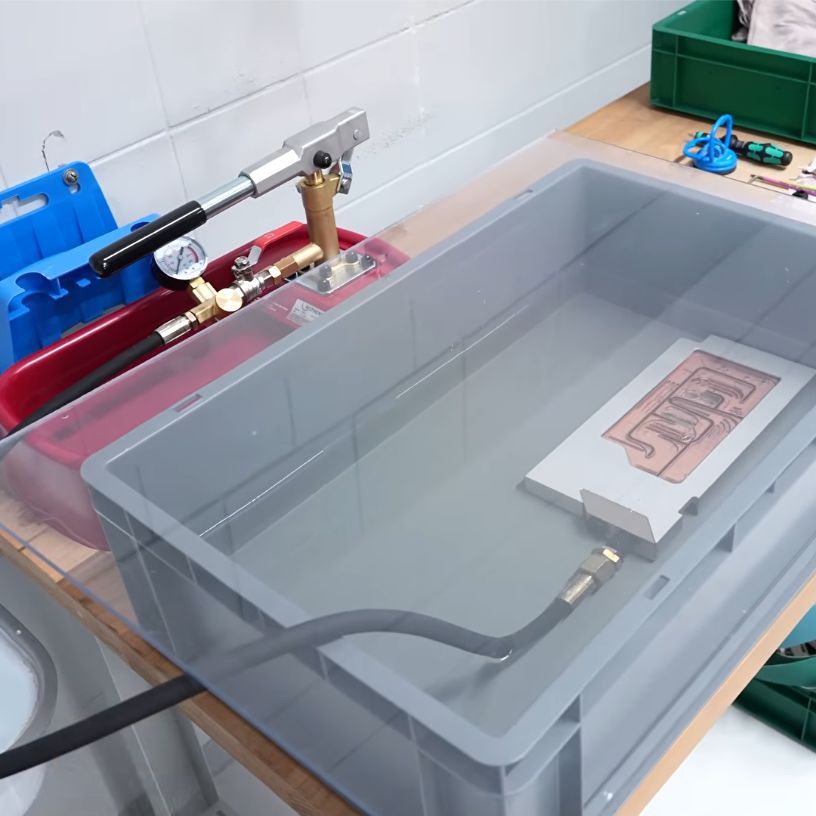
Although normally the water cooling loop is only expected to experience pressures of about 600 mbar, the new glass windows that are now entering mass-production had to be tested to their breaking point. This involves pumping water into a few test blocks until they fail, using the test rig that you can see above.
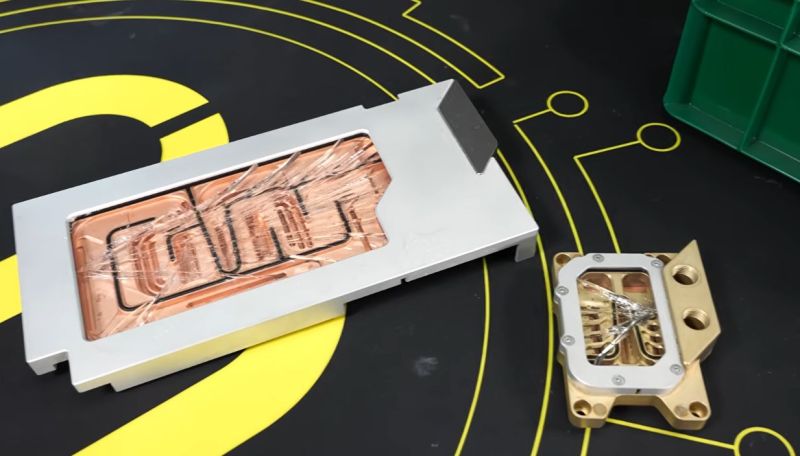
First the big GPU water block was tested, with the acrylic version breaking at around 8-9 bar, while the glass plate shattered at around 5 bar. The failure mode was also interesting, with the glass plate shattering into fragments, while the two acrylic plates tested failed in a completely different location and manner.
A smaller water block with glass window failed at about 10 bar, demonstrating mostly that smaller glass windows are a lot sturdier. Effectively glass windows in water cooling loops are viable, and they also do not suffer from e.g. discoloration, but you do give up a big chunk of your safety margin if your water cooling loop suffers a major pressurization event. Which of course should never happen, but we’re definitely looking forward to the upcoming field trials of these new water blocks.












Somehow I think that if your watercooling loop is reaching 10 bar, you have other things to worry about, or you need to disconnect from the industrial compressor….
I thought the same thing. Unless you’re trying to run a steam engine, those are some very high numbers
Exactly, and unless you have air trapped in your block you’re not really going to see anything? Maybe they can put a little spinner in there to entertain people with.
There are additive that gives a swirling metallic liquid look but it degrades the thermal efficiency.
Is it Mica powder, by chance?
Totally for people who are in the game for the “hey look at me” , I don’t see the interest in “seeing” cooling fluid going true , same as car modders that won’t do the 1/4 mile, i.e :posers . I don’t care what my rig looks like , I care for above spec perf. And if that means an ugly waterblock , so be it.
perhaps a pressure valve connected as a dead mans switch, with full off when triggered
der8auer is publishing some record of his testing to pre-empt:
– complaints from media reporting on his latest product about using glass for this purpose
– complaints from users who damaged their own waterblock due to operator error, then try to pass it off as manufacturer’s fault in front of a wider community.
And it will still crack randomly. I suspect thermal stress and how the screws create load is way more important of a factor than the measly pump pressure. It’s a nice test, but he missed the bigger picture.
He did mention dealing with such random cracking before in samples a long time ago, likely due to defects in the glass. Sadly it’s not mentioned what exactly was done to address this, but on the bright side these glass waterblocks will be premium models for people who can afford a bit of water damage :)
I must shamefully admit I had no time to watch it in full on the train to work and had audio off. I’ll give it a shot and do it during my break. The subject is interesting though and I am glad you wrote the article about it. May I suggest “sapphire” glass as the NASA equivalent of ideal window? I never had a wrist watch with it break or scratch (luckily).
Thanks Maya!
Yeah, there are a lot of ‘glass’ formulations and similar that one could use here. Acrylic isn’t perfect either, so it’s nice that there’s at least interest in alternatives :)
that’s why text is superior.
Folk, blog, dammit! :)
Yup , glass won’t take the screw load , then add thermal differential…. Crack,. Case proven with all the glass shower curtains that shattered.
glass weakens with stress. Its why chem labs have to replace glassware before it breaks. You can see the built up stress with a polirimeter or polariscope. Every thermal cycle is going to stress things. Glass is a bad idea unless you can prevent thermal cycling stress from being applied. (Possible) By the video, I wouldn’t trust these guys with glass. Stick with PMMA. Competition has room to move in if they want to make a safe glass version!
I’m surprised they did not screw it to a heater during the test, I would think one side as well as the rim being heated by the CPU/GPU as well as the pressure of the retention mechanism to said CPU/GPU could play a role.
I never saw a water cooling block as seen with a IR camera but I just imagine there is a temperature gradient even when water runs through it. And I also wonder if there is a gradient on the sealing material, even when it’s admittedly a thin strip.
On the other hand; we now know that they don’t seem to test that stuff at Boeing when making billion dollar space vehicles… so perhaps it’s odd to expect it from a water cooling block maker :)
On cooling
https://techxplore.com/news/2026-02-generation-ai-semiconductors-thermal-constraining.html
https://phys.org/news/2026-02-diamond-owl-swoops-method-electronics.html
Unclear, but I thought some metals do not agree with each other. Half of the block is aluminum and the other copper.
“Certain metal combinations should be avoided to prevent galvanic corrosion. For example, aluminum and copper.”