
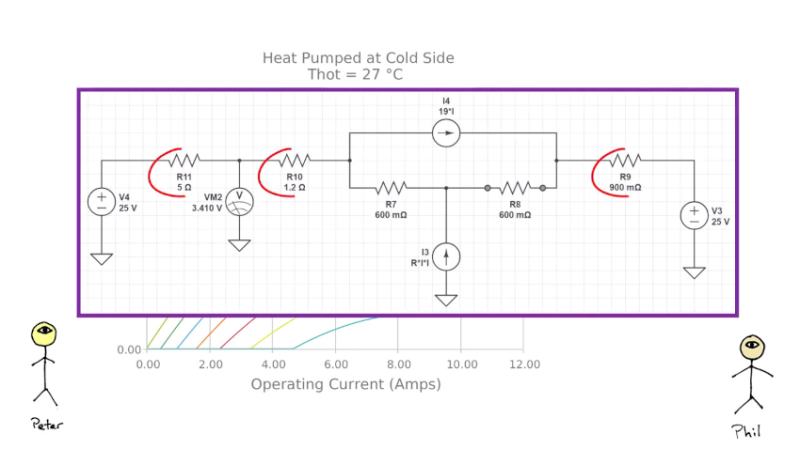
If you know about Peltier modules, a solid-state fridge seems like an easy project. Pump 12V into the module, include a heat sink and a fan. Then you are done, right? According to [Peltier Power], this is not the way to design things, but it is common enough to give these units a reputation for failing quickly.
The problem is that while it makes sense that an inefficient Peltier module needs more power to get more cooling. But the reality is in practical applications, many designs push the current up when it should be moving it down. The curve describes a parabola, and you can be on the high side or low side and still get the same result. But obviously, you don’t want to put in more current and get the same cooling that you could get with lower currents.
According to the video, the mistake people make is pushing to a stable point to reach a cool point, then increasing the current until the chamber cools further. However, maintaining the cool doesn’t have to require a higher current. Once cold, you can reduce the current to maintain temperature, so to get colder, you can just lower the current less instead of increasing it. Of course, that’s somewhat of a simplification. You have to account for other thermal design factors, but that’s the general idea.
He has noted this behavior in commercial units, but did find one brand that had the correct logic. He also has some tips on using these types of coolers.
Our favorite use for these modules has to be a cloud chamber. Naturally, we’ve seen a fair number of homebrew fridges.












While pwm kills the unit quickly. No way around linear regulators.
You just need to use a constant current buck regulator, which a pwm circuit is half way to being.
Yup. PWM won’t kill the unit if you lowpass filter it – which basically turns it into a buck converter. Probably not necessary to actually even bother with a regulation loop.
I’m definitely going to have to watch this in full when I have the time… It looks like he has some sort of multistage counterflow arrangement with watercooling blocks near the end. I’ve been thinking of doing something similar for an automotive dehumidifier.
Peltiers are MUCH more efficient at low currents and low delta-T (which seems to be his point based on the limited skimming I’ve done so far of the video)
You’d think this would be common sense, but even CPU and GPU manufacturers still do this, to the point where undervolting your computer components brings increased performance.
The reason for that though is that individual dies have different minimum voltages they can run reliably at. Manufacturers set the voltage and clock speeds so that every die they release will work at an acceptable level, even if it hasn’t been perfectly tuned to get the maximum performance (because setting such a performance tune will cause most units out of the factory to fail immediately.) There’s a reason it’s called the “Silicon Lottery”.
True, but just like allowing the chips to automatically overclock themselves they are starting to get wise, there is now a ‘quality index’ on high end unlocked chips. So you can get a hint of overclocking potential.
That’s a thermal management thing.
Undervolting/underclocking keeps it out of thermal slowdowns.
Youre reducing the instantaneous performance to the sustainable one, gaining consistency.
A better heat sink is a better choice, but many computers are laptop hardware these days.
Looking at you (cr)apple.
I’d be curious to see what these systems look like with stacked peltiers. I remember reading many years ago that you could stack pecs to reach really cold temperatures efficiently. I always wanted to do the math on it but always have something better to do. Seeing that there is a sweet spot for a single unit it would be neat to see someone compute multiple.
Stacking is not difficult, but the staging ratio quickly becomes ridiculous: each stage is about ten times bigger/more power hungry than the previous. You can get 20-30 C per stage, but past about 4 stages it’s insane: you can only pump a few milliwatts for any rational size of stackup.
One DIY cheat is to run alcohol in a cold loop from a domestic bar fridge freezer, bringing the “hot” side of the peltier to 0 C or so, allowing a two-stage cooler to hit -40 C and still be able to suck a watt or so out. This is useful for older large CCD image sensors to integrate for many minutes/hours and still keep the dark current in check.
That’s a nice trick. I will keep that in mind. Cooling down a ccd has to require a ton of engineering forethought. Preventing condensation and all that. I guess if you hit -40c you probably don’t need direct contact to the back of the chip though. So there is that.
Yes, the bare chip will frost over instantly. And if it’s a windowless chip that frost happens right on the silicon. It’s actually kind of pretty, and the chip survives just fine, but its obviously not ideal for imaging in that state.
Yeah, you do need direct contact with the backside chip. Usually a simple copper block, but it also needs to typically be spring loaded to accommodate thermal contraction. Glues don’t fare well between ceramic and metal with that kind of temperature change. The whole thing needs to be in a near-hermetic enclosure seal, which obviously includes an optical window.
Backfill is typically just nitrogen at atmospheric pressure. You don’t gain much from a vacuum, and the engineering issues multiply significantly.
Makes sense to me. I’ve seen some ccds from the old andor days that had the hermetic seal and all that. Only ever used them at ambient because the source was very bright.
Interesting about the hermetic nitrogen seal. I had to repair some cheapy ft ir’s in a pinch once. They had different concerns but it was interesting to see how they handled keeping the environment dry. Mostly with desiccants. I never got to work on the ln2 cooled detectors. I imagine that’s similar to what you’re describing.
Really cool to hump heads with someone who has similar experiences.
Actually the publisher of this video does address stacked peltiers. The problem with most stacks is similar to the problem this video addresses – Peltiers suck when driven near full power.
If you want to stack for increased efficiency you need to reduce the voltage/current significantly.
What?
Warm up my Vodka?
GTF out.
It’s below 0, pours oily, as it should.
Instead of stacking (which in your case, is likely already useless), you can multiply the units and the “cold” contact area. Put 2 peltier module running on the same current curve on 2 different places and you’ll save more power than a stacked dual module. You’ll likely realize -20K easier this way than cranking up the single module power curve (which doesn’t really work as this article says so) and -20K is likely enough for your need.
5 stacked peltiers
https://www.youtube.com/watch?v=ImiSpAjKjss
i got one of these for christmas, people got tired of me opening warm sodas in the middle of the night. so instead we get to waste tons of power on a peltier device and put up with fan noise while im trying to sleep. im kind of glad they have a deathcode. maybe i can replace the fan with a quieter model.
I noticed this when I was trying to “overclock” a 12v soda can fridge. Increasing the voltage didn’t help.
This is legit. I have a peltier fridge I’ve been using to keep a product at 50F. Last night I dropped the voltage, cutting the power from 45W to 15W, and it’s still able to maintain temp, albeit at a slightly higher duty cycle. As a side benefit that’s actually a huge QOL upgrade, with the heatsink fan spinning slower it’s now basically silent.