
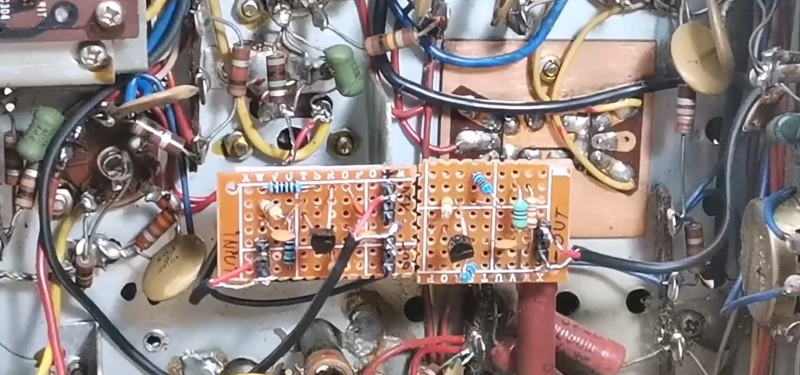
There was a time when only the richest ham radio operators could have a radio with a panadapter. Back in the day, this was basically a spectrum analyzer that monitored a broad slice of the receiver’s intermediate frequency so you could see signals on either side of the receiver’s actual frequency. Today, with SDR technology and computers, this is an easy thing for receivers to implement. But what if you want to refit a classic radio? It isn’t that hard, and [Mirko Pavleski] shares his notes on how he tackled the project. You can also check it out in the video below.
The plan is simple. A FET amplifier taps the radio’s IF stage before the first IF filter. This provides good isolation and buffering. Then, an emitter follower stage provides a matched output to the SDR through a low-pass filter. The SDR remains tuned to the IF frequency, of course. The rest is essentially software and procedures.
Of course, your exact connection to your radio will differ unless you have the same receiver shown in the video. A modern scope with an FFT should be able to help you quickly locate a good spot, though.
Of course, you could just listen through the SDR, but that doesn’t seem sporting but that’s what it looks like he does in the demonstrations. Essentially, he’s using the radio’s RF system via the first IF mixer, then letting the SDR handle the rest. But you could just use the display and tune the radio instead.
If you really wanted a cool system, you could frequency count the internal frequencies and display the correct frequencies in software. Then you could also track the current frequency. This would make it seem more like a traditional panadpater and less like just replacing most of the radio’s features with an SDR.
We’ve seen these before, of course. Many times.












To those who’re wondering what it’s all about..
Back in the 1970s, advanced users (operators) of the popular Yaesu FT-101 radio line had owned a YO-100 / YO-101 monitor scope.
https://www.rigpix.com/yaesu/ft101.htm
http://foxtango.org/ft101/YO-100%20YO-101.htm
Other lines of radio transceivers had similar accessories at the time.
They weren’t mere luxury items to show off, but allowed checking modulation and signal quality.
That’s important, since hams are required to check their own transmissions and make sure everything is fine.
In principle, they were as important to amateurs as an oscillograph is to an electronic hobbyist.
A panorama adapter (pan adapter) as mentioned in the article
is that kind of analogous equivalent to a shortwave listener (SWL) or broadcast radio listener (BCL).
(Btw: Both are traditional terms used to describe listeners. An SWL doesn’t necessarily limit itself to shortwave band, either.
There are also radio amateurs that are listeners only.
Some don’t even have a license to transmit, but merely a listening sign.
To participate QSL card exchange, among other things.
In German, for example, they were historically being called “Höramateure”, listening amateurs.
Here they have DE suffix over here and must pass a telegraphy test to get their sign.
These guys are sometimes more ambitious than ordinary radio amateurs and focus on receiver technology.
Being listeners, they also must master patience. Kudos to them.)
Correction, DE prefix. Of course.
Another high-end device was a so-called spectrum analyzer.
It covered few KHz to over a GHz and was cutting-edge trchnology of the day.
Some did cost a fortune, as much as a house.
They weren’t available to most ordinary users.
What was already available to mortals, though, were wide band receivers.
The Yaesu FRG-9600 was based on a VCR tuner, for example.
Which was in the affordable range and very good for amateur needs.
(VCR tuners were highly integrated by the 80s and being mass produced.)
The original Panadapter was a 2inch (5cm) o’scope that only covered a slice of plus or minus a few 10’s of kHz what you are tuned to. It could not display a lot. A good RF front end begins to restrict what can be picked up at the input of the IF even today with the gear now.
My first “look” at the RF spectrum was cutting the tuning voltage coming from the digital half of an 80’s car radio where that voltage tunes the radio the regular RF and osc way. This was 30 years or so ago. By sweeping that voltage instead and sending it to the horizontal of the scope, bingo there was the whole FM band and the top of channel 6 TV. Then it was on to a first gen bag phone. Seeing that whole band busy and things pop up allover and then homing in on one call. Ten turn pots are pinnacle of analog.
I use a softeock lite II, it preforms as panadapter and sdr. Small ,easy to assemble kit, just tap power,if, and run audio out to pc (or usb) soundcard .
AD8AW.
Why would you need an FFT on your oscope to get this working?
I mean, I have an FFT on one of my scopes, can’t see a reason I’d need the function here. I also have FFT on an 8 ghz R&S Spec An…. So my spec an works as a scope. I could see using it here, for the scope functionality, but why?
My old school analog Tek scope would work just fine here. Seems this is someone blathering about.
To Joshua: The scopes that Yeasu offered didn’t do anything for a panadapter, which is what this is. Other mfg did offer pan scopes, but the YO didn’t do it.
Observer: It would take an observer to see the obvious overuse of the work obvious, obviously. Great OBSERVation :)
echodelta: I miss the simplicity of 70s and 80s tech. The things we took for granted back then. Like Yeasu taking a VCR tuner and making an entire widebanded receiver out of it. And then people using that same tuna to make homebrew 1ghz spec ans.
Now we can whip out a CC and get an 8 ghz used R+S for a few hundred dollars.
I miss the old days when you could buy parts that where stamped correctly and Motorola actually made semiconductors.
And yes, get off my lawn.
Thank you! ^^
Here is another way of doing it, using just a sweeping sig gen and an oscilloscope. https://soldersmoke.blogspot.com/2019/05/diy-waterfall-quick-and-easy-panadaptor.html
73 Bill Hi7/N2CQR
When Germany rook over the French intercept station near Paris, the French were already using panoramic displays on their receivers. These were adapted to spot clandestine transmissions over a modest bandwidth of a few hundred kHz. This would allow the frequency to be logged and radio goniometric stations to be tipped. Most resistance signals were splits, so this also allowed the search for the control station.