
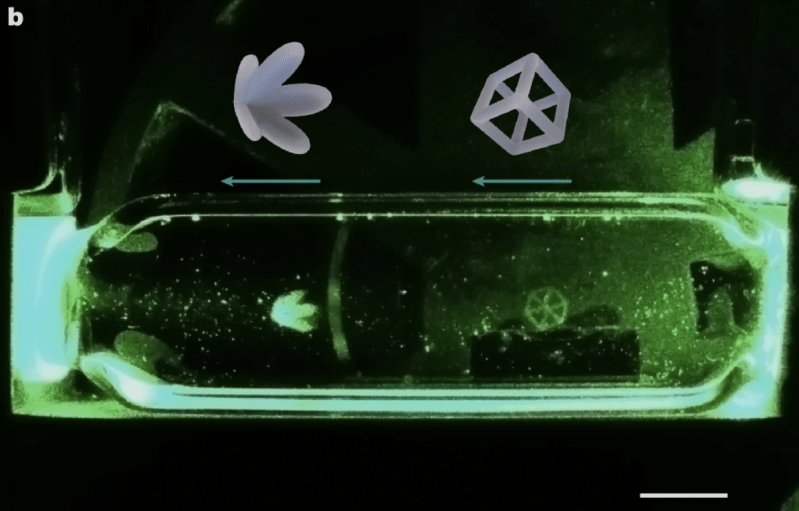
One of the more promising 3D printing technologies that hasn’t quite yet had its spotlight is volumetric 3D printing. Researchers from the Department of Automation, Tsinghua University, have developed a new method that uses a high-speed periscope instead of rotating the printing volume — resulting in print times of less than one second.
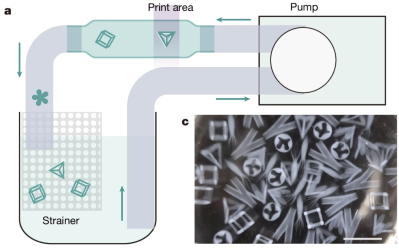 Normal volumetric printing uses a rotating volume of photosensitive resin to print nearly any geometry desired. However, this method presents issues when printing at high speeds. If you rapidly rotate a liquid, it won’t exactly stay still. So why not rotate the projector itself? This change also allows the use of less viscous resins, which is particularly useful if you want to pump fluid around.
Why would you want to pump around liquid? Scalability of course! Printing in seconds while pumping the results into a collection vessel would allow for mass production more flexible than traditional ejection methods. The researchers manage to keep quality high with some fancy algorithmic correction, which allows for accuracy on the scale of μm.
While this technology still doesn’t find a common space among average hobbyists, this may soon change…especially with these mass manufacturing capabilities. For similar volumetric printing capabilities, check out xolography.












Probably could have used a bit more detail from the abstract.
You know, just a bit…
like for example what volume is printed in <1s
<1cm. It’s in the article
This makes it slightly less exciting, still interesting
“that hasn’t quite yet had its spotlight”
I was looking for 3d printing services that could do volumetric printing not a year ago. You know you’re doomed when google gives no results except research papers and medical equipment so rare they not only have no price tag but no manufacturer sources to reach out to and be laughed at for even asking :/
The first time I saw these volumetric systems I wondered why they were rotating the vat.
While I get that DMDs are more readily available, I cant help but think a Grating Light Valve would be a better fit for this application. It would be computationally simpler with a single scan line. Additional, The highest native resolution DLPs are available in today is 2716 x 1528 with anything higher being a pixel shifting trick. while Silicon Light Machine’s GLV G8192 has 8192 elements in a column with a refresh rate of 125khz.
Are those variable periodicity gratings or only amplitude? Wonder how much one of those things costs. Really neat.
The glv is capable of dynamically modulating the lights period and/or intensity. Ive no idea what the GLV costs. Im only familiar with the technology from its use in PlateRite Computer-to-plate systems. The machine I operated had a half million dollar pricetag so the GLV itself could literally cost ANYTHING below that. I assume they are fairly pricey though as they lack the scaled manufacturing that DLPs market demand allows.
Sorry I wasn’t clear. I mean can you make the gratings go 2 on 2 off, 3 on 3 off, etc?
Well under half a million dollars is a nice thing to hear. If I were guessing I’d bet they are 10k or something.
I think I follow your question. If you looked at their webpage the demonstration animations seem to only show them operating in difraction mixing mode which gives highly variable intensity control. The GLV is capable of operating in a “binary” mode where each of the 8192 elements moves its portion of a laser stripe either to the target field or diverts it to a susceptor material strip.
The GLV 8192 can write 1 gigapixel per second.
A DLP can run (in 1-bit mode) 4 Mpix at 1440 hz, 6 gigapixels per second.
Which one would you choose for a high-throughput application?
Bear in mind that in the 1 cm target volume used here, the intrinsic resolution of the photopolymer medium can support only a few hundred voxels across. Higher resolution light patterning is not useful.
Want larger volume? That means lower absorption by your photoinitiation sites, ultimately yielding the same relative resolution in this tomographic process, so still no need for a high resolution pattern.
Maybe if you can do dual-photon you can get over that hump, but then you have other thermal issues.
Soooooo…. What’s volumetric 3D printing anyway?
volumetric 3d printing is a process by which beams of light are projected into a mass of resin such that the entire part solidifies all at once rather than in a layerwise manner. This involves rather complicated computations to allow light to pass through regions of resin that are not intended to solidify at a rate that doesnt trigger their photoiniator, while exposing the regions that are supposed to solidify sufficiently to trigger their photoiniator. Its very size limited, only being applied to very very small objects at this point.
Videos are helpful here. The original paper obfuscates it a bit, but the helpful folks at https://techxplore.com/news/2026-02-ultrafast-3d-method-complex.html have in-lined some videos in their long piece on it. Sorry, can’t link direct to the embedded videos — you’ll need to go to their page.
Thank you for that link.
I’m still a bit confused about the “volumetric”, though.
It looks like they get at least two lasers to cross at a point, and they can move that point around quickly — but regular FDM deposits at a moving point.
Is it just that the viscosity and speed (so less need of support scaffolds) and much cleaner equivalent of retraction end up producing results different enough that they need some new name, and volumetric sort of works?
Or are they spreading the first laser widely, and selectively blocking the second laser so that they are printing plane-at-a-time?
Volumetric 3d printing is not accomplished through dual beam intersection. Thats an entirely different technique. Volumetric printing is accomplished by using a series of projected frames from multiple angles sequentially that are carefully planned such that the regions intended to solidify are given just enough light energy to trigger their photoinitiators while the regions that are intended to remain are not. The entire part solidifies all at once when the exposure threshold of the PI in the intended region is met.
Yeah, I was under the impression that “Normal volumetric printing” was called stereolithography or resin printing. I’ve never heard in 15 years of reading Hackaday that “volumetric printing” involved a spinning vat!
Volumetric 3d printing is a technique first demonstrated in 2017. Several companies have commercialized systems in the 6 figure range. To date no one has successfully employed the technique on any object greater than a few cubic centimeters in size. Its very niche. Heres a video from 7 years ago https://www.youtube.com/watch?v=31xHZvUP1Ls
Heres a 2019 article on the Computed Axial Lithography method as it was being called by one group of researchers at the time.
https://www.theengineer.co.uk/content/in-depth/how-the-cal-3d-printing-process-transforms-liquids-to-solid-objects-in-minutes
Last one, I promise. In 2020 a 3d printing centered site, fabbaloo posted an article on volumetric 3d printing. Implications of 3d printing https://www.fabbaloo.com/2020/02/implications-of-volumetric-3d-printing
The author had a few questions, confusions, and comments that were addressed anonymously by one of their readers prompting a follow up article, More thoughts on volumetric printing, which was pretty much just an edited dump of the readers knowledge, ideas, and speculations around the topic. The information conveyed explains a lot of the basis of the technology at that time. https://www.fabbaloo.com/2020/02/more-thoughts-on-volumetric-3d-prining
hope this helps anyone who is still scratching their head to get it a bit better