
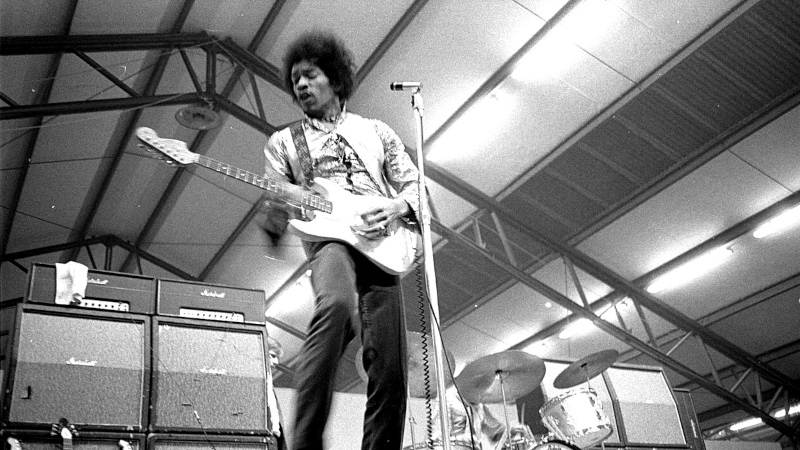
The guitarist Jimi Hendrix had a unique sound which has influenced countless musicians over the decades. He achieved it through mastery not only of his instrument, but of the complex feedback relationship between amplifier, environment, and guitar — coupled with a series of effects pedals including some then-unique ones made for him. Musical commentators have pored over his work for decades, but a recent piece in IEEE Spectrum is particularly interesting as it examines things from a technical perspective.
It centers around an electrical simulation of Hendrix’s effects chain, and makes an assertion that’s obvious on consideration but not the usual take on a Hendrix performance; that in his hands it became a wave synthesizer rather than the instrument itself. Certainly for anyone with an interest in analogue audio electronics as they pertain to musical synthesis it helps in placing the influence of the different circuits on the sound, and in hearing the familiar performances in a new light.
This isn’t the first time we’ve seen someone take a modelling approach to a guitar effects chain, indeed it’s obvious something missing from the work above is the guitar itself.
Header image: Gemeente Rotterdam (Stadsarchief) CC-0.












The photo in the article shows studio engineer/producer Eddie Kramer, Jimi (of course) and (apparently, after one google search) “studio manager Jim Marron” of Electric Lady Studio. Not, as is incorrectly stated underneath the photo in the article, Mitch Mitchel, Jimi Hendrix and Noel Redding of the Experience. Someone might want to let IEEE Spectrum know (can’t comment there without an account).
Yeah, I wasn’t sure about that pic in the OP too.
Fascinating analysis. I remember unsuccessfully experimenting with a similar pedal setup in my youth – should have looked for an electrical engineer to help. Love the use of a rectifier to produce the second harmonic.
But can it be done with MIDI?
Is this retorical question?
In a word No….
You do know midi isn’t just a static collection of instruments right? It’s a control system. So in a word, Yes, but it’s not a keyboard, you have to provide the sources.
Yes I am aware of that, however I don’t the expression or the complex tonal qualities would be accurately represented.
Still the best performance (Woodstock) of our national anthem I have ever heard.
The man was a musical genius, and departed this life far too soon.
Yes he was, and he credited Link Wray for some of his ideas.
Jimmy Page is a Link Wray fan as well.
Very much so on both counts.
https://en.wikipedia.org/wiki/27_Club
I get that it’s pioneering stuff and really awesome to anyone who’s hadn’t heard a guitar like that – but honestly it sounds like torturing a cat to death.
A lot of the early experimental stuff is kinda hit and miss.
At least he could sing without an Autotuner…..
In context, it was intentionally raw:
https://www.newyorker.com/culture/cultural-comment/rewinding-jimi-hendrixs-national-anthem#:~:text=Jimi's%20Woodstock%20anthem%20was%20both,experiment%20entirely%20worth%20fighting%20for
And that’s exactly what elevates it. Perfection is always less important than intent.
Yep, but it doesn’t carry over without the context.
Also a protest at the horrible waste of life in Vietnam…
You really missed the point, try just a bit harder.
There are perhaps better examples of the other point I was making. Take for example the classic “Popcorn” synthesizer tune as an example of pioneering music. There’s a compilation of the different versions over time:
https://www.youtube.com/watch?v=qTUM8gFyLqo
The 1972 Moog Quartet version (second in the video) sounds harsh, sloppy, it’s struggling to perform. It sounds more interesting than good. Then you have the hot butter version which sounds like it was played to a backing track of a fart cushion – this is the classic version that got famous. It was the first “machine music” that many people had ever heard.
Contrast that to the Klaus Wunderlich, V.Mescherin and the 1988 dance remix versions which are much better as music to listen to. By then, people had nailed the synths and the production down to the level that we had command over the end result.
Then we get to some techno stuff, and then finally Crazy Frog and Swedish Chef.
It’s as they say, the point of a dancing bear is not that it dances well, but that it dances at all.
Here’s a better recording of the 1972 version
https://www.youtube.com/watch?v=8bW1y6e8Cmg
You can hear the players struggling to turn the knobs and dials, mashing away at the keyboards trying desperately to stay in time with the drum machine and what had they.
The observation that guitar pedals and other outboard effects can be used as modular analog synthesis, and that analog synthesis can be used to treat incoming audio, is far from a new one. In fact, I have seen some articles on combining these with feedback through a mixer (especially one with sub-buses) to construct an ad hoc synthesis environment.
Very true. But to a non musician like me it suddenly made a lot of sense.
I remember having a lot of fun in the University Radio Hull studio back in the early ’90s playing with feedback loops using a Revox reel to reel tape recorder.
Before the invention of Python the thing I liked about Radio Shack was you could buy jack and plug adapters to hook up your tiny Casio keyboard (w/sampler!) to your guitar pedals.
Now I remember selling those. It was a cool time to have access to electronics.
I don’t need a stack of Marshals to get feedback I run a watt of the output into the putdown coil which is near the pickup which is a contact mic. That stops the magnetic feedback (squeal) so the strings do all the feedback. It’s self contained effects-amp-battery-speaker, slide only with volume pedal in the slide bar.
I’ve seen things very like this built into a number of custom guitars (even classical), and mandolins, exposed only as an additional volume adjustment.
Really wished this hackaday write up would have defined “wave synthesizer” since i’ve never heard that term before. Clicked through to the IEEE article and it expands on the term: “full-blown wave synthesizer.” I shouldn’t be surprised, the rest of the article is absurdly introductory as well. An octave pedal doubles the frequency! Saturation creates sustain! A wah-wah pedal can shape vowel sounds! Clipping creates upper harmonics and filtering removes them!
The only really sublime — though also very introductory — claim in the article is that you can’t replicate these performances with digital effects because the analog chain allowed an immediacy of feedback — both between the instrument and the performer and between the instrument and the speaker — that is essential to technical mastery. The reason i like to see that is that almost every music project on here serves mostly to demonstrate the limitations of a hacker who doesn’t understand this key fact about performance. Which only frustrates me because that depth of ignorance is where i myself was at 25 years ago.
Sorry to be so negative it’s just how i feel.
Not too be too contradictory, but of course digital feedback systems are possible, and it’s made easier by incorporating analog systems and concepts. What’s true is that most dusk systems simply aren’t designed for this due to the obvious cost differences in a fully sampled realtime system. That’s why you don’t see much equipment designed for it, and when it is there’s a massive premium.
It’s roughly like frequent arguments about high audio latency in Linux compared to windows, when what’s actually being compared is passthrough vs processed audio.
It’s almost like you don’t understand why certain audio devices were more popular for recording and sampling, because they had analog channels and low latency controls in hardware. That they were still often limited was again, cost.
I had an Octavia pedal like Hendrix’s & even by itself through a decent amp it’s close to his sound. One can add a few more effects, wah wah, distortion, compressor or others to vary effects in an analog chain. Ironically with digital modeling Roland has a small pedal with a wah rocker & 3 or so footswitches that among a few hundred presets has a few labeled Hendrix & Robin Trower that do an amazing recreation of the originals. Can run through a tiny amp like Orange’s entry level amp/speaker combo & you can get feedback & a very close to Hendrix sound.
Since mention was made re keyboards many synthesizers or samplers have guitar like sounds & these can go through effects pedals. There’s mixing or delay tricks one can do to play with feedback but modern synthesis & sampling has so many sounds available besides built in processing feedback itself is probably low on the interest.
Also these days most DAWs (computer digital recording) have loads of effects plug-ins to experiment with.
My early work was inspired by Hendrix and guitar controlled synthesizers were also a thing. My SoundCloud is AUiooo.
My first ever manager at my first ever job was an old man named Randy who started his career as a sound guy for festivals in the 60’s. Had a number of incredible stories about cobbling fixes together to make sure sets could go on, and really left an impression on a younger me. He’d be proud, I eventually found my way to fixing things for live entertainment as well.
Oh, and I know a lot of old men have stories about working with Jimi and Janet and the Stones. Randy had the stories, and the candid photos to prove them true. Loved watching him take those out when someone thought he was full of it.