
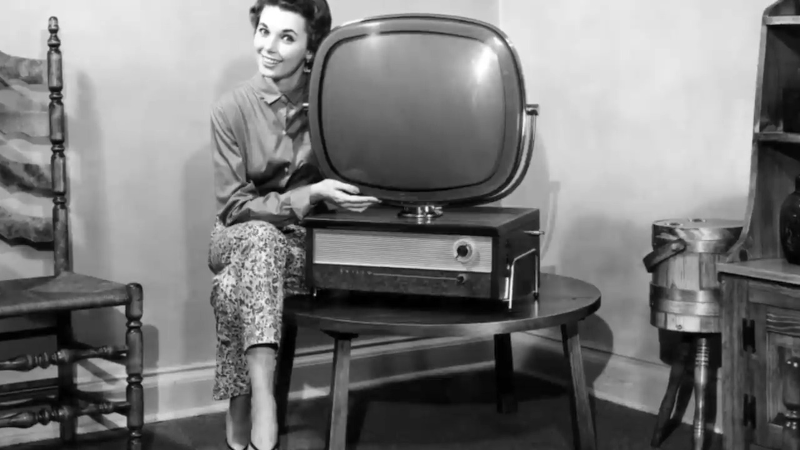
Philco was a common household brand for many years. The company started in 1892, making street lights. Then they pivoted to batteries. This was big business when early radios were all battery-operated. But in the 1920s, line-powered radios threatened to shrink their customer base, so they pivoted again. This time, they started making radios. So what happened? [The Last Shift] has the story, and you can see the video below.
Philco used advanced manufacturing techniques to make radios more affordable. By 1930, they were the number one radio maker in the world. After World War II, they moved into everything electric: mostly appliances, but also the new king of the electronics market, the television.
Philco faced much competition and wanted to stand out. The answer was the Predicta, a TV like no other at the time. It used an advanced semi-flat picture tube with a plastic coating. The 17-inch or 21-inch picture tube was detached from the TV itself. In one model, the tube sat on top of the TV with a swivel mount. In a pricier variant, the tube connected to the TV with a 25-foot cable. Who needs a remote control? Put the TV by your recliner and change channels while watching the screen across the room.
The physical design was unique and in demand. The problem was that the semi-flat tube was unreliable. It was also black-and-white in a time when color TV burst on the scene. They made the set from 1959 to 1960 and discontinued it due to lower demand and high warranty service costs. By 1962, Philco was bankrupt.
Ford (the motor company) bought the company and used it as a vehicle for defense work (including NASA) and car radios. By 1974, the company was sold again to GTE. The giant factory in Philadelphia was razed.
We know of at least one famous collector of Predictas. If you wanted real remote control, you could get a more conventional Philco Directa at about the same time. It used a mechanical ultrasonic remote similar to the Zenith Space Command system.












I’ve never heard of Philco, but I was curious, so I took the opportunity
and asked an LLM (GPT-4o mini) about which company was leader in 1930.
And it responded with Philco, indeed.
On my request, it also generated a rank list of the radio makers of the 1930s.
It seems that Telefunken was popular in Europe, but not worldwide. Interesting.
“Ranking of Popular Radio Makers in the 1930s
Philco: Dominated the U.S. market with innovative and affordable radios.
RCA (Radio Corporation of America): A major player in broadcasting and radio manufacturing; known for its high-quality products.
General Electric (GE): Produced a wide range of consumer electronics, including radios, benefiting from strong brand reputation.
Motorola: Gained recognition for its portable radios and played a key role in the development of radio technology.
Western Electric: Known for producing radio equipment for broadcasting and commercial applications.
Telefunken: A leader in Europe, celebrated for its high-quality and technologically advanced radios.
Zenith: Gained popularity in the late 1930s, known for its high-performance radios and innovative designs.
Atwater Kent: Focused on higher-end radios and was known for its quality craftsmanship.”
Normally, I would prefer to do such a research manually, but I’m not that familiar with the 1930s.
So I hope you don’t mind that I was using an LLM for generating that list here.
Was Google down again?
Here you go, for next time:
https://en.wikipedia.org/wiki/Philco
Hi, no it was there. But I was interested in how it compared to other manufacturers of the time, how it differed.
At first, I considered the idea of Philco being important being some sort of US defaultism.
But I had doubts, so I had asked the LLM a couple of questions.
Because searching through text material is one of the few actually useful applications of LLMs, I think.
As turns out, Philco indeed had some relevance in radio history.
That’s interesting, because I’ve never read about it in German/European radio books before.
Until LLMs lie to you. I’ve had multiple occasions of “lets try to see if the LLM can get some data from a datasheet for me”. And about 40% of the time is just made up stuff.
Sure, media competency is a thing. Critical thinking, too.
Back in school we were thaught to always check different sources and try to see things from different angles before forming an opinion.
In this case here, it’s non critical though. Even if there’s some misinformation, nobody gets hurt.
By turn of century, then-new Wikipedia was considered unreliable, too.
There were more trustworthy online sources such as Encyclopedia Britannica.
And of course, grandma’s encycploedia in the book shelf.
I still have such a thing. The Brockhaus, I think. Have to check..
Yeah, better to use LLM for knowledge only if you would have to ask a friend. And try to confirm it from a nother source, if possible.
LLMs are so 2020……
Books are the new LLM….
“You want a magic cube, son? They’re in the library. They’re called ‘books’.”
─ Joe Friday, Det.
The problem with pooping somewhere lies not in how you poop, but that you poop.
To apologize for how = Streisand Effect.
or That list was just what this article needed!
For reasons!
Can we ban this AI slop already?
we need you to hand in your brain ASAP
In the 1970s I created a remote control for my TV’s volume and channel.
It was a 6ft/2m wood moulding with a quarter quadrant cross section. The latter helped move the volume control slide pot.
But you forgot to file a patent!
a bicycle brake cable may have worked also, and been more mobile for a remote.
years ago philco made some terrible ac 230v light switches. they had aluminium contacts and as the switch arced would burn back until they no longer worked. you could bend the contacts closer and they would work for a little longer.
I currently use a philco branded electric kettle. it works as well as any other.
Philco had an RF remote control in 1939: https://philcoradio.com/repairbench/mystery/operation.htm
But if they wanted less complexity and cost they could’ve used a wired control.
Modern-day Philco is owned by Philips, so it is probably selling rebadged Philips stuffs.
Punny how it sounds now “Philco owned by Philips” : – ]
Years back scored Philco cassette radio boombox, looks made/sold in the late 1980s, must be one of these rebadged Philips kinds.
Philips gear was sold for years in the US as Magnavox to avoid any trademark claims by Philco.
Norelco was the workaround company used to market Philips products in the US. NORth-american ELectronics COmpany. They did this to not be confused with Philco’s similar spelt name. By that time they didn’t want to be identified with had become a shoddy brand when they made notable post-war German products.
The most notable of those products was the Norelco Carrycorder, the first cassette.
Remember the Norelco electric shaver commercials.
Those, too. Search amazon for Philco.
My parents created their remote in 1955, another in 1960, and a third in 1963.
Each one required a couple of years for growth and training. The last of the three remotes departed company with the TV and her parents in 1981.
LOL, indeed. For a while I was also the antenna rotor. I’d go out and turn the pipe the antenna was mounted to 90 degrees to pick up stations from one or the other larger cities nearby.
Congratulations, you invented the fing-longer.
I once saw one of those radios in an antique shop. I was drooling! Sadly, I had other things to spend my money on.
It’s sad that they went away. To think, one bad product brought down the whole company. I was surprised how many things they made. I suspect there were other issues at the corporate level at hand as well.
One of the biggest flaw I see to corporations is that the share holders always expect growth. Just a steady sure revenue stream is not enough. I’m nbot saying they shouldn’t innovate. Thet is crucial, but the need to branch out and make all things for the sake of growth is not sustainable. Sooner or later, you get too big to be able to shift when the market changes.
As for LLMs go, I see they can be handy for this and for that, but not for me. I’m tired of hearing of them being championed for every thing and the fact that there are some who feel compelled to whine about some one using one.
Stop using llm slop literally nobody thinks you are contributing to the conversation. Just stop it.
There were perfectly flat CRT’s found in (Nazi) Germany. I thought it was the world first, and certainly better than that Philco pincushion. German glass fab technology was advanced for the era, and there was some horror that TV would’ve been a powerful propaganda machine had it been widespread.
The Philco was also very dangerous with exposed CRT HV wiring and of course the mild implosion if the neck was bumped. Too cheap.
A flat, square screen needs a lot of deflection circuit compensation/trimming to keep it in focus at the corners. For black/white not too bad but crazy complex for colour CRT’s.
Regarding the ultrasonic remote control, I worked in a TV repair shop and saw quite a few.
A funny thing is jingling your keys would make enough ultrasound it would start the TV changing channels, motor turning the tuner. So that was the emergency remote control lol.
As would jingling dog tags, random logging trucks with dangling chains, glass breaking, all kinds of things. It wasn’t uncommon to find your ultrasonic remote set turning itself on in the middle of the night. Fortunately most had a disabling switch on the set.
I remember well my high school (’69) electronics teacher’s rant on this TV, like the smeared video thru that long cable and things about Philco in general first year in that school. Senior year in a different school they had donations for a flea market and one non working TV for me to look at if it was easy to fix, otherwise I could have it. It wasn’t, too many bugs. I knew the different ways tube stuff was made back then. Those guts were crap and I threw the chassis out but saved the cabinet and swiveling picture tube just like the one in the photo, I still have it in storage. I thought then of driving the deflection coils and tube with a Zenith or RCA chassis, anything better than Philco’s sand-baked resistors and funky tubes.
Now the CRT was still good but I know of their poor life, so now I could use a small projector inside, better than one I saw in a shop window where a flat panel was stuffed into a Predicta.
This puts me in mind of a particularly execrable Apple product, the difference being I like the Phillips item.
Philco was very popular during the radio era because they were affordable. They made some nice looking radios. A particular 1939 console radio was featured in a Mr Wong movie. The radio had a “Mystery remote” without wires. It was a very simple tuned circuit that ouput pulses below the AM BCB, using a phone type dial. I repaired such a radio years ago.
As for TV remotes, Zenith called their ultrasonic remote “Space Command”. We had a Zenith color TV console back in the 1960’s. I think the tube was 19 inch. At the time, my father worked in a TV repair shop, so probably got it by paying over time. He kept that TV working for many, many years. The remote stopped working early on, though.
Sadly, brands like Zenith, RCA, Westinghouse, etc. are now just a name that is licensed to place on cheap consumer electronics.