
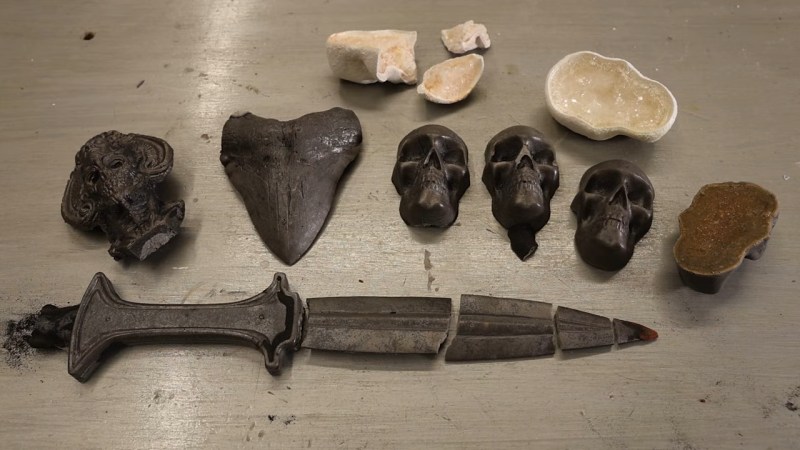
Sodium Chloride has a melting point of 801 C (1,474 F), putting it comfortably between commonly-cast materials like aluminum and bronze. Which led to [Robinson Foundry] asking the question: can you cast salt like a metal? The answer, surprisingly, was yes!
[Robinson] tries casting the salt with two different methods: like it was glass, and like it was metal. In the glass-like casting, he packs a ceramic mold with salt and tosses it into an electric kiln, there to melt and very slowly cool. In metal-like casting, he just tosses salt into a crucible and melts it in the same beer-can kiln we saw when we featured his lost-pla casting a while back. The molten salt is poured very carefully into sand casting molds. If you’re familiar with the technique, you can skip to about 5:20 when he does the reveal.
As it turns out, the sand casting works out much better. While the glass-style casting in the electric kiln grew much larger crystals and so is more translucent, it’s also stuck completely inside the porous ceramic. Perhaps the ceramic would need glazed to pull off that technique?
On the other hand, the sand reacts with the salt in some way– molten salt isn’t exactly a noble gas, after all–to create a lovely gunmetal finish to the parts. They almost look like metal, though the brittleness gives away the game when he opens the mold to show a dagger in several pieces. For the decorative busts and megalodon teeth in the test, though, it is a great success.
Now, we’re not going to say this video came about because of high metal prices, or comment on what sort of trade policies might be driving up the price of metals like aluminum in the USA, but we do think this a great hack. While salt-based castings are obviously going to have very different physical properties than metal, for decorative work, it creates a lovely finish out of a material that’s cheap as dirt. Hopefully he comes back to the glass-style casting; we would not want to trust that black coating around food, and a salt crystal salt shaker sounds too good to pass up.
The only times we’ve seen molten salt around here is in nuclear reactors, and in homemade batteries, though that first one obviously wasn’t table salt.












Hmm very cool. Although I’m not sure about the material properties of a casted salt part, I am quite intrigued in its ability to make inexpensive single use moulds for something like aluminium or tin or bronze.
On a second thought…I don’t see much of a point. I guess smaller grain size than sand casting, so better feature size/resolution? Wax casting still wins in this aspect though
FWIW a eutectic mixture of one mole each of KCl and NaCl will have a slightly lower melting point, 657C or 1214F, making it slightly easier to melt. I suspect the mix would be somewhat hygroscopic, though.
I saw this vid a few days ago.
Anyone have any guesses as to the “gunmetal grey” surface color?
It’d be interesting to take a conductivity measurement on that surface, just to see if there’s anything interesting there…
One of the comments on the video suggested the salt was contaminated with carbon from the crucible.
Carbonized oil from the sand.
Yeah, exactly this. If he’d used greensand he would have had an entirely different look. Or refractory.
One thing to bear in mind, molten salt explosions are pretty dangerous.
Hence cool.
Very very cool.
Not sure about molten salt X YouTube home foundry hobbyists.
Seen some horrible safety practices.
Blue jeans, sneakers, backward baseball cap, welding gloves and safety squints…
Toddlers wandering into shot…
While they were pouring aluminum…
Over concrete and under roof eaves, that kind of thing.
They left it in the video…’Only had one shot of the pour’
Truth: Couldn’t help but root for Darwin (preferably mold spits metal right in their ‘nads), even though I knew THAT wouldn’t have gotten posted.
Alternatively, the unused video of his wife kicking his ass up around his neck.
Remote detonate your molten salt explosions hackers!
What is wrong with over concrete?
“Now, we’re not going to say this video came about because of high metal prices, or comment on what sort of trade policies might be driving up the price of metals like aluminum in the USA, but….”
Then why even imply a connection? Do you bake with flour because “trade policies” have rendered sawdust too expensive? Or because a cupcake made with flour will have different properties than one baked with wood?
There are plenty of other websites that will serve up political BS in whatever flavor/quantity suits you.
I come here for hacks and tech info.
Sorry that reality is too intrusive for you.
You needn’t apologize, but you might consider checking historical aluminum price records. Even the recent spike is well below its 2022 peak when other “trade policies” were in action. Prices are heading down , and as domestic production gears back up, prices will continue to fall.
As for “hacker” casting projects, specifically, there is no end to scrap available for melting… including soda cans that litter the roadside. Busted lawn furniture and old lawnmower engines are another rich source of aluminum.
Again, none of this has anything to do with casting molten salt, which was my original point.
Unfortunately the majority of bauxite is imported. But secondary production (recycling) is where the bulk comes from. Takes a lot of electricity though, and guess who they’re competing with?
Absolutely seething, lmao
HaD has fallen into the trap that their policial side is the only side with smart people. So they can’t even imagine there are others that would read the site. “They’re too smart for those luddites”. In reality, most of them are so incredibly lazy when it comes to political topics, they sit in their echo chambers and just say (concept) sucks. No depth. No discussion, becuase if someone asks “why”, a simple easy question, its far easier to call them a slur that the ludicrous “Horseshoe theory” calls “the right” (Horseshoe theory ONLY works when you pretend that libertarians and capitalists don’t exist, and there is only the upper left quadrant of the political spectrum – as “scholars” did to distance themselves from similar ideologies.) To argue with horseshoe theory, using the common slur they use is to express ones own intellectual laziness when it comes to politics. And yeah, a 5 minute google search that agrees with everything you think is still laziness. Instead, try this – how are those deregulating – limiting the SCOPE AND POWER of government – your chosen slur? (Hint: They aren’t, horseshoe thory is horse….manuer theory.)
Glazing the ceramic molds probably wouldn’t help here. Sodium is a great ceramic flux.
An alumina wash on silicon carbide molds might work. Salt-fire kilns use silicon carbide shelves with a protective alumina wash to withstand the vapors and to ease cleanup.
Concrete has a lot of water in it. I had a mold float because of insufficient weight on it and the big blurp of aluminum that flowed out onto the concrete then blew up into my face along with a conic section of concrete maybe 5mm deep at the most. I was sure glad I was wearing a face shield.
Pour over sand or dirt.
Moisture. Concrete in contact with the ground is almost always damp, and molten metal spilling over is likely to get a steam explosion, which throws the metal everywhere.