
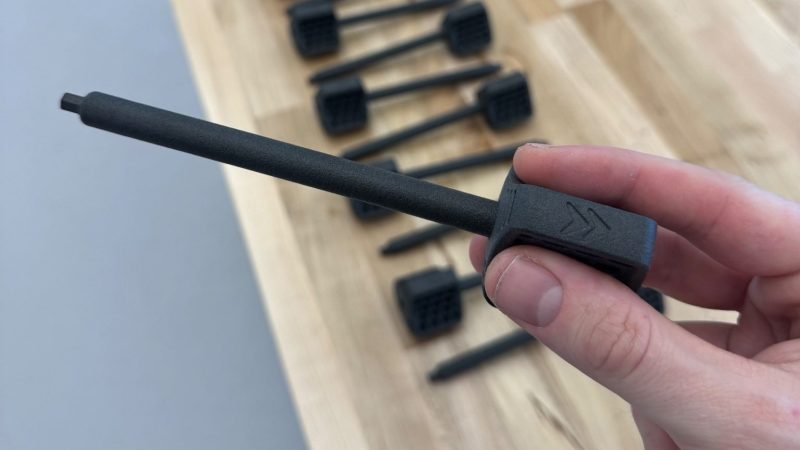
MRI machines come with a variety of safety warnings. Perhaps most importantly, you have to be very careful not to take ferrous metal objects anywhere near them, since strong magnetic fields can send them flying, causing damage and injuries. To that end, you might find yourself in need of magnetically-safe tools when working on such machines. [Sam Schmitz] recently whipped up a nifty example of an MRI-safe torque wrench himself.
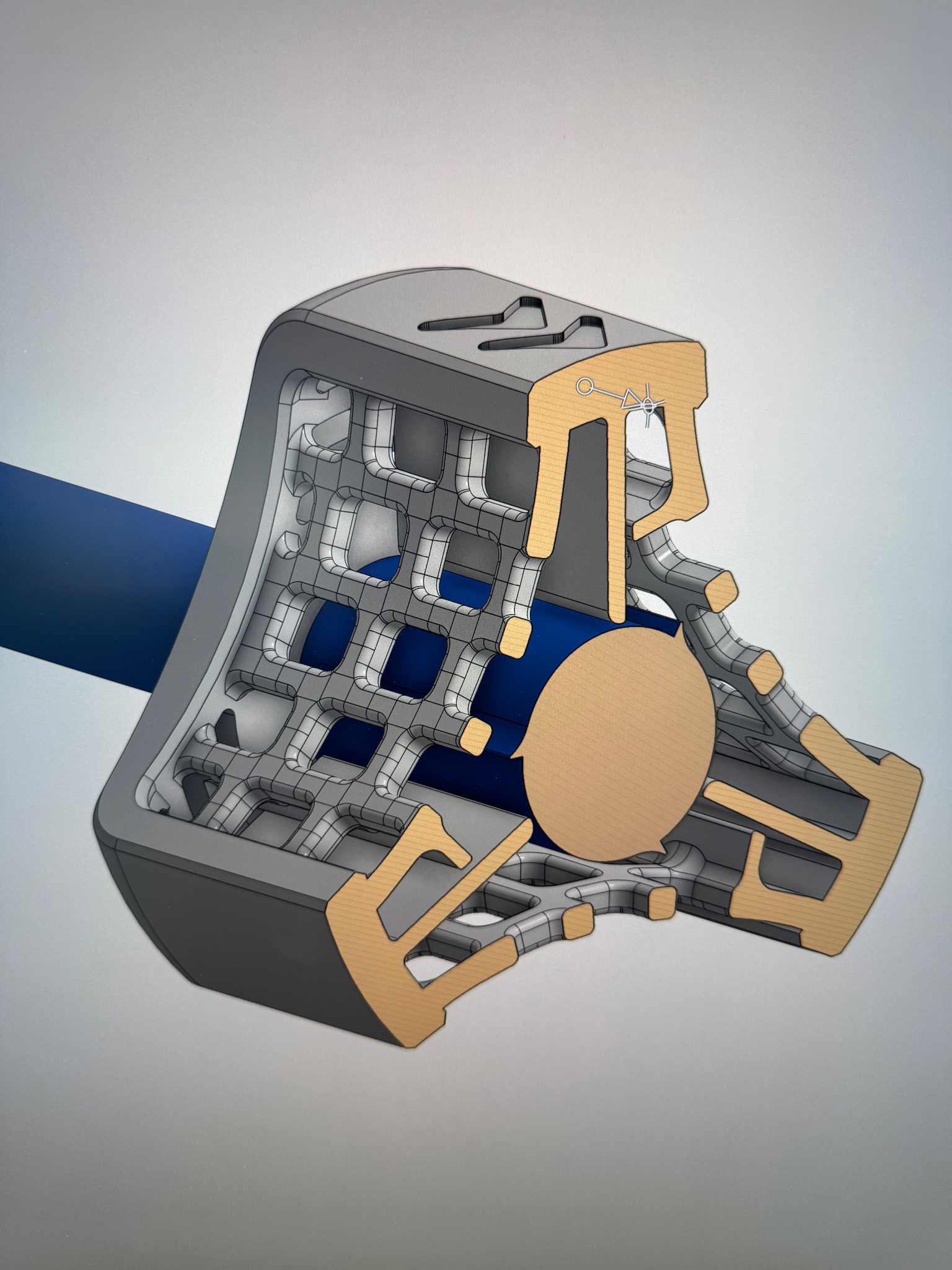
It’s a 3D printed design which can be produced on a Formlabs Fuse 1+ as a single piece in nylon using a selective laser sintering process. The torque wrench works in a deceptively simple manner. As the handle is rotated, a flap mates with the flat side of a fin on the shaft. This allows the shaft to turn. However, apply more than 0.6 Nm of torque, and the fin will eventually give in, snapping over the lip and stopping any further rotation that would over-tighten the fastener. [Sam] suggests these printed torque wrenches largely come out to the correct torque spec when printed, and can survive a thousand cycles or more while remaining in a usable spec.
The wrench does have one drawback though—it is apparently painfully loud to use. When the handle snaps past the detent, the “click” is quite piercing. [Sam] has measured the sound at up to 125 dB. Not exactly the best when it comes to ear safety!
If you work on MRI machines regularly, you already have the tooling to do your job. However, it’s neat to see that such a specialized tool can be easily and reliably 3D printed… with the slight drawback that you need a $60,000 SLS printer to do it. SLS isn’t readily available at the DIY level just yet, but it is slowly getting there. We’re waiting with bated breath.












Surely the torque characteristics can be replicated on a less expensive SLA printer with enough trial and error? Maybe even an FDM printer?
My thought exactly. Nylon in a FDM printer sounds most reasonable.
But I’d really like a resin that will work for this in a SLA printer. I’m very disappointed in the mechanical properties of the inexpensive (<$100/L) resins on the market. Only when you get to the specialty stuff north of $300/L do you get really nice materials.
Risking being too obvious, you don’t need to own the printer to get parts made on it.
And that price is peanuts to the price of having an MRI machine ;-)
Of the order of $150,000 – I assume most of us would have to club together in some sort of a syndicate to cover purchase and upkeep costs.
https://www.oncologysystems.com/resources/mri-system-guides/used-mri-machine-price/
Yes – JLC3DP and PCBWay both offer very convenient access to various 3D printing techs. There are others, but they typically charge enough more that the Chinese are still more cost effective even with the added cost of shipping.
See my review of services here: https://saccade.com/blog/2019/12/fit-testing-block/
Another risky obvious would be to suggest 3D printing an MRI device .
I like the design, and expect the issues like the sound can just be designed around. I don’t really get why this post focusses on the cost, though. A similar version can be designed to be printable with a hobby FFF printer, and getting stuff made in general isn’t all too expensive.
I just realized I need to print some of these for SMA connectors, for 50 N-cm (5 in-lbs).
Granted this is an elegant design, but 3d printed nylon and design a deflecting torque wrench would be more versatile.
This still requires a swept motion, looks like 30deg vs say a 5deg ratchet, hence a deflecting wrench would be no different.
It’s impressive, but a simple bend a lever torque wrench would be easy to make.
A 0.6 Newton meter wrench sounds like something you could make from popsicle sticks.
Still it’s an impressive design. Maybe it should be a musical instrument?
Of course the click is loud, he has literally given it a soundboard to smack into.8