
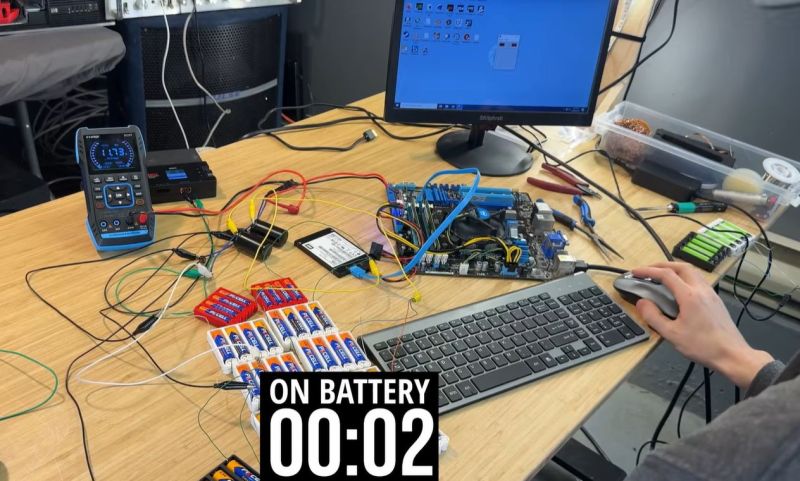
Everyone is probably familiar with the concept of battery-powered devices, but generally, this involves a laptop with a beefy battery pack and hardware optimized for low power draw. You could also do the complete opposite and try to run a desktop PC off alkaline AA cells, as [ScuffedBits] recently did out of morbid curiosity. Exactly how many alkaline cells does it take to run a desktop PC for any reasonable amount of time?
One nice thing about using batteries with a desktop PC is that you can ditch the entire AC-DC power conversion step and instead use a DC-DC adapter like the well-known PicoATX and its many clones. These just take in 12 VDC and tend to have a fairly wide input voltage range, which is useful when your batteries begin to run out of juice. In this case, just above 10 VDC seemed to be the cut-off point for the used DC-DC adapter.
In the end, [ScuffedBits] used what looks like 56 alkaline AA cells connected in both parallel and series, along with two series-connected 6,800 µF, 40V electrolytic capacitors to buffer the spikes in power demand, after early experiments showed that the cells just cannot provide power that quickly. Although admittedly, the initial thin wiring didn’t help either. With alkaline rather than carbon AA cells, improved wiring, and some buffer capacitors, it turns out that you can indeed run a desktop PC off AA cells, if only just about long enough for a small game of Minesweeper.
Amusingly, the small LCD monitor used in the experiment drew so little power that it happily ran on eight NiMH cells for much longer, highlighting just how important power conservation is for battery-powered devices. We wonder if you could marry this project to a battery project we saw and end up with something practically portable?












Hahaha. Ridiculous. I love it.
the most interesting are these 3d printed cell holders, nice one. fun experiment!
https://www.thingiverse.com/thing:456900
( There’s also a remix for putting the batteries in series too)
You could have just put 70- 80 AAs in series and gone straight into the AC input for a quick experiment like this, as the first thing a mains PSU does is rectify the AC to DC. The polarity wouldn’t even matter. If it’s a PSU with 110/220 switch th n be sure to set it to 110 (and back after!)
This could have been a calculation on a napkin.
Not worth clicking on the video.
True, but I watched it nevertheless. If he would have used a single car battery, he would’ve been able to run the computer for quite some time, and without much additional jank.
mATX motherboards and their power requirements etc are really quite clear. Its easily possible for an individual to make a battery pack, along with a DC-DC converter to make a desktop motherboard portable.
Yeah! That guy should keep his head down and stay in his lane! How dare he besmirch your expected experience on a hacker forum with his blatant inefficiency! I am duly incensed for you!
I say we all draft strongly worded letters and imagine to ourselves what would happen if we actually sent them. That’ll show him (and save on postage)!
I think he missed out…..
He could have applied for and received a multi million dolor grant from a certain western government to study running computers off alternative power.
After all someone got a grant to study Shrimp on a Treadmill.
https://www.reuters.com/fact-check/shrimp-treadmill-study-cost-misrepresented-2025-02-21/
Still a great article.
Thanks HAD
It’s simply the Betteridge’s law of headlines in action.
Any youtube video in the format of “How many Y does it take to do X?” can be answered by the word “No”.
So this begs the question……
How Many Lemons does it take to play DOOM on a Pentium laptop?
Next time use a higher voltage battery string and a DC to DC converter to step it down to 12 volts. Alkaline batteries drop to around 1.2V pretty quickly under load. Even though the battery was dropping below 10 volts, it still had lots of capacity left.
The computer wants a regulated 12 volt supply. I’m surprised it kept running at such a low voltage.
Nothing in modern computer runs at 12V (harddrives was last thing, SSDs run internally at 3.3V), very little if anything runs at 5V, most things run at 3.3V and lower. The most power hungry part is CPU and it consumes most power from VCORE supply – that is, depending on type of CPU, typically from 1.2V to 1.5V.
12V is used so that the cables from power supply and traces from connector to VRM doesn’t have to be that thick. Its is possible that somethings has cutoff at 10 or so volts to prevent operating from unstable / faulty power supply.
It should have a meter that shows Dollars/GHz-Hour
Pedantic note about discrete gpus in a time of 2500w bioses and rampant melting/burning connectors for power.
With respect to cpu being the biggest load, and “modern computer”.
Beyond that, yep correct.
The standard voltages are those found on the ATX and Molex connector. :)
How these are being converted on motherboard or in drives is a different matter, of course.
cant help but wonder how well this might work with a buck boost converter between the batteries and the main board. slightly less efficient, yes, however so many Jules left in the batteries even at the reduced voltage.
is my napkin math right? looks like the load was 28w at idle, rough calculation batteries were at 70% capacity under that load of ~0.4A per parallel block. add a few more in parallel and you might get close to using most of the potential 1800-2500mah in each cell. with their 8s7p configuration max 175Wh capacity, buck boost with 60% efficiency, is still over 3 hours run time. did i miss something?
okay might gett an old i3 out of storage to test
AA batteries can sustain roughly 1 Watt for 1 hour with 70-80% internal efficiency. After that you have to reduce current to get the rest of the capacity out. They get pretty hot if you do that, too.