
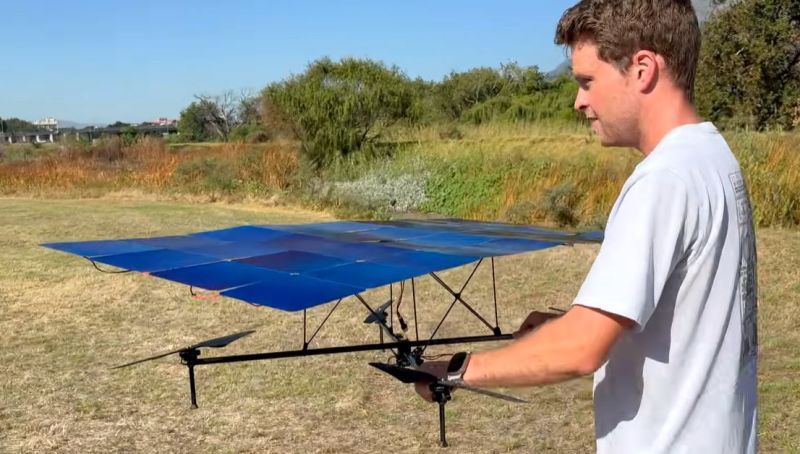
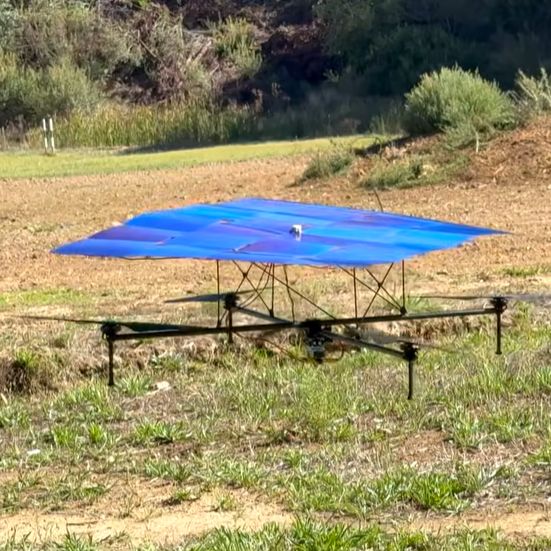
The dream of fully powering everything from aircraft to cars on just the power generated from solar panels attached to the machine remains a tempting one, but always seems to require some serious engineering including putting the machine on a crash diet. The quadcopter that [Luke Maximo Bell] tried to fly off just solar power is a good case in point, as the first attempt crashed after three minutes and wrecked its solar panels. Now he’s back with a second attempt that ought to stay airborne for as long as the sun is shining.
Among the flaws with the first prototype were poor support for the very thin and fragile PV panels, requiring much better support on the carbon fiber frame of the drone. To support the very large solar array, the first drone’s arms were made to be very long, but this interfered with maneuvering, so the second version got trimmed down and the array raised above the frame. This saved 70 grams of weight from the shortened tubs, which could then be added to the new panel supports.
After an initial test flight resulted in a crash when the PV output dropped, the need for a small battery buffer was clear, so this was added, along with a reduction of the array to 4×7 panels to get the same 20V as the battery. The array also had to be reinforced, as the thin array was very wobbly in addition to making it impossible to fly with any significant wind.
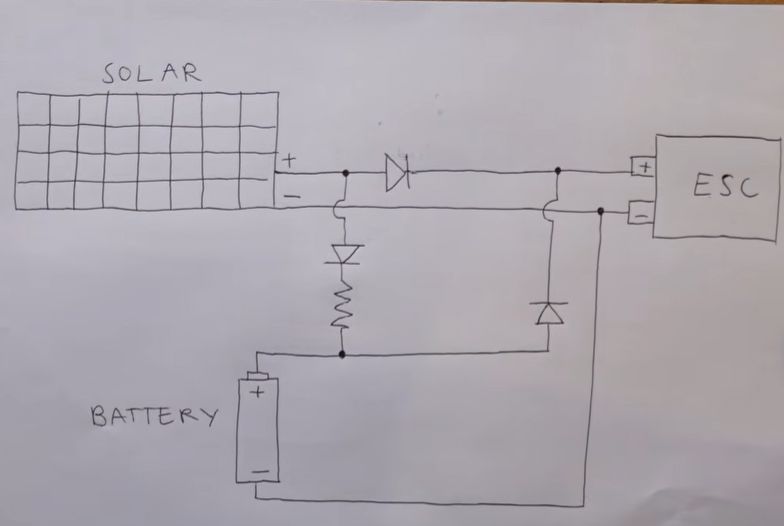
During the subsequent five hours long test flight it was clear that the resulting PV-powered drone was at the limits of its performance, with even some mild cloud cover forcing the battery to provide backup power.
For the test location a tree-sheltered site far away from windy Cape Town was also selected to provide the best possible shot, as keeping position with this drone was very hard. With the low weight and the big surface area of the solar panel array catching any little bit of wind, the GPS-based position keeping was essential. Unfortunately a few hours into the test this feature failed.
Manual position keeping is definitely possible, but [Luke] had to constantly counteract the drone wanting to drift off somewhere else. Ultimately the test flight ended when it was still very much a sunny South African summer’s day, due to the current provided by the array no longer keeping up with the power demands of the motors.
What this perhaps demonstrates best is that if you want to use PV solar power for your flying drone – especially with a significant payload – it’s probably best to use it for recharging while idle, or to extend the battery life by an appreciable amount. That said, props to [Luke] for persevering and making it work in the end.












In before the inevitable comments griping about how this project is presented in a YouTube video instead of punchcards, smoke signals, or passed down orally through the generations.
you forgot the mandatory arduino, raspberry pi and 555…
now get off my lawn!
Ne555. Add a helium balloon
I wonder if it’s not possible to build the solar panel as a curved wing-like structure that an be pointed into the wind, taking some lift from the air current.
Yes, a wing-like structure but on in one dimension or… across a single plane. The improved aerodynamics of tilting the propeller to be inline with this plane would thrust it in the direction of air currents which could lift it up. Who knows, maybe someone will take this air and plane idea and do something with it but probably not.
Then you’d be left wondering how much of your endurance is due to the panels’ aerodynamics.
Of course, solar powered planes incorporate the cells into the airfoil.
Why not make the entire thing a rotary airfoil covered in solar panels, powered by tip props?
These types of projects are interesting but I’d like to see them explore using model planes and attempting to use the techniques birds use to stay aloft over their incredibly long flights.
It would be so cool to see a plane using an updraft to gain height and mostly gliding while recharging.
Just use a buoyant semi-rigid bag to support the PV array. Basically a drone under a solar blimp.
I can imagine a use case like gathering weather data at some altitude, or surveiling. So it’s ideal for it to stay aloft, but when needed it lands in a safe, recharging spot. Maybe on a secure roof, or on top of a pole? It would need to sense low power.
I am extremely surprised that the top-heavy version did better. I would think that increases the power needed to constantly stay balanced.
My first instinct would have been to have a flat plane of panels with empty cells where you want a rotor.
Or to carry the panels a fair distance below the copter, like a helicopter “sling load”. That way the extra weight is stabilizing.
Put the panels inside the bag! Can they deal with being insulated and getting super hot? If you use a metalized lower half of the envelope, you can also illuminate the backside of the panel, perhaps eking out extra power there too.
I’m impressed that this worked at all.
Graduations on your successful flight ..History being made on this day ..
It doesn’t work that way.
https://en.wikipedia.org/wiki/Rocket#Pendulum_rocket_fallacy
If they are attached by a rope that would no longer apply.
Also my gut says that with how quadcopters alter their thrust vector it would still not apply.
There’s the fscking comment system acting up again.
That was a reply to [D]
See also, Solar Hyperblimp:
https://youtu.be/0VBTKEPAzvA
https://hyperblimp.com/
Hang the panel underneath vertically and use active orientation for maximum power. Use a panel that can be back illuminated.
In https://hackaday.com/2026/02/18/creating-the-worlds-most-efficient-quadcopter-drone/ it was mentioned that due to lift effects, a horizontally moving drone is actially a lot more efficient than a stationary one, so the idea certainly has merits.
I work in public transit with the planning of electric buses and people often ask why we don’t put solar panels on the roof. In an ideal situation, they can provide about 1.5% of the power requirement of a bus, but the roof surface is needed for other things as well so ultimately it is not very useful.
There are aome buses that do have them as every bit helps.
Your opinion about Aptera car ?
One interesting thing to remember, available solar energy increase by the square of the scale of the aircraft. Mass increases with the cube of that scale. So W/kg is inversely proportional to the size scale.
Batteries on the other hand scale with the cube of the scale. So does fuel, for example a tank of gasoline, as does an engine.
What that means is, there’s no intrinsic advantage or disadvantage if you half the size or double it when using batteries or an engine with fuel. On the other hand, if your using solar, if you double the scale, you have the W/kg of the vehicle. If you half the scale. You double it. While that may not hold exactly in the real world. For example, if you made a model car 1/50th scale, it would be made out of steel foil and be difficult to handle. You might crush it just by touching it. Still, it should be obvious that if you were to plot W/kg vs scale for fuel and for solar, there’s going to be some point where solar actually wins the day. I don’t know what size that is but it would be interesting to work it out.
+1 ….. and fill the bag with helium.
+1 ….. and fill the bag with helium.
Then a plain (hot-air) blimp would seem the solution, you can use solar power to power propellers to move it around and perhaps use selective electrically controlled shielding of incoming sunlight to control buoyancy/altitude so you don’t waste much energy controlling that aspect.
This also makes me wonder if its CO² that is the secret ingredient in hot-air balloons, seeing they always fill it with gas burners so you would think it’s not regular air that’s inside them but has much more CO², and if it is does that mean it retains heat much better? and would get heated by the sun too?
But all that does not answer the question if you can keep a quadcopter afloat with solar power, which seems to be what this is all about.
So wait, now all the replies are just separate posts?
testing.
Might flying semicircular flight paterns allow the panels to point directly at the sun about a third of the time?
If each solar panel was attached to thin-film sealed bag, might you get more rigidity, better aerodynamic shape & the trapped solar planel heat might give the bag neutral weight?
RC gliders do this all the time.
This was intended to be in reply to the comment ” I’d like to see them explore using model planes “
seems like somebody did this before, on mars.
What about having the PV array as a disk within a carbon fibre loop suspended under the drone? The loop could hold the shape etc (like a bubble film) and it could hang on lightweight fibres.
A very impressive project. Well done. There are several fixed wing solar drones on YouTube, all needed a small battery for the same reason. Would be cool to see you develop a better one.