
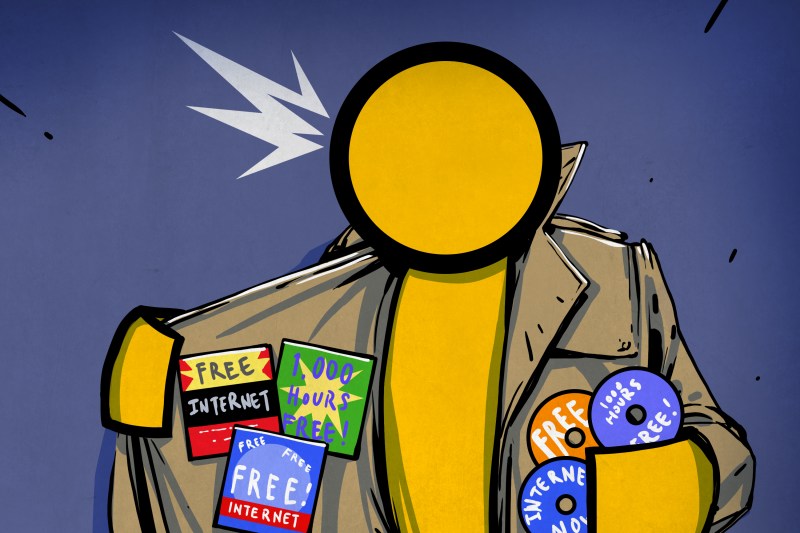
In the early days of the Internet, having a high-speed IP connection in your home or even a small business was, if not impossible, certainly a rarity. Connecting to a computer in those days required you to use your phone. Early modems used acoustic couplers, but by the time most people started trying to connect, modems that plugged into your phone jack were the norm.
The problem was: whose computer did you call? There were commercial dial-up services like DIALOG that offered very expensive services, such as database searches via modem. That could be expensive. You had a fee for the phone. Then you might have a per-minute charge for the phone call, especially if the computer was in another city. Then you had to pay the service provider, which could be very expensive.
Even before the consumer Internet, this wasn’t workable. Tymnet and Telenet were two services that had the answer. They maintained banks of modems practically everywhere. You dialed a local number, which was probably a “free” call included in your monthly bill, and then used a simple command to connect to a remote computer of your choice. There were other competitors, including CompuServe, which would become a major force in the fledgling consumer market.
While some local internet service providers (ISPs) had their own modem banks, when you saw the rise of national ISPs, they were riding on one of several nationwide modem systems and paying by the minute for the privilege. Eventually, some ISPs reached the scale that made dedicated modem banks worthwhile. This made it easier to offer flat-rate pricing, and the presumed likelihood of everyone dialing in at once made it possible to oversubscribe any given number of modems.
The Cost
Once consumer services like CompuServe, The Source, and AOL started operations, the cost was less, but still not inexpensive. Some early services charged higher rates during business hours, for example. There was also the cost of a phone line, and if you didn’t want to tie up your home phone, you needed a second line dedicated to the modem. It all added up.
By the late 1990s, a dial-up provider might cost you $25 a month or less, not counting your phone line. That’s about $60 in today’s money, just for reference. But the Internet was also booming as a place to sell advertising.
Mad Men
Today, a few large companies dominate online advertising. However, in 1990, the field was crowded, and everyone was rushing to find a way to effectively advertise to Internet users.
A company called FreeInet thought it had the answer. Give people free dial-up service and make them watch ads to generate revenue. NetZero bought the company in 1998 and helped it grow explosively. You could argue that FreeInet was the first successful free dial-up company.
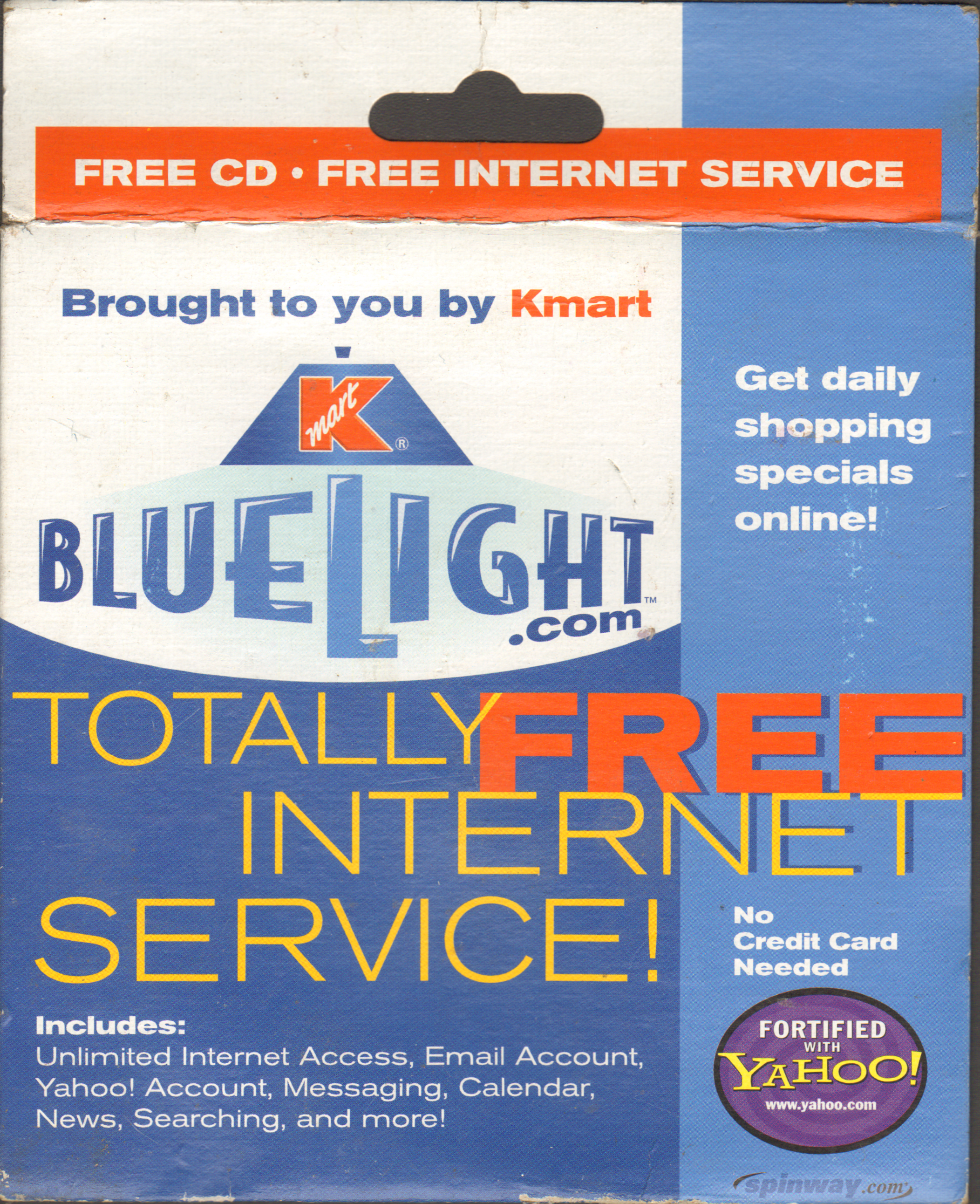
There were other companies in the space, too, such as Juno (which started out offering only e-mail) and BlueLight, which was run by retailer K-Mart, hoping that people would use their free Internet access to shop at K-Mart (spoiler: they didn’t). K-Mart actually cobranded with a free ISP called Spinway, and it was widely reported that people who used the service were not more likely to buy from K-Mart. Instead, they went where everyone went: chat rooms, music download sites, and, of course, adult sites.
But the free market was mostly NetZero and Juno. NetZero even advertised on TV, as you can see below. NetZero even had a patent. They sued Juno over that patent, although the two companies would eventually merge.
At least the ad wasn’t as suggestive as the one we remember from Juno.
Of course, this is all in the US. In the UK, where, at the time, there were no free local calls, Freeserve became a big player in free Internet access in conjunction with a major British electronics retailer.
The Product
Some free providers showed ads in a window or otherwise inserted them into your browsing experience. They could gather demographic data on where and how you were browsing, and that was also a viable product. If nothing else, if you were at a car website, the service could show you ads for cars, for example, and either charge the advertiser more or, at least, expect a better result.
There were other earlier schemes like Bigger.net, which promised lifetime access for $59. What could go wrong? There were limited tests of ad-supported access, and even a company that wanted to give you network access bundled with long-distance service. That lasted a month.
Of course, there were hacks. You could move the ad window off-screen, for example. There were programs that would keep the connection alive since most would time out rather quickly.
While Internet ad rates were artificially high, the concept made sense. At the time, people were trying to map traditional print ads’ costs to the Internet. Not only was this too high, but it also overlooks the fact that the Internet is perfect for paying on performance. Just showing an ad to 1,000 people (some of whom have it blocked, anyway) isn’t worth much. You want clicks or, even better, conversions.
But the dot-com crash around 2000, along with a glut of online advertising venues, saw a collapse of the ad market. Even K-Mart started offering a limited amount of free service with a cheap plan if you needed more or wanted extra features. United Online, the fusion of NetZero and Juno, also switched to a “freemium” model.
Enter Broadband
The death knell of dial-up ISPs, including the free ones, came as broadband penetrated more and more households. Why tie up a phone line and dial up at 56K when you could have a connection “always on” and with speeds at least 20 times higher? Apparently, NetZero didn’t get the message, judging by the ad below.
NetZero does still exist, or at least, they have a home page. We couldn’t get any of the links to work.
However, these innovative free ISPs were trailblazers on ad-supported Internet services. They were also among the first to adopt freemium pricing. Even more, we suspect it drove more people towards the Internet. Everyone loves something for free, and while you might not want to pay AOL $22 a month just to see if you would like being online, you certainly would grab a free CD and get online.
Dial-up still hangs on, though. Even AOL offered it until recently.











By the mid 90’s my friend had saved up so many ISP promo 3.5″ floppies that he used them as spacers when laying down ceramic floor tile in the kitchen.
Amiga and Atari users probably did same, maybe used them as frisbees or used them as blank disks. ;)
Because what else? Software wise they were pretty useless to them in absence of any software support by ISPs and online services.
I forgot mentioning Acorn and MSX2 users! Sorry about that! 😅
At least PC GEOS had gotten an AOL client on floppy!
https://www.atlasobscura.com/articles/the-history-of-geoworks-microsoft-windows-upstart-90s-competitor
I would tape over the write protect hole and reuse them. They were lower capacity disks. I think they were 720k, but they were free so why not.
The local provider, Freeserve used to literally shower you with CDs. I found a use for them though. Bird scarers on the allotment!
https://thumbs.dreamstime.com/z/old-compact-disc-bird-scarers-unwanted-cd-s-used-to-keep-birds-away-young-crops-116338866.jpg
Ad revenue is one profit revenue, the mandatory “service fee” that’s added to the advertised price AFTER the fact is another one, albeit, smaller one – and this is on the top of the tax-sponsored critical infrastructure maintenance “fees” just given to the telcos without asking where exactly they go. While some are clearly spent maintaining the infrastructure, the other ones go to the CEO salaries, stock buybacks, etc.
Funny has it – 1 – the price of average (not high-speed) internet connection has gone down almost 300-fold since then; if one is to resurrect slow-mo dialup it would be close to free, since it is now all 100% voice-over-IP, so in very real sense it is already accessing the interwebs without costly analog equipment – 2 – SkyNet showed that there is a way around (I believe satellite interwebs are called 6G, and few countries like China already go full-speed ahead) – 3 – have we (the US) not been hiding under the rock R&D-wise we’d be investing into 7G (quantum entanglement) that won’t even need satellites, as theoretically one can connect to the endpoint right through Earth – and if that 7G materializes I am opting to subscribe to the Internet providers in South Korea or Japan, or any other country that ignores artificially created “regulations”, say, New Zealand.
I was a little late to the real dial-up phase – got started on ISDN – but I did use one of those free AOL 600h(?) CD offerings once to test if it were possible to establish two separate PPPoE connections through a single ADSL modem (over a single ADSL line) to two different ISPs.
Worked fine – just threw in a hub(didn’t have a spare switch back then) between the existing router and the DSL modem to connect a second router.
Never found a good use for all the other AOL CDs. :-/
I’ve used the trial CDs for everything from testing drive loading mechanisms during repair to shimming wobbly tables.
They make for colorful clocks, I guess?
Using an Windows 95 CD all the time gets boring, eventually. :)
(To the young: I mean using CDs for the clock face of an analog clock.)
Where I live in rural UK we got tone dialing very late in the day. Pulse dialing Compuserve was not a pleasant (or cheap) experience!
As the article mentions, there were no free local calls in the UK. Early ISPs usually used an 0845-xxx-xxxx non-geographical telephone number, which had revenue share on the calls (e.g. 50% to the carrier (usually BT) and 50% to the ISP). Even at 1p a minute I managed to rack up horrific quarterly bills.
Gods I appreciate FTTH so much
Dialup, broadband, how did I ever put up with that bullshit?
Now if only they all updated to IPv6 and dropped their CGNATs, we would have another golden age of internet
+1 to that. My current ISP is fiber, but there’s no IPv6, while my old cable internet had it years ago. Instead, my current ISP keeps putting me behind CGNAT, which somehow screws when me being able to connect to some gaming servers. My fix it to call them back and ask for a public IP, which they’ll do, until they randomly update their config and put me back, lol.
The lack of IPv6 always struck me as bizarre but I did hear that as well as the infra (the hardware is all there but actually having reliable support).
Some places are reluctant because of privacy concerns as well as concerns that malware blocking is trickier.
Seemed weak to me at the time but as time goes on I really can’t understand why we’re all don’t have first class ipv6 support now
Maybe it’s also because of modems vs routers?
Exposing devices to the internet directly is dangerous, after all.
The only good “excuse” for demanding a static IP address is hosting a website on a server at home, basically.
But then it’s about obtaining an real IP address, of course (an IPv4 address).
(Here in Germany, we often used to have DSL/cable routers with built-in modem rather than just simple modems.
Such as Fritzbox routers or Speedport routers.)
Blasphemy!
I dropped AT&T as an ISP because of their stupid router-modem combo. The internet was meant to connect point to point, not just to be yet another top-down service like cable tv. I do care about being able to host servers, and/or access my machine remotely. That’s what the internet is for!
Their modem-router combos did have port forwarding capability but it was very buggy. If you could get it working at all come back tomorrow and it stopped.
I think we need to differentiate between the various access types. In Germany, cable TV providers only offer “DSL lite” (that’s a standard term, you can find it online).
Regarding the separate modem: Two years ago, I got a 1 Gbps fiber optic connection, and I choose the classic separation of modem (Telekom) and router (Fritzbox), both connected via Ethernet.
It was, in the 60s and 70s when the hippies were still around.
Back then, ethics and trust still mattered.
By the 90s, though, the internet was considerd untrustworthy.
A whole generation grew up learning to question everything said and done on the internet.
The internet as we know it is as trustworthy as CB radio used to be.
Hi, we do have real cable internet, too. It’s just that modem-routers are common.
However, many customers who sign a contract for a cable or fibre internet connection do end up with a DSL connection.
It’s a bad trick by telcos to make customers pay in advance for the real broadband connection that may be realized in years.
So yeah, “DSL Lite” might be real.
Big nope to IPv6 on the privacy side.
I refuse to even pass IPv6 traffic until there is a reasonable way to stop every “smart” device that actually requires internet access (like a tv/phone/tablet. Not a refrigerator) from going and doing whatever the hell it wants on the internet without my permission.
It is totally infeasible to wrangle a bunch of different devices that all have hard coded “trusted” IPv6 addresses that they constantly phone home to, and can be updated any time the manufacturer pleases.
Hell no.
Force them to IPv4.
Let them access a handful of curated IPv4 DNS records.
Block EVERYTHING else going out from those devices.
And yet, it’s STILL not the most annoying thing to block.
I’m not even going to start to complain about how obnoxious it is to try and block a ‘dual homed’ device like a cell phone, that can do it’s job just fine on my wifi, yet constantly decides it has no connection and falls back to cellular so it can phone home. (Or worse, disconnects from my ‘limited’ wifi and connects to a neighbor that it has deemed ‘safe’)
https://en.wikipedia.org/wiki/DATAPAC FTW.
Free local numbers in most cities, with access to worldwide networks from there.
I used it every day from 1986 until 2001, when I finally got a DSL line.
It lasted a lot longer than it had any need to, it was that useful and popular.
Bluelight (run by KMart) did all their time limit checks client-side. Bypass their client and 24/7 free 56K Internet access, if you wanted.
Fyn times
There was also nocharge.com who’s business model exploited a carrier rule at the time how whomever terminates the call (answers) can charge back the originating (calling) phone company at a fairly low rate. While a single call may have been nothing, hundreds or thousands of calls on for hours at a time does add up.
It reminds me of the outdial service the two PDN networks you mention (Telenet/Tymnet) called “PC Pursuit” and “Starlink”.
Both of these services would allow you to call a local number, then be able to log into the network, connect your session to a remote city’s modem pool then call out from their modem to anywhere that modem pool could reach – knowable due to telephone prefixes and the system related to that number – business computer, BBS, whatever.
All of this for $20/month during non-business hours.
When you think about it, that was an amazing service to offer when long distance calls were still, at minimum, 10 cents per minute.
There was another tier of free dial-up Internet in the USA that most people have forgotten. After the breakup of AT&T in the mid 1980, Competitive Local Exchange Carriers (CLEC’s) arose. So if you wanted local phone service, you could buy it from the traditional local phone company, or from a CLEC. If you bought from a CLEC, they had to get the service to you in some way, which often meant leasing lines from the incumbent phone company, or using microwave or some other method, none of which were particularly cheap. Nevertheless, CLEC’s (which still exist to this day, though many have switched to offering VoIP service) did take a lot of business (especially commercial customers) away from the local phone companies. At first service was provided on a “bill and keep” basis but the traditional phone companies hated any loss of business they thought belonged to them (remember, most telco executives had come up through a system where the local phone company had a monopoly) and so they made the argument to the courts that essentially said, “Why should phone companies be able to send calls into our switches without paying us to complete those calls?”
And so the courts ruled that when one phone company sent a call to another, the originating company must pay the terminating company a few cents per minute for the duration of the call. The phone companies were fine with this because at the time most of the traffic flowed from CLEC customers into the traditional phone company exchanges, while only a small percentage of traffic flowed from the traditional phone companies to the CLEC’s. The CLEC operators, realizing this put them in an unsustainable situation, tried desperately to find ways to balance the traffic flow so that traditional telco customers were calling into the CLEC more, and spending more time on those calls. At first they tried various recorded services – horoscopes and other various recorded information services. And if local laws permitted, they’d offer adult chat lines. If a CLEC customer could generate a high volume of incoming calls, they might be given their phone service at a vastly discounted price, or even for free, just to keep the minutes of use more balanced in favor of the CLEC. However in many cases this still did not tip the balance in favor of the CLEC, and the traditional phone companies congratulated themselves on their cleverness, thinking that soon all the CLECs would be out of business.
But then, dial up Internet happened, and this was like a godsend for the CLECs. If they could snag a dial up ISP as a customer, and particularly one that offered free Internet, they could get calls coming from traditional phone company customers that would last many minutes, sometimes even hours at a time, and for every one of those calls the traditional telco had to pay a few cents per minute to the CLECs. And the phone companies screamed about how they were being ripped off but because they had spent years arguing for the compensation system that now disadvantaged them, the courts were not willing to make another change so soon.
So Juno, NetZero, BlueLight, and a number of smaller regional providers got service from CLEC’s for free or deeply discounted prices (it was rumored that some CLEC’s even gave kickbacks to their ISP customers to keep them from switching to a different CLEC). And in some regional areas a CLEC would itself offer free Dial Up internet, in effect cutting out the third party from the equation.
At some point Cable TV providers applied to become CLEC’s. I personally knew of one case where a small regional ISP was bought out by the local cable company, with the intent that the ISP would form the backbone of their cable broadband offering. Well, that acquisition had barely gone into effect when the cable company was acquired by another larger cable company that you might have heard of – Charter Communications (now Spectrum). So for a time, at least in that area, Charter offered both broadband and dial-up service. Many CLEC’s still serve commercial customers, though nowadays they are more likely to have fiber links to their customers and to offer VoIP riding on their broadband service, or where they don’t have fiber, on another provider’s broadband. In a way, dial up Internet saved the CLEC’s from a quick extinction. As for the phone companies, they tried to counter the use of dial up with DSL service, which might have worked (for a time) had they been the slightest bit customer-focused, but as it was most people who had DSL hated it and switched to cable broadband as soon as it became available. Now some traditional phone companies are offering fiber to the home, which can be even better than cable, but with competitive wireless and even satellite offerings available (and the slow pace of the fiber buildout) it may be too little, too late. And so it goes.
Dude this could have been a hackaday article, riveting
The one constant is the legacy telcos (or “Ma Bell” as it’s known here in Canada) still don’t have the slightest concept of customer focus.
There were some great free dialup providers, some didnt even have ads or time limits! My favorite was ‘freewwweb’… no idea how they actually survived as a company.
Also, ‘hacking’ netzero was insanely easy (at least, when i was using it) – you opened a data file in winzip, and deleted a small file in there, bam, no more ads!
I just used a packet sniffer to see the raw user/pass and plugged it into the standard Windows dial-up connection program. Would get kicked once in a while (assuming they tried to check their software was running).
I felt quite clever when I found the NetZero folder with the ad images and just replaced them with black images of the same size with the same filename.
You could aso just find the encoded netzero name and password stored somewhere (I forget if it was on disk or in registry) and then use them in the standard Windows dialer. No ads.
By giving away their service at a loss in order to win early market share. Possible as long as there are investors lining up to bet that this ‘disruptive’ but not ‘yet’ profitable company- along with everyone else in their line of business- will be worth a whole lot more, and real soon now. How though…? Who cares how! Line go up. Surely it can keep going up indefinitely.
It’s a good thing the financial world learned its lesson after the dot-com crash, and we don’t do this sort of thing anymore.
In the UK with no free local calls we dreamed of having always on internet over a phone line, even if it was only 56k dialup. There were a few solutions though – some services offered a freephone number (0800) and then used some other arrangement to allow you to get cheap or in some cases free calls. I think I had an ISP subscription but the deal was you could use one of these services to dial up and get unlimited (‘unmetered’) access which I did use. I think it disconnected every hour or something. And another time I had a cable company provide the phone and the internet and it was free to call from their phone line, but it was constantly engaged so you had to be patient. The idea of an always-on connection seemed like an unattainable dream… and yet here we are. I was lucky as a student as my housemate was also the landlord and had plenty of money so we had a very early broadband connection, and I ran a 50m coax 10base2 connection (using Windows 98 Internet sharing!) so I could tap into it. Never looked back… and I do remember using it to download Windows XP betas from Usenet. A new world had dawned.
I owned half a UK phone minutes based “free” small local isp back in the era, we took irrc 24% of the call revenue profits generated from dialing the 0845 number maintained by a larger service company but maintained the modem backs and dial in infrastructure. There was no such thing as free local calls in the UK unless you tone dialed or phreaked ss7 in some way ;)
We put together a cdrom customised with all our config + some utilities with microsoft IEAK and gave guidance how to get other computers online using our services. Had a homepage with our domains and local info pages etc. It came out nice and looked professional.
The business never made any profit, eventually just enough to pay my phone bills really which were obscene due to being in a quake clan and a irc addict, but not to eat and do fun stuff.
For local info to give to people, the council flat refused to provide us with anything, we had to go in with a sheet of paper and a pen every few days and hand copy their publicity flyers while a worker watched to stop us illicitly photographing their flyer or scanning it somehow. Really the local info pages were just a attempt to give a noticeboard style events page to local users as giving something back.
We did web design and hosting too for small to medium business clients with a linux box in a rack in a datacentre I remember installing slackware on from floppies and fighting with sendmail m4 files etc, and drove out to meet them and make their bespoke websites and sold them domain names, in vim, that worked on all the platforms we could test against including against the bobby parser. Lots of Gimp filters in the artwork at times :) They could pick up mail via pop3 on our dc server.
What killed the business model stone dead was freeserve launched a few months later just when we started to get enough customers onboard to break even. They were the 10,000 lb gorilla of the uk free isp world, had huge budgets for advertising, and got cover cd’s everywhere you looked and saturated the market and beyond.
Fun times, and I’ve used a lot of what I learned doing it over the years.
“sold them domain names, in vim, that worked on all the platforms we could test against including against the bobby parser.”
I always default to UK English but ya got me there. I know what a domain name is, and vim, and I occasionally parse things and sometimes run afoul of bobbies but I’m not getting you. Brilliant post otherwise.
Leaving the dorm with it’s ethernet and going back to the parents’ house with dialup for the summer was rough. I did that one summer then I got an apartment with friends. (not just that reason of course) Anyway… cable modems were still a year out at that location, DSL more like two! So I set up a computer in the livingroom that acted as a router and a caching proxy. It dialed out and we could all be online at the same time via the LAN. If someone wanted to use internet in the livingroom that machine had a browser too. And it cached all the image files so if a roomate had already been on the same site… instant loading.
i think i used net zero + hacks when i was in college. i usually had to bum a phone line though.
No such thing as FREE. There was afaik one place on the planet (US with free local calls) and only couple ways of making this work financially:
1 Telco hoping customer will order second line. “free” dialup is paid for with that additional subscription.
2 Telecommunications Act of 1996 reciprocal compensation. CLECs terminating modem banks for dialup services being paid by Telcos. Telcos hated it and forced FCC to amend the rules in 2001. After 2001 those same companies switched from providing free dialup to free international voip calls and free teleconferencing in order to keep milking reciprocal compensation :)
3 Telcos reluctantly providing service to avoid 2.
4 Stupid VC money in case of mentioned ad supported Dialup.
I used free dialup for two and a half years while living out of motels with my toddler after my divorce.
We were charged for local calls.
We were not charged for the 1800numbers that the free ISPs offered.
The only thing that wasnt free about free dialup for me was having to deal with the ad bar, which was less invasive than the commercial breaks television forced us to endure.
I would spend my days going to thrift stores, used book stores, flea markets, and garage sales. I would spend my evenings listing my finds on ebay. Thats how I supported us until my daughter reached kindergarten and I was able to take an hourly wage job.
I never would have made it those two years without free dial up internet. Not just because it was my only income source, but also because the online connections with people I made was the only mental or emotional support I had during those tough years.
Just checked NetZero. Seems to be working. Wanted me to sign up for a free dial-up account, lol.
Yeah, NetZero is still alive and (presumably) kicking; I actually still keep my old NetZero email account as a backup to my main.
I would frequently use netzero, you could connect via dialup to “sign up”. I would simply minimize the netzero program, and open netscape and could stay connected for 20 minutes at a time. Totally free, not intended but not curtailed either.
I remember at the local computer club (incidentally the same one where later the MiniMig would be invented by Dennis van Weeren), it was a buck for an hour of internet.
I started out in the mid-90’s with Juno, with the free email (dial in and download). They eventually offered free internet as well, though not longer after that I got ISDN from Verizon.
At work I’m not sure who they had, but we had PC in the front office with dial up, and I got our IT dept to connect it to the network so I could access it from my office. Within a year we had a T1 connection, which at the time was mind-blowing.
My favorite hack from those days: intercept my NetZero password in its encrypted form and use it with a regular Windows modem dialer, thus bypassing NetZero’s own ad-bloated app. Free internet, no ads; was especially useful during travel, in hotel rooms.
NetZero eventually caught up when they realized that no ads were served, but still it was a blissful period.
those where the days, my dads list of sprint numbers and his old versa 6060 NEC laptop, I was hacking so much mainframe in the 90s 128bps modem crispy…
Aaaahh 1995..
wnd = FindWindow(“AOL FRAME25”)
// getChildClass(wnd,…);
xx = SendMessage(pwTxt, WM_GETTEXT);
The rest was history :)
I used an acoustical coupler to connect to local bulletin boards (BBS) with my Apple II. Then a service call TorontoFreenet allowed you to log onto the Net for free, time limited per call. At 300 bps only text was feasible so I used the early search engines Archie and Veronica. I remember one of the sites I could reach was the CIA’s World Factbook. Impressed buddies by showing how I “broke” into the CIA’s computers.
I won’t get into my attempts at blue boxing.
I always assumed free ISPs charged you via your phone bill.