

With the launch of Artemis II from Cape Canaveral potentially just weeks away, NASA has been releasing a steady stream of information about the mission through their official site and social media channels to get the public excited about the agency’s long-awaited return to the Moon. While the slickly produced videos and artist renderings might get the most attention, even the most mundane details about a flight that will put humans on the far side of our nearest celestial neighbor for the first time since 1972 can be fascinating.
 The Artemis II Moon Mission Daily Agenda is a perfect example. Released earlier this week via the NASA blog, the document seems to have been all but ignored by the mainstream media. But the day-by-day breakdown of the Artemis II mission contains several interesting entries about what the four crew members will be working on during the ten day flight.
Of course, the exact details of the agenda are subject to change once the mission is underway. Some tasks could run longer than anticipated, experiments may not go as planned, and there’s no way to predict technical issues that may arise.
Conversely, the crew could end up breezing through some of the planned activities, freeing up time in the schedule. There’s simply no way of telling until it’s actually happening.
With the understanding that it’s all somewhat tentative, a look through the plan as it stands right now can give us an idea of the sort of highlights we can expect as we follow this historic mission down here on Earth.
Test Drive in Orbit
The first day of Artemis II will be focused entirely on testing out the Orion Multi-Purpose Crew Vehicle (MPCV) in the relative safety of low Earth orbit. Should any critical issues be found that would endanger the life of the crew, they can return home in a matter of hours — disappointed surely, but alive.
That might sound dramatic, after all, the Orion already flew on Artemis I back in 2022. But that was a relatively stripped-down version of the spacecraft, which was missing several key systems. Chief among them, the Environmental Control and Life Support System (ECLSS). This system provides breathable air, drinkable water, and manages the temperature, humidity, and pressure inside the capsule to provide the same sort of shirtsleeves working environment that crews have experienced on Apollo, the Space Shuttle, and the International Space Station.
Before performing the trans-lunar injection (TLI) burn that will send them on the way to the Moon, the crew will put the ECLSS through its paces. To stress test the system, the schedule even includes a period on the second day in which the crew will perform aerobic exercise using a flywheel-based device built into the capsule. Exercise is not strictly required on a mission as short as Artemis II, but the fact that the Orion can support such activity could be important for more ambitious flights in the future.
Assuming the ECLSS is operating as expected, the crew will move on to a series of tests that will demonstrate Orion’s ability to navigate and maneuver in close proximity to another spacecraft. This is not a capability that is actually required on Artemis II, but it will be absolutely critical for future missions. In Artemis III and beyond, the Orion will need to rendezvous and dock with a commercially developed lander that will be waiting for it in orbit, not unlike the Command Module and Lunar Module architecture of Apollo.
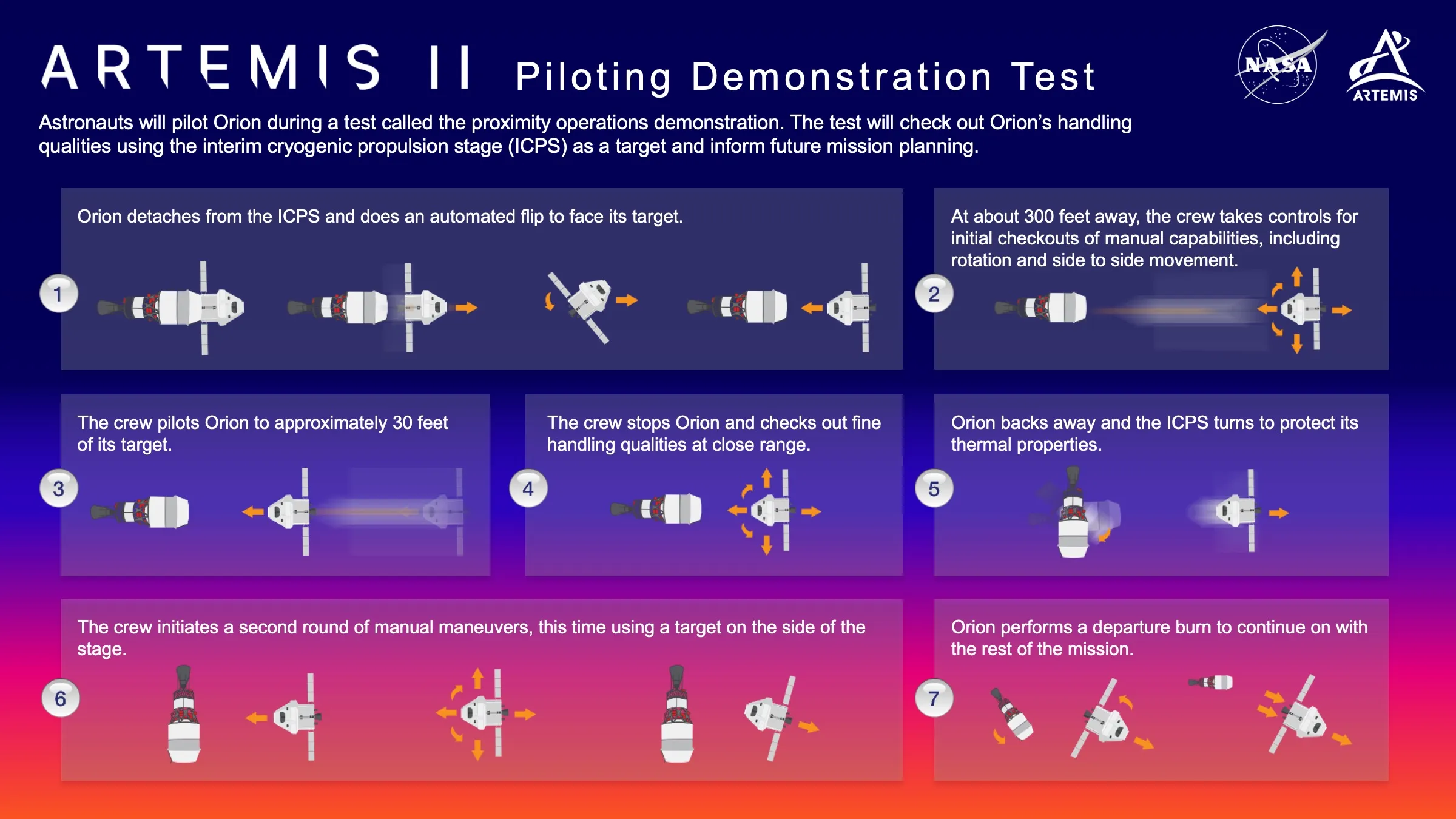
There won’t be a lander in orbit for Artemis II, and in fact, the Orion that’s flying this mission doesn’t even have a docking hatch. But they can still simulate the act of docking with another vehicle by using the spent upper stage of the Space Launch System (SLS) rocket, known as the Interim Cryogenic Propulsion Stage (ICPS), as a stand-in.
With this shakedown of the Orion complete, the crew will finish the day off by testing their connection to the Deep Space Network. This link will be vital as they journey beyond low Earth orbit, and this test must be completed successfully before the crew will be given the go-ahead by ground controllers to initiate the TLI maneuver that will set them on course for the Moon.
Setting Course for Luna
With all of the systems tests out of the way, the crew will focus most of their second day on preparing for and ultimately executing the trans-lunar injection burn.
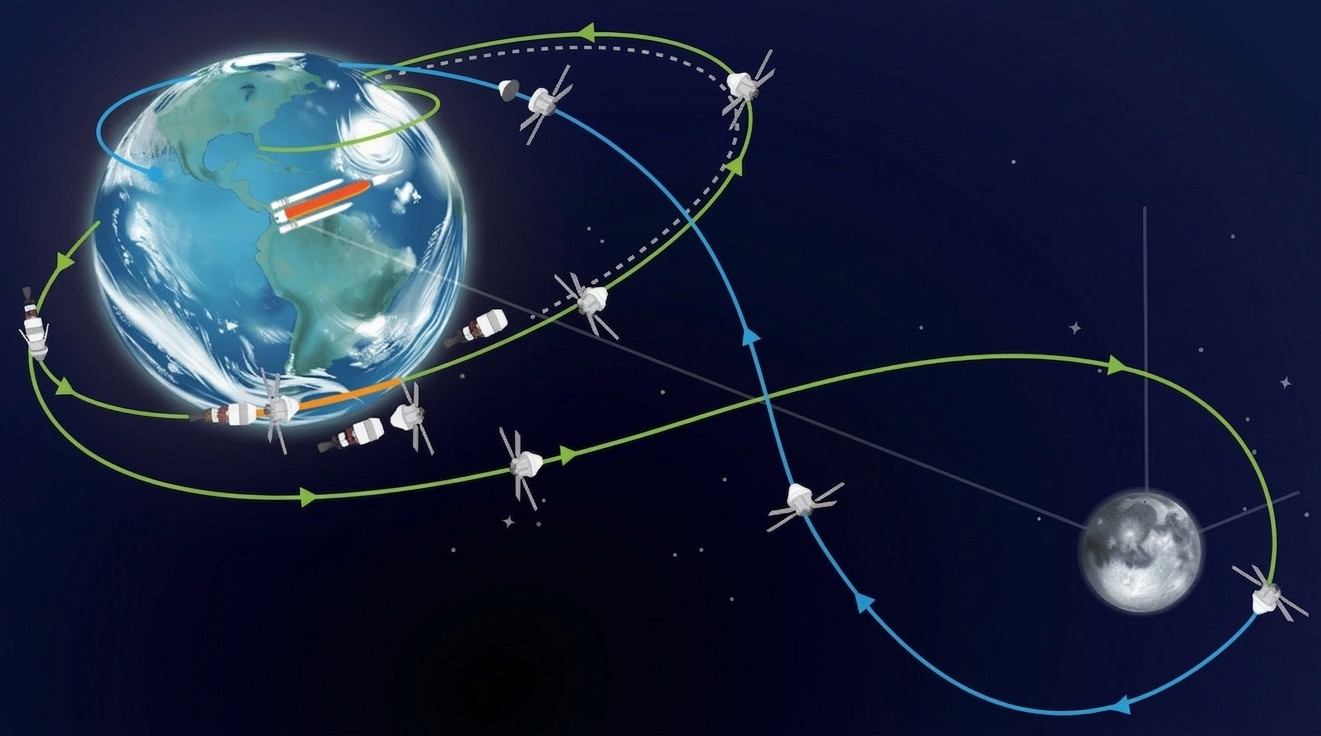 In many ways, this is the most critical element of Artemis II. Up until the point that the TLI is initiated, the Orion can easily return home by simply slowing down and dropping back into the Earth’s atmosphere. But once the engines are fired and the vehicle is accelerated to the velocity necessary to intersect with the Moon’s gravitational sphere of influence, they are fully committed.
Interestingly, the completion of the TLI maneuver on day two marks the final major engine burn of the mission. Because Artemis II will be flying what’s known as a free-return trajectory, the same engine burn that puts them on course for the Moon also enables their return eight days later. That is, the flight path of the vehicle is such that it will go around the Moon and then “fall” back towards the Earth automatically.
This is a fault-tolerant flight path which will bring the spacecraft back to Earth even in the event of a propulsion failure. The same approach was used during the Apollo missions as a contingency should the spacecraft fail to enter into lunar orbit — a plan famously utilized to bring the crippled Apollo 13 home.
On the Road to the Moon
Once the TLI burn is completed, Orion is essentially “on rails” for the rest of the flight. A few minor course correction burns are expected over the next several days to fine-tune the spacecraft’s closest approach to the lunar surface, but later, its ultimate splashdown point back on Earth. Obviously you can’t correct a deviation in your course until you actually know how far off the mark you are, so the exact timing and frequency of these adjustments will need to be determined on the fly as the vehicle is in transit.
With the Orion sailing through its predetermined trajectory for the next few days, the crew will have time to perform various experiments and prepare themselves for the later elements of the mission. A number of medical tests are scheduled for this period to see how the crew is performing, and they will perform drills to determine how quickly they can get into their Orion Crew Survival System (OCSS) spacesuits in the event of a emergency.
The crew will also be given time to study the areas of the lunar surface they will be asked to photograph once the spacecraft makes its closest approach. Since the exact position of Orion relative to the Moon won’t be known until the vehicle is on its way, the crew can’t really prepare ahead of time. Once the Orion is on course, ground controllers will be able to calculate what parts of the lunar surface will be visible through the windows, and can inform the crew as to the points of interest that they would like close-up imagery of.
The Big Day
If everything goes according to plan, day six of the mission should see the Orion capsule swing around the far side of the Moon at a distance of less than 10,000 kilometers. The only thing officially on the schedule for this period is, as you might expect, lunar study.

As Artemis II won’t be entering into lunar orbit, this is the only chance the astronauts will get to gather video and images of the surface. They’ll document all of their observations, some of which will need to be recorded and transmitted back to Earth later as mission control will lose contact with the crew for about an hour while the Moon itself is between Earth and Orion.
Soon after the spacecraft emerges from this communications blackout, its expected that scientists on the ground will get a chance to interview the crew about what they saw while the memory is still fresh in their minds.
Given the flurry of activity expected in this relatively brief period, the crew will remain largely off-duty for day seven so they can rest up for the final leg of the mission.
Heading Back Home
With the Moon officially behind them, the final three days of the mission will be largely focused on the splashdown and recovery procedures. It’s expected that several course correction burns will be performed during this period to fine-tune the spacecraft’s course and bring it down safely in the Pacific Ocean. In between these maneuvers, the crew is also scheduled to demonstrate manual attitude control of the Orion.
There are a few more experiments to perform and a bit of housekeeping to do, but it’s safe to say that — save for the fiery reentry into the Earth’s atmosphere — the most exciting aspects of the mission are all completed by this point. There is however one experiment that stands out: on day eight the crew will perform a radiation drill meant to simulate a solar flare, and will use supplies stored in the capsule to quickly erect a radiation shelter. A suite of radiation sensors will be used to determine the effectiveness of the makeshift shielding.
Must-See TV
Most of the people reading this weren’t alive to follow along with the Apollo missions as they happened, and have only experienced them in a historical context. We’ve seen the photos, watched the recordings, and read first-hand accounts from the astronauts. But there has always been a certain detachment — we know that humanity visited the Moon in the same way we know of Marco Polo’s travels through Asia or Edmund Hillary’s trek up Mount Everest. It’s something that happened in a bygone era, the accomplishments of another generation.
But Artemis II and the missions that follow it represent a new generation; an adventure that we’ll all get the chance to experience together in real-time. NASA will be bringing the full capabilities of the Internet and social media to bear, and the world will get to watch every moment unfold in high-definition. If the weather holds and there are no technical issues, we should be seeing the crew work their way though this ambitious agenda in just a few weeks.












And we hope they will be paying attention to any monolyths up there, just in case.
Nice reference. Might have to wait to find one of those until the excavation crews arrive.
There is a zone of protection that could be of great utility:
https://phys.org/news/2026-03-earth-magnetic-field-previously-undetected.html
A great location for a space colony
More:
https://www.science.org/doi/10.1126/sciadv.adv1908
The statement that most of the people reading this weren’t alive to see the first lunar landing really drives home how long it took us to decide to go back.
We went there and discovered it’s nothing but fine dust. Then we sent robots to remind ourselves there’s in fact nothing but fine dust. Now we’re burning money again to rediscover it’s nothing but fine dust. It makes me facepalm so hard, I’m shooting poop out of my backside.
If all the cash wasted on Artemis was given to proper NGOs we could’ve turned Russia into a lake with their own hands. Offshore drilling rigs are a proven technology so we’d keep getting cheap oil while not having to deal with crazy alcoholics anymore.
The original point of Artemis was to build a sustainable infrastructure for lunar and deep space missions. It wasn’t just about the Moon: the entire point of Gateway was a station at a very convenient point in the gravity well (it’s essentially a Lagrange point station from a potential energy standpoint, but with way more accessibility to offset the slight delta-v cost).
This would allow for polar missions, for instance, but also would just allow for fleets of cubesats on rideshares to just massively expand interstellar presence.
Of course that goal’s mainly been effed up thanks to the predictable mess of Starship and international national security pressure. But it wasn’t a “discover more dust” idea. It was a good plan.
“international national security pressure.”
What the hell are you talking about?
Both the original space race and Artemis are both being accelerated because of concerns that Someone Else Will Get There First.
Are you paying attention?
The whole ‘enrich your scumbag friends by calling them a NGO and giving them money for nothing’ thing is getting exposed fast.
The moon is a much better place for the money to land vs the Clinton global fund.
TF is wrong with you people?
Cheap oil and no future. That’s what you propose. Why would anyone want that? So space is hard. So what? That’s what makes it worthwhile. In your proprosed magat non-future we might as well become the crazy alcoholics ourselves. You don’t leave anything else but a cheap buzz to look forward to. The h3ll do you people even get out of bed for?
Keep drilling that oil and earth can be nothing but fine dust. Instead let’s go figure out how to hack the fine dust elsewhere into a livable habitat. Maybe we can get some Helium-3 while we are at it.
Your worldview is broken by too many false assumptions.
Your not even wrong, just incoherent.
Beware, most “realists” are just pessimists in disguise. ;)
Anyhow, the reasons to go to that dusty rock isn’t just geology, err, regology.
It’s also a testbed for manned missions.
Building moonbases also helps to simulate space colonies.
To see and understand how people can handle isolation.
The moon is special in so far, because earth remains in view all time, which is comforting.
Thus, the moon is ideal for our first baby steps into space.
Okay – a small, stable asteroid would be another alternative, maybe.
Last but not least, the moon is a good backup site for an archive about human history.
Up there, there’s no weather or earthquakes. Information stored up there remains intact for millennia to come.
The idea is also picked up by Moonbase 3, but that’s not how I came to this idea.
So instead of learning how to travel further in space, we should drill more oil and make our planet LESS habitable, making the need for understanding how to travel further in space even more relevant but further out of reach? You’ve got a certain energy about you I can’t quite put my finger on and expect my comment to get posted.
“how long it took us to decide to go back”
It was an easy decision not to. The reason no human has been back to the moon in 57 years is because for science or commercial use it is not even REMOTELY worth the HUGE cost of doing so. Just as was the Apollo Program, Artemis is primarily an exercise in political wiener waving which has once again been hyped by lobbyists and their politicians into a Moon Race v2.0 with a country we beat to the moon 57 YEARS AGO.
Q: What is the total cost thus far for all aspects of the Artemis program?
Grok 3 AI:
A 2021 NASA Office of Inspector General (OIG) report estimated $93 billion in total projected costs for the Artemis program from FY 2012 through FY 2025 (including about $37.2 billion already spent as of early 2021, with the rest projected through 2025).
Q: What would be the height in feet and miles of a $93 billion stack of crisp, new $100 bills and what distance would they span in miles if laid end to end?
Grok 3 AI:
The stack would be about 333,250 feet tall (roughly 63 miles high).
Laid end-to end they would span about 90,120 miles. For comparison, Earth’s circumference at the equator is about 24,901 miles, so this chain of bills would wrap around the Earth roughly 3.6 times.
Book: The End of Astronauts: Why Robots are the Future of Exploration (2022)
NASA wastes 50% of its budget on human spaceflight. It’s no longer the 1960s. END THAT.
“Artemis is primarily an exercise in political wiener waving”
Artemis’s accelerated schedule is an exercise in politics. And Starship HLS is an exercise in corporate sleaze funding. But, just like tons of things from NASA, the original plan for Artemis was extremely solid science and development.
Because do you know what happens when you develop a sustainable mechanism for shuttling things back and forth to cislunar space in a Lagrange halo orbit for supporting humans? You make rideshare projects free. Cubesats and small landers have access to basically the entire Solar System.
Asking “how much money has been spent on Artemis” and assuming it’s all about humans is wrong. Because the human cost is not in place of satellite/robot exploration. The two combine for very little extra cost.
Read the Gateway papers. Go look at the number of announcements of opportunity out there. If it’s done right, it’s a massive advancement in scientific capabilities.
Right, the launch system that all up flies for less then the cost of a single engine on the Senate Launch System is ‘corporate sleaze funding’.
The problem is the congress critters that see everything as a jobs program.
They need to go up against the wall ASAP.
‘Very little extra cost’ LOL.
You lying sack of…
“Right, the launch system that all up flies for less”
Starship HLS and SLS are not competitors. They’re completely separate portions of Artemis. Comparing them is pointless. SLS’s existence is not on technical merit, it’s a Congressional priority for separate reasons that have nothing to do with NASA. I don’t know why people bring it up when talking about Starship. Artemis was freaking designed for Falcon Heavy. They had no intention of keeping SLS around after like 5 or 6 flights to transition out.
The reason I’m critical of Starship HLS’s funding is that there was zero chance HLS was going to be ready. None. Not at all. It was specifically called out that the risk profile was significantly higher.
But because SpaceX was willing to take so much smaller amounts of money, they got the bid even though anyone could predict they’d blow up the schedule. Which they did.
You’re really not understanding the difference between direct congressional funding and NASA funding. NASA can’t control directly funded stuff. Their own stuff is science-driven.
You do realize how much the US government wastes on “defense” every year so that we can go and “defend” ourselves before “they” get a chance to defend themselves from us, first, right? 93 billion, if even remotely correct (telling you chose Grok) is about 10X less than a years worth of …. lobsters and crabs for the department of war, because they couldn’t spend all the billions we threw at them last year? Priorities are a mess. Forget science, let’s all eat lobster… oh wait, no, we paid for all that lobster but got none of it. That’s just for the folks in charge of blowing up the earth instead of flying to the moon.
Right…SpaceX blew up the schedule…
NASA has very little discretionary funds, it’s all political, the joint is run by GD politicians.
I know a ME that worked for a NASA contractor for almost 20 years.
In the end he couldn’t take it anymore.
In 20 years he:
Designed a single bracket that ended up on the ISS.
Filled out literally tons of paperwork.
Sat/slept through 1000s of hours of useless meetings.
He could have done that with a MBA, had much more fun in college.
“NASA has very little discretionary funds, ”
I’m sorry. This is getting to the point where it’s not even worth it to respond. I don’t think you understand how NASA funding actually works.
Congress has a number of projects which NASA is specifically directed to fund, with conditions. SLS, Orion, and HLS (which includes Blue Moon and Starship HLS) are those. This is flat out in the NASA funding bill. There is no discretion by any of the administration to say “this is a bad idea” and kill it.
This is not the case for the majority of their projects. Note I said “projects” not “funding” because obviously Artemis is big-ticket.
But even Artemis is different than most. If you look at Mars Sample Return, for instance, which was specifically called out for years (look at last year’s HR1) because of efforts to kill it (which succeeded this year) – no one was saying ‘you have to do it this way.’ Mars Sample Return was killed realistically because NASA couldn’t figure out a way to get it done cheap enough to make people happy.
The Exploration budget requires the use of SLS and Orion. That’s different.
“I know a ME that worked for a NASA contractor for almost 20 years.”
Hey, now you know someone who’s worked with NASA for longer!
“Right…SpaceX blew up the schedule…”
Yes. It did. Because when the original Artemis HLS calls went out, they were very obviously targeting something like a Falcon Heavy based launch system, using a simple tug and basically an Apollo LM on steroids. All of these things were straightforward, proven, and would’ve been quick and easy.
The only super heavy lift vehicle at the time of the call was Falcon Heavy. That’s it. SLS was in development. New Glenn was in development. Starship was talked about. But the HLS call went out in 2019 and Falcon Heavy became NSSL qualified the same year. It existed. SpaceX was literally the only vendor that could propose an HLS system using existing launch technology.
They didn’t. And I guarantee that when SpaceX proposed Starship for the HLS at the absurd price point they did, people at NASA facepalmed and went “are you freaking kidding me.”
But they didn’t have a choice. None of the vendors were going to be able to hit the Artemis III timeline, and everyone knew it, but SpaceX was offering to do it for dirt. So you pick it up, and just quietly know that SpaceX is going to completely torch the original schedule and deal with it as you go.
All of the other schedule delays – the spacesuit (lol), SLS, Orion, etc. – they’re all pointless. Everyone knew Starship would be the long pole. Being multiple years early is pointless. You just have to not be last.
It’s expensive and risky to send humans so far, just to do nothing special.
It gives people something to aim for, to dream of. Gives hope.
The “space age” made millions if not milliards of people happy.
They worried about Gagarin, watched the space rendezvous of early capsules, prayed for Apollo 13..
Same goes for oldTrek in some ways, which inspired many to take a career in engineering, the medical field or in science in general.
And yes, we must go out there, eventually, for sake of humanity.
Humans have to become a two planet species, at very least, in order to survive.
Earth is the cradle of humanity, but someone can’t remain forever in a cradle.
It’s very very important that we go out there as long as we can. Who knows what the future brings.. IMHO.
Sort of makes you wonder if the end goal is, in fact, doing nothing special. I wonder if there might be a secondary objective to twiddling thumbs on a space voyage.
I was seven when Apollo 11 landed, and I remember it pretty well.
I also remember when one of the other missions landed, and the coverage on TV ended, I went outside and the gang of neighbor kids asked where I had been. When I told them, they all said it was old news and didn’t care.
It astounded me. How could they not care?
Different strokes, I guess.
My experience was similar… I was super excited to watch the live broadcast of Apollo 11 on TV (even though there wasn’t much to see by today’s standards). But my parents preferred to go to the park that day (it was daytime this side of the Atlantic); the whole “moon landing circus” wasn’t really their thing anyway. I was sooo disappointed…
Maybe there is some synchronicity between being excited by lunar landings and visiting this site:)
Sorry to hear. Such people exist, unfortunately.
They are maybe afraid of things somewhat above their small, trivial world.
They can’t mentally process the idea of solar systems, galaxies, nebulas and local clusters.
Instead, they’re happy to read a local newspaper and go to church on sunday.
Cannot agree more. If humanity never developed the “we need to be more, see more, understand more, etc” urge, we would never even have developed the wheel…never-mind drilling for oil.
Personally, I think we should have been on Mars already…50 years ago…
Thanks for the historical perspective. I’m much younger than you, and all the history we see of that time is that the whole world was super-excited by the moon landing and the whole world stopped what they were doing to watch it on TV. It’s actually kind of refreshing to hear that there were curmudgeonly pessimists back then too :-)
Judging by the comments section on anything to do with space exploration (not just on HaD, but everywhere), it seems a lot of people don’t care today either. This sucks. How uninspired can you be?
Sigh, so many extremely shortsighted people.
Hopefully they won’t suffer the same fate as the dinosaurs when the chips are really down…
JMS said it best:
Go Artemis!
Go Artemis!
What was needed is a modular system:
https://ntrs.nasa.gov/api/citations/19910018890/downloads/19910018890.pdf
https://www.secretprojects.co.uk/threads/us-80s-tnmts-amls-studies-aka-shuttle-ii.3876/
I’d like all easily available fissile material up there. Meltdown? No buggy. It would be great for pulse-Orion.
Space factories need to come first, then true reusable launch vehicles (RLVs) can be made in orbit by taking advantage of any metallurgy advances due to microgravity.
Musk is using Earthbound tech to reach space.
That’s a handicap.
Use stage-and-a-half LVs like SLS/ET for wet workshop floorspace, as per Gene Meyers” SPACE ISLAND GROUP.