
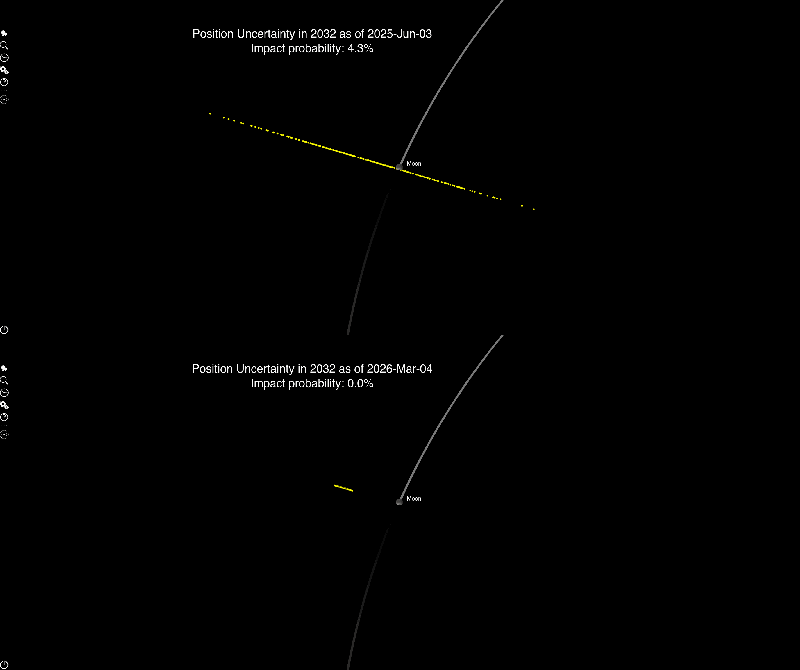
When Asteroid 2024 YR4 was first discovered, it created a bit of a kerfuffle when it was reported it had a couple-percent chance of hitting the Earth in 2032. At 60 meters (196 feet) across, this would have been in the “city killer” class that nobody really wants to see make landfall, so NASA and the ESA scrambled all assets to refine its trajectory in time to do something about it. Amongst those assets was the James Webb Space Telescope (JWST), which is now reporting it will miss both us and our moon.
We reported that JWST was being tapped for this task over a year ago, when the main concern was still if YR4 might hit Earth or not. An Earth impact was fairly quickly ruled out as the window narrowed to include only to Earth’s moon, and concern shifted to excitement. A city killer striking Earth is obviously bad news. The same thing happening to the Moon is a chance to do science — and 2032 would have been plenty of time to get assets in place to observe the impact.
Unfortunately for the impact-curious, JWST was able to narrow down the trajectory further — and we’ve now gone from up to a 4% chance of hitting Luna to a sure miss of 20,000 km or more.
As this game of cosmic billiards we call a solar system continues, it’s only a matter of time before Earth or her moon is struck by another object. Unless we can deflect it, that is — NASA and partnering agencies have been testing how to do that.











An asteroid/Moon collision might not be so much fun..
https://en.wikipedia.org/wiki/Seveneves
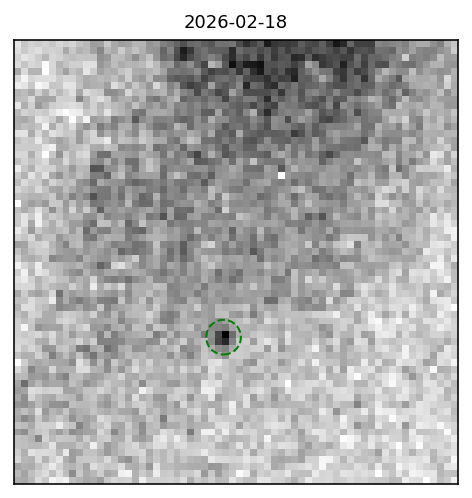
Even with the JWST, asteroid 2024 YR4 only fills a few pixels.
I get it. Space is big. REALLY big. It’s easy to miss a few zeros when comparing things.
The pixel size of JWST’s NIRcam is 0.031 arcsec, 0.15 microradians.
At the roughly 50 M km distance, that 60 m rock will subtend 1.2 nanoradians.
That’s not “a few pixels”. That’s less than one percent of a single pixel.
The blur in that image is just the intrinsic imaging resolution and residual motion blurring. It’s astonishingly good (literally out of this world, hah), but that’s it.
That’s a technically extremely challenging feat, capturing something that small, that faint, and moving that fast. Kudos to the imaging team that pulled this off.
It’s actually helpful that it doesn’t cover multiple pixels. I mean, if it would have, it would have reflected more light and been more visible, but… ignore that part. Because of its distance, it’s extremely dim – but that also means they can stack multiple images without the source moving. All they needed was for it to be in a field of view where they could source track on other stars, and then they could boost the SNR of the detection to the point where it was detectable.
I don’t actually know where the image in the linked article came from : NASA’s got a separate page with details on this directly.
https://science.nasa.gov/blogs/webb/2026/03/06/how-nasas-webb-helped-rule-out-asteroids-chance-of-2032-lunar-impact/
It’s dim because it’s small, not because of its distance from the sun: It’s still currently pretty close, astronomically speaking — well within Mars’ orbit, so still pretty well lit by the sun, about half as bright as the moon.
It’s close astronomically speaking but super far considering its closest approach is “the Moon.” It won’t always be this dim.
Also I don’t know why you think it’s half as bright as the Moon, because it sooo is not. It’s magnitude 30.
It appears that dim because it is small, not because it is dark. It is (currently) still lit by the sun to about half the brightness of the moon.
“… A city killer striking Earth is obviously bad news. The same thing happening to the Moon is a chance to do science…”
I submit we won’t be doing much “science” after ejecta from a massive lunar impact takes out hundreds of Earth satellites… which fragment, taking out more… which fragment, taking out more… domino-style… until the umpty-thousand spacecraft now in orbit are all in pieces.
The debris cloud in that scenario would be impenetrable. It would be decades or even centuries before the orbital space above Earth would be clean enough to launch another satellite, let alone a human.
It would be interesting to see the models to support or refute that kind of hand-wringing.
How much ejecta would make it to lunar escape velocity?
How much of that has enough energy to make it down the well to low earth orbit?
What is the residence time of that material as it crosses the orbits of satellites?
I suspect those speculations are grossly overwrought, but it would be interesting to see the models. What numbers to you have to support such drama?
I don’t know about the doomsday scenario, but here’s a paper covering some of your questions
https://arxiv.org/abs/2506.11217
Very interesting and well done paper. Thanks for the link.
The overall issue is that the impact would have occurred on the near side, which is extremely rare (hence the reason why the maria exist). Far side impacts are less of an issue, but near side impacts are Very Bad.
“How much of that has enough energy to make it down the well to low earth orbit?”
That’s not how gravity works. A tractor beam not a Repellotron. Look at a well planetside. How much “energy” does take to fall down it?
To fall vertically down a well will require about thirty megajoules per kilogram, from low orbit.
Or about one megajoule per kilogram if you’re in orbit around the moon.
Your qualm fails if the thing strikes the dark side. Is there any information on that?