
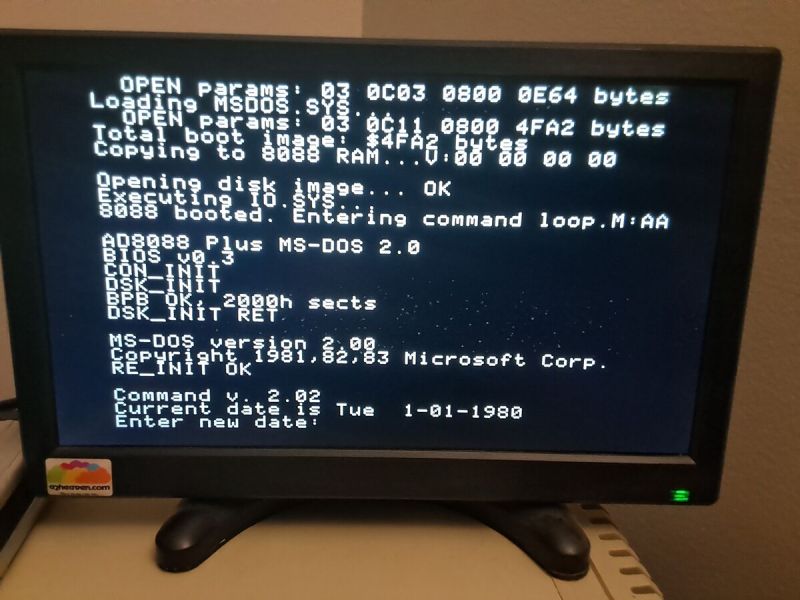
Although the Apple II range of computers were based around the 6502 processor, they could still run x86 software using expansion cards that were effectively self-contained computers. This way an Apple IIe owner, for example, could install an Intel 8088-based AD8088 co-processor card by ALF Products and run CP/M-86 as well as MS-DOS. Unfortunately, as [Seth Kushniryk] discovered while digging into this MS-DOS option, there don’t seem to be any remaining copies of the accompanying MS-DOS 2.0 software.
The obvious response to this is of course to try and port it once again, which [Seth] did. So far he got it to boot, though it’s not quite ready for prime-time yet. Although the AD8088 card is fairly self-contained, it still has to talk with the Apple IIe system, which poses some challenges. To help with the porting he’s using the MS-DOS 2.0 OEM Adaptation Kit that was released along with the sources a while back.
The Apple II has to first load the basic MS-DOS files into the 8088’s RAM before handing over control, which works now along with the basic functionality. Before [Seth] releases the port to the public he still wants to fix a number of issues, in particular the clock. ProDOS on the Apple IIe encodes the year differently than MS-DOS, so that the latter’s clock is off by a few years, and the console driver is still not quite as robust as [Seth] would like it to be.
Beyond this there is also working with the other cards in the Apple II2 system, including the Super Serial Card, and working with the ProDOS filesystem.












I had that card in mid 90s. And don’t remember if it actually helped me or not. Some sort of hardware virtual machine.
🩶
During the early to mid 80s there were several expansion card products that imitated a complete PC. The Apple ][ is an odd choice since it was quite a pricey platform to start with (and not a particularly robust one, either). Other ones I have personal experience for PCs were the ubiquitous Z80 card running CP/M, an Apple ][ card and several different sorts of “PC plugged into a PC” cards. The last group were interesting because they intended to share a hard disk but the only way to do this reliably was by networking. (You’d need MS-DOS 3.x for that, BTW) One system I worked on actually went as far as incorporating early 10Base2 (coax) network cards into the mix so you could actually network these multi systems together along with standalone PCs. Networking software — early versions of MS-NET — sucked, though, and the only viable solution, Netware, wasn’t that usable for this kind of system (this is 1985-6, BTW — very early on in the life of networking systems).
Later on in the 1980s there were a number of small companies making PC add-on cards featuring whatever fashionable processor was on offer. For a time this was the only way to get an evaulation system.
(Incidentally, I still have floppies with various brews of MS-DOS on them. Not 1.4, the original CP/M clone, unfortunately, but 2.x, 3.x and so on. Obviously they’re not used for anything.)
The Apple II was widely used in schools at one time. People would buy them for their children because they had learned it in school, then buy a CP/M or MSDOS card for the parents’ use. A friend had an offer from a relative to buy him a computer, as long as it was an Apple II. He managed to slip in a CP/M card so he could be somewhat compatible with work.
My father worked a Philips at that time. Some people there designed and build an Apple II clone, the CHE-1 (Computer Hobbyclub Eindhoven). There was a rather large group op Philips related people that bought that computer and from that point on other cards for the Apple II were designed and build. I do have the Z-80 CP/M card and that allowed me to run wordstar and turbo pascal on my CHE-1. Still having fond memories of soldering these cards, it always gives great satisfaction to work with things that you’ve build yourself.
Such a Franken-puter is against all that is holy. DOS on an Apple? Don’t call me when your CRT turns all the way around and starts spitting up pea soup. This is worse than the girl/dog hybrid from Full Metal Alchemist….where’s my firebrand?
BURN IT!
The thing is that the Apple II and IBM PC were both considered to be equally popular platforms for a couple of years.
That’s how hybrid PCs came to be, such as the Gigatronic KAT (Apple2+PC) or the Spectravideo SVI-838 X’Press 16 (PC+MSX).
https://www.youtube.com/watch?v=Zhu9vxEm8Gc
https://www.youtube.com/watch?v=Pjeq24_QNVk
What blasphemy! Wozniak is a fan of pea soup! Do not derogate the pea soup!
Not joking, true story: https://www.theregister.com/2011/05/03/woz_talks_patents_and_soup/
I wonder how the floppy drives worked. IIRC, the Apple 2 and PC had very different floppy formats. While both were soft sector, I think there was some odd optimization that Woz did that made compatibility difficult. I recall trying to write some code in the ’80s so I could at least read Apple 2 disks from my PC.
So, if you did have a bootable DOS 2 floppy, how would you read it on an Apple 2?
I expect for CP/M, there was a special version built for Apple 2 co-processor cards.
Looks like there’s further progress now. Apple II graphics, and WordStar!
https://sethkush.com/post/2026/03/22/reboot-camp-83-ms-dos-on-the-apple-iie-is-ready/