
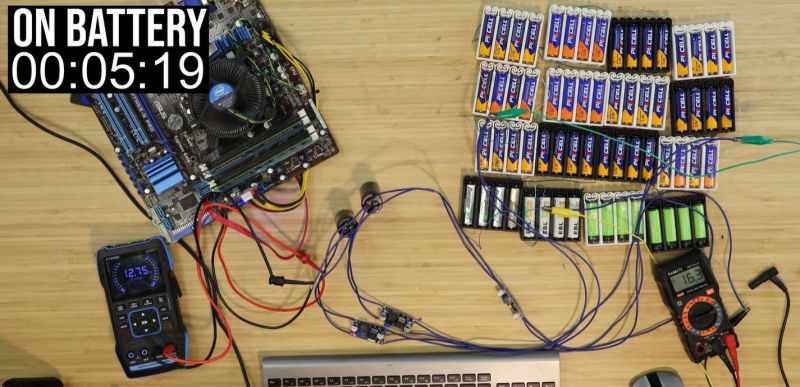
After the previous attempt of running a PC off AA cells got a lot of comments, [ScuffedBits] decided to do the scientifically responsible thing and re-ran the experiment with all the peer-reviewed commentary in mind. Although we noted with the previous experiment that only alkaline cells were used, [ScuffedBits] rectified this by stating that both carbon and alkaline AA cells were used the first time around.
For this second experiment a number of changes were made, though still both carbon and alkaline cells were put into the mix. To these a third string was added, consisting of NiMH cells, for a total of 64 cells with each of the three strings outputting around 25 VDC when fully charged. These fed a cheap buck regulator module to generate the 12 VDC for the DC-DC converter on the mainboard’s ATX connector.
Although it appears that the same thin Cat-5e-sourced wiring was used, with the higher voltage this meant a lower current, making it significantly less sketchy. Unlike with the first experiment, this time around the Core i3 530 based PC could run much longer and even boot off the DIY battery pack. After a quick game and pushing through a Cinebench run for 64 Watts maximum power usage, it turned out that there was still plenty of time for more fun activities, such as troubleshooting Minecraft and even playing it.
After a total runtime of 33 minutes and 19 seconds the voltage finally dropped too low to continue. A quick check of cells in each string, it turned out that the carbon cells were the most drained with significant terminal voltage drop. The alkaline cells had been pushed down to a level where they could still probably run a wall clock, but the NiMH cells showed a healthy 1.2 V, meaning that a fully NiMH battery pack could go a lot longer.
This probably isn’t too surprising when we look at the history of battery packs in laptops, where NiCd quickly got pushed out by NiMH-based packs for having significantly higher power density and none of the problems with recharging and disposal. Even today 1.5 V Li-ion-based AA cells do not have significantly more capacity than NiMH AA cells, making this chemistry still very relevant today. Even if you’re not trying to build your own battery pack for running a desktop PC off.











Older laptops with removable battery packs full of NiCads had AA or similar sized batteries in them.
My first laptop used 4/5 A cells, a few of them in a pack. I’ve rebuilt them once before.
The alkaline cells likely had about equal capacity to the nimh, but alkaline cells lose a lot of capacity under high load, while the nimh (and nicd) hold up well.
Ni-cd, carbon cells, where do you even get those cells these days? I haven’t held a zinc cell since forever, and ni-cd has been illegal here since 2006 .
They’re available for specialist use exempt from RoHS. They’re not available for private individuals.
Carbon cells still crop up in places. Again, special use. For example, in agricultural use they’re sometimes used in large formats for electric cow fence generators. Those have been mostly replaced with zinc-air cells though, because they offer vastly superior capacity. They’re interesting stuff: you activate the cell by breaking off a tab that lets the air in.
Also, the batteries that come bundled with IR remotes and toys, other gadgets, are often zinc-carbon because they’re cheaper to make.
Alkaline batteries are still zinc. The difference is the electrolyte: alkaline versus acidic.
A few years ago, Harbor Freight sold “Heavy Duty” cells that were carbon-zinc-acid based, just like the very old days. They sucked, but they were available. I’ve read that other companies sell “Heavy-Duty” cells as well, it’s the code name for “Not Much Power.”
Here in .au I see them bundled in things like cheap solar garden lights. Don’t buy cheap crap from Bunnings. Don’t trust the cheap “home and garden” store to keep toxic heavy metals out of your home and garden. Next time we can talk about the lead in their brass plumbing.
Probably higher, actually. If you go to very light loads (~10 mA) generally you’ll get pretty close to 3000 mAh for a decent alkaline battery, which would be a big challenge for a NiMH cell.
Just need a few thousand cells or so.
NiMH still has significant self-discharge, so for devices that operate for months to years on a battery the alkaline cell is still the better option. Lithium thionyl batteries are sometimes used, but those are not user-replaceable because of the chemical and fire risk in handling.
um i don’t understand the purpose of the experimental result of how dead the batteries were, by type…the detail of how they were connected together determines everything and there’s no way they could have been connected together where that result means anything about the batteries?
The whole thing doesn’t make much practical sense, so it’s just an absurd “look what I did” video. Nothing wrong with that, but not much valuable technical content.
“all the peer-reviewed commentary”
People bleating on the internet ≠ “peer-reviewed”. For all you know, I might have bleated about it and I guarantee that ≠ “peer-reviewed”.
In other words, it’s absolutely peer reviewed… in the literal sense.
Yeah, I don’t think he knows what peer means.
He don’t know, ther is technology to convert AC to DC
Next up should be a bicycle powered PC or even better…..how many potatoes would it take to run the computer ?