
The physicist William Shockley is perhaps today best known for three things: his role in the invention of the transistor, his calamitous management of Shockley Semiconductor which led to a mass defection of employees and precipitated the birth of the Silicon Valley we know, and his later descent into promoting eugenics. This was not the sum of his work though, and [David Prutchi] has been experimenting with a now-mostly-forgotten device that bears the Shockley name (PDF), after finding one used in an early heart pacemaker circuit. His findings are both comprehensive and fascinating.
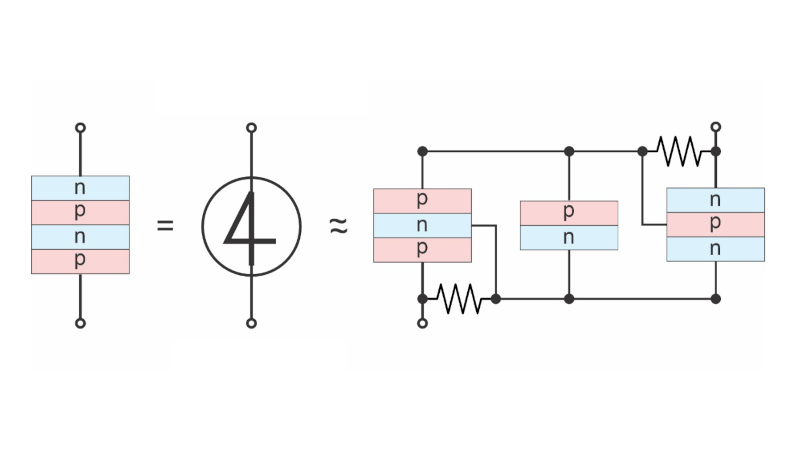
The Shockley diode, or 4-layer diode as it later became known, is as its name suggests a two terminal device with a 4-layer NPNP structure. It can be modeled as a pair of complementary transistors in parallel with a reverse biased diode, and the avalanche breakdown characteristics of that diode when a particular voltage is applied to it provide the impetus to turn on the two transistors. This makes it a voltage controlled switch, that activates when the voltage across it reaches that value.
The PDF linked above goes into the Shockley diode applications, and in them we find a range of relaxation oscillators, switches, and logic circuits. The oscillators in particular could be made with the barest minimum of components, important in a time when each semiconductor device could be very expensive. It may have faded into obscurity as it was superseded by more versatile 4-layer devices such as the PUJT or silicon-controlled switch and then integrated circuits, but he makes the point that its thyristor cousin is still very much with us.
This appears to be the first time we’ve featured a 4-layer diode, but we’ve certainly covered the genesis of the transistor in the past.












It is kind of unrelated, but I find it interesting that John Bardeen, who was the actual theoretical force behind the invention of the transistor, is someone people usually never have heard of, though being the only person in history winning not one but two physics nobel prizes. Even Einstein got only one, yet everyone knows him, also Marie Curie is widely known in the science community (won a chemistery and a physics nobel prize). Maybe you guys could elaborate on that in some other blog post.
It looks like an SCR without the gate …
DIACs are nice too, but nowadays even them are hard to find. One of the last nice SMD DIACs, SMDB3, was recently discontinued. I used it for remote sensing of high voltages, basically just a voltage-controlled LED blinker with minimal component count.
Similar devices as still on the market for ESD protection: TVS diodes with deep snapback. Their construction is a bit different though.
You failed to mention the other things that William Shockley was famous for: his unabashed racism, and his rabid support of eugenics. “My research leads me inescapably to the opinion that the major cause of the American Negro’s intellectual and social deficits is hereditary and racially genetic in origin and, thus, not remediable to a major degree by practical improvements in the environment.” — William Shockley
The Playboy Magazine interview is informative. Shockley wasn’t smart enough to realize that Playboy was going to trick him, and he fell into their trap.
You did read the article, right? It’s number 3 in the things I said he’s famous for.
“… and his later descent into promoting eugenics….”
That was a acknowledged. Read the article again.
Too busy and too triggered by the surname. Ain’ nobody got time fo’ that Jesus!
Didn’t even read the first paragraph. Sad, right?
every time i see the Shockley diode i have to overcome my confusion in relation to the Schottky diode.