
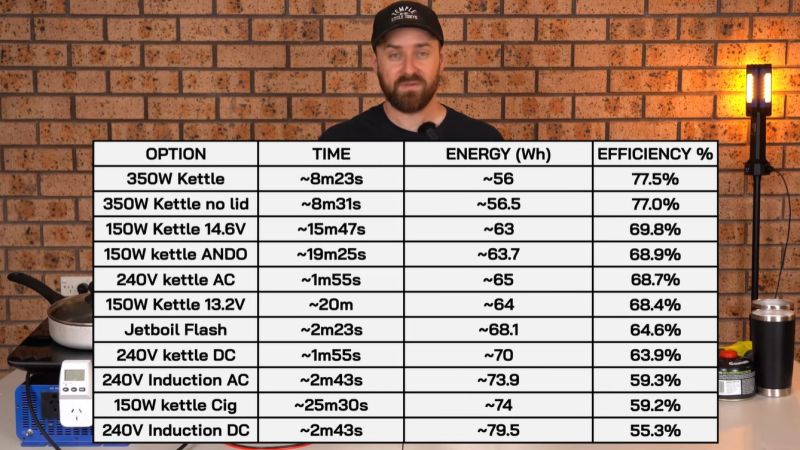
The topic of boiling water is apparently a rather divisive topic, with plenty of strong opinions to go around on what is safe and the most efficient way to go about it. Thus in a new video [Cahn] sought to address the many comments that came in after his previous testing of electric kettles on either 12 VDC or 240 VAC.
What’s interesting about this whole topic is that at its core the overall efficiency of boiling water is simply a matter of calculating the energy input minus energy losses, with the remaining energy going into the water.
As we can see in the video, using a higher battery voltage doesn’t really change the efficiency of a 12 VDC kettle, but the higher current draw does manage to melt a fuse that can’t take the heat — requiring a 20 amp fuse instead of the 15 A one.
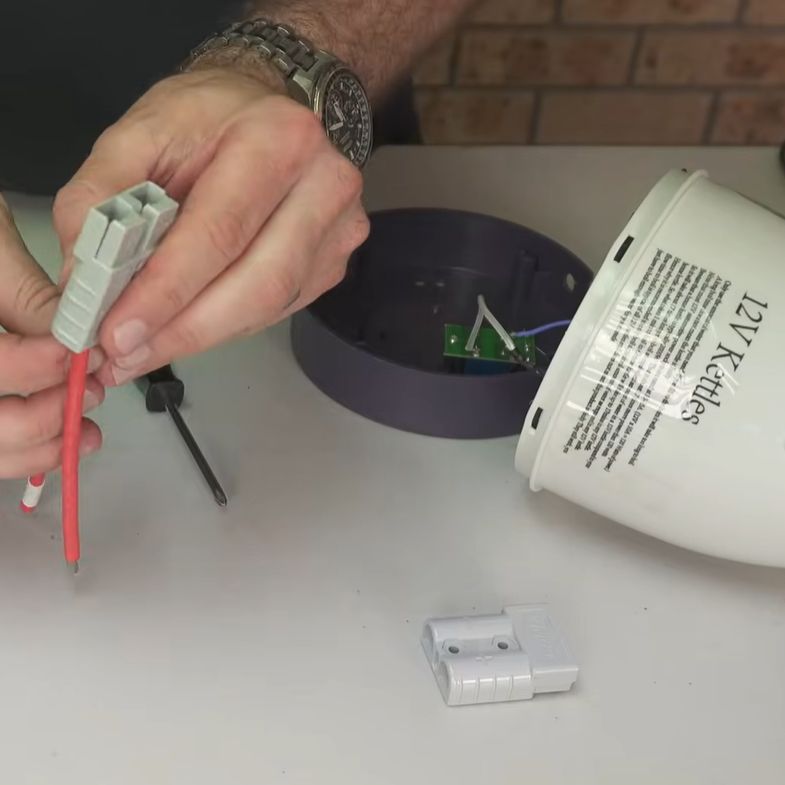
One change that does make a difference is how it’s connected. Replacing the thin gauge wiring and the attached cigarette lighter plug on the 12 VDC kettle with beefier cable and an Anderson plug made things run cooler, resulting in an efficiency bump of about 10%. This cut the time required to get the water boiling by around 6 minutes.
Added to this test were an induction hob and an iso-butane-powered Jetboil, both of which scored rather unimpressively. For the induction option it’s obvious that a lot of energy is wasted by having the pan radiate it away from the water, while burning iso-butane loses energy through the exhaust gases. Ultimately what you pick to boil water with should thus be mostly determined by convenience rather than sheer physics.












Elevation has a lot to do with the time:
Water boils quicker and easier at sea level than it does at 7 thousand feet
I suspect most of the tests were done at the same elevation.
Water boils quicker and easier at 7 thousand feet than at sea level.
Sea level = 100°C
7 thousand feet = 92.5°C
7000 ft = 2133.6 m.
I think that it boils muuuuch easier at 7 thousand feet as the pressure is lower there therefore it will boil at lower temperature.
Invert that. Pretty sure the reason you have to boil longer a higher altitudes is because it boils at a (quicker/easier) lower temp than sea level.
No, the boiling temperature of water is lower at higher place. 100°C is at see level. At Everest top it’ lower, something like 55°C if my memory don’t fail.
It’s about the local pressure .
493 g
[shakes kettle]
494 g
That itch to squeeze out morr accuracy made me smile. To avoid transfer losses and resolve the actual boil-off though, the whole disconnected kettle in dry, filled and as-boiled conditions ought to be weighed.
I’m confused how induction can be less efficient than resistive heating. In resistive heating, the energy is lost as the kettle becomes hot and heat is lost in the environment. Where are the additional losses of induction heating going to?
The heat from all the losses in the power electronics is not going into the target.
The resistive heating element is generally immersed in the water. Induction heats a metal pan, whose outer surface is not in contact with the water so it radiates heat away.
I still don’t get the point of this test. Oh, it’s to generate you tube views. I didn’t watch it.
Agreed, it is just YouTube revenue clickbait, somehow I keep managing to miss the play button :) .
A pointless test really if all you really want is 98C water in a cup ready for a tea bag etc within 10 seconds you just use one of the many instant fastboil water systems you can get for not much more than cost of a decent kettle. A bonus being, no heavy pot of boiling water to lift, energy consumption is only for less than 5 seconds, and nothing wasted in kettle to go cold.
This sort of thing… https://www.kitchenwarehouse.com.au/product/wolstead-instant-hot-water-dispenser-2-5l (there are MANY others, just first example I came across, NOT a recommendation) you can get much cheaper on your favourite chinese supplier website
The point of this test is that when you’re limited to a 12V supply (e.g. in an RV) the efficiency matters rather more than when you have mains power available.
My kids like noodles in the morning. So I always boil a pot of water night before, freeze it, and when they want noodles fast I just defrost it and presto – instant boiled water for your noodles!
I prefer the dehydrated boiling water – it doesn’t take up so much space in storage.
Well, that answers every students question if a heater has 100% efficiency
Go watch yourself. I don’t give a flying hockey puck about your “content”.
“This cut the time required to get the water boiling by around 6 minutes.”
The fact this was even possible indicates a problem.
Yours, Britain, the nation that built a peaking hydro plant so that the entire nation could make tea during an ad break.
350W is a little low for a kettle. UK kettles are 2.2kW to 3kW usually. Why only test caravan kettles?
The important thing is to boil just what you need but be aware of someone else coming along and asking for you to brew them a cuppa too.
yes! my wife always fills the kettle to like 4+ cups but we never make more than 3 at a time…meanwhile, i will put as little as 1 cup in there and then i have to stop and refill it when i find out someone else is interested in a cup.
Even in the states 350W is very low, about four times lower than most kettles, which tend to be 1500W.
Given how nearly everything is powered by switching PSUs these days I really wish the US would just get it over with and adopt the type C euro plug into the national electric code so we can st
Never!
Y’all are quitters. Imperial measurements forever!
Because it’s not just low voltage kettles but also one with a gas burner, and mains options hooked up to an off-grid inverter, with inverter losses factored in. All under the premise of off-grid operation.
The question is rather what that Jetboil gadget is doing in there, but it’s an interesting contrast.
But I agree: the original sin is that nobody has had the guts yet to merge a kitchen scale into the kettle base at the same price point ordinary units sell at. That way, you’d immediately know whether you overfilled or not.
From personal experience with cheap A*express load cells, I suspect the amount they drift away when heat soaks through the device negates technical feasibility.
Not sure if joking… all the kettles I have ever used have a transparent sight glass so you can see directly how much water is in there.
One glance at that chart tells me what I need to know. So long as I am in the US… skip the electric kettle and just use the stove. Reconsider this only if I ever find myself in a country with 240V mains. Unless I can find a kettle with a long cord that would plug into the electric stove outlet… Is that a thing? Would making it void my insurance? I might have to do some research now…
The chart doesn’t cover any 120V kettles, but others have (like [Technology Connections] on youtube).
Despite what you might expect, a 120V electric kettle will still typically boil water faster than a kettle on a gas stove or even a conventional 240v electric stove due to superior heat transfer.
The chart does demonstrate that a 240v induction range would beat a 120v kettle handily, if you have one of those.
No idea what insurance would say about using a 240v kettle off a US 240v plug, but you would hardly be the first person to do it. There are adapters.
I personally wouldn’t want to use a case-grounded kettle on US 240v, as there’s no ground, just a neutral in between two 120v phases. But a double insulated one would probably be fine.
It looks like efficient ways to boil water while boondocking (a North American term for RV parking anywhere without services). But it does open up the relevant discussion about fastest hot water in our kitchens where energy is available for the task.
Suggesting joy with 3000W Euro sourced kettle for speedy water boil for North America where all kettles are 1500W limited by 120V and 15A circuits. But a Euro kettle that is rated 3000W @ 240V (2755W @ 230V) is a dream. Twice as fast! Just had to wire a Nema 6-15R outlet (240V @ 15A) into my kitchen and feed it with a double pole breaker (and change the cord plug on the kettle). Per the video test method, 500ml (measured by weight… “mass” for metric purists) at 20C into the kettle takes 60s to boil and 10s additional for the kettle to shut off. 491 ml comes out as measured by digital scale. 60s! Barely enough time to get the cup and teabag ready.
Or just use an on-demand flow-through heater, and have 90+ C water pouring into a cup+tea bag to start brewing in 5 seconds from a cold start. Have a full cup of tea in less than 60 seconds.
That’s from a 120 V 15 A circuit. I use mine every day.
man this is the second comment here about adding extra high-capacity receps in the kitchen and it’s really tickling my urge to do that so i can get the ~3000W stand-alone electric induction wok
If all you want is an electric wok, why not skip the inefficiencies, unreliability, expense and noise of the induction part and just get a 120 V directly-heated electric wok?
It’s going deliver the same amount of heat to the interior surface, be just as fast, and much more portable to other locations.
i guess no reason…i’ve just never heard any bad things about the induction product other than that the ~1500W version is a disappointment
American kettles are just awful. Was back home in Ireland two years ago for a 6 month stay, my €35 ALDI kettle knocked out a full load in 90s… here I wait forever. Also shout out to British style plugs. The best.