
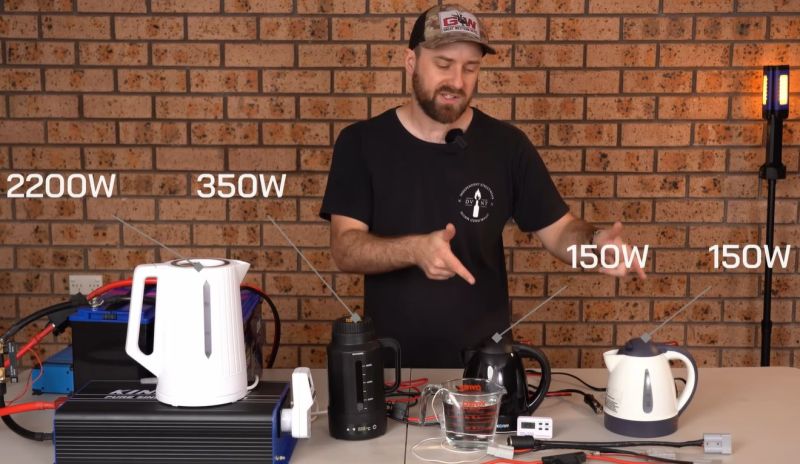
If you have a 12 VDC power system, like the battery of a PV solar system or car, would it be more efficient to boil water for that cup of tea with that 12V straight from the battery, or use a 240 VAC mains kettle via a ~90% efficient inverter instead? That’s the question that [Cahn] decided to answer experimentally, using a bulky 3 kW inverter and a collection of electric kettles.
Although the used amount of 500 mL of water is boiled much faster in the 2,200 Watt mains kettle than in the 150 and 350 Watt low-voltage kettles, this obvious difference is somewhat irrelevant if you’re only concerned with efficiency. To measure the power used a Victron smart shunt was used with each run, keeping in mind that a perfect efficiency for heating 500 mL from room temperature to boiling is around 43-44 Wh.
With two runs per kettle, the 240 VAC kettle used 65-70 Wh. The first ‘150 Watt’ kettle pulled nearly 200 Watt to boil the water after about 20 minutes, using 62-64 Wh. The second ‘150 Watt’ kettle pulled around 180 Watt, took 23-25 minutes and used 68-74 Wh. Finally, the ‘350 Watt’ kettle drew over 420 Watt and used 50-56 Wh in just over 8 minutes.
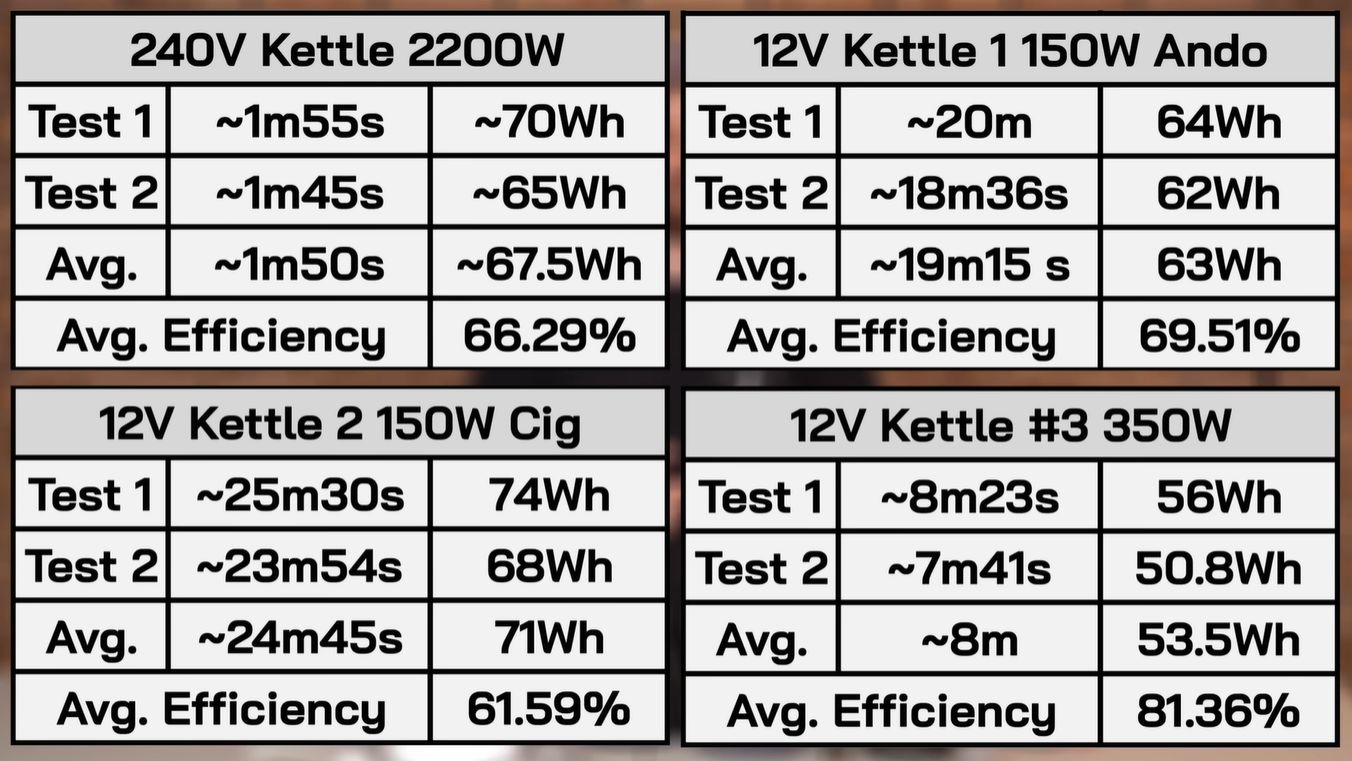
When you look at the final results, it’s interesting to note that the low-voltage kettles got both first and last place in this contest, even when factoring in the inverter losses for the 2.2 kW kettle. This makes it quite obvious that the issue at hand is less about DC vs AC or mains vs low-voltage.
The 350 Watt kettle is clearly better designed, featuring a level of insulation that the cheap 12V kettles lack, while pumping more energy into the water at a much faster pace due to the higher current.
Of course, this also shows the whole headache of using 12 VDC appliances like this, as you can only pull so much current from a cigarette lighter socket, while connecting directly to the battery and its juicy 100 A or more poses its own logistical problems. Taking the inverter losses as the price to pay for convenience is thus another totally valid option whenever you’re out camping or at that off-grid cabin.












Extended to AC outlets…. North American 120V outlets are limited to 1500W (due to 15A wire and 80% rule). Europe has “3000W” kettles (actually 2755W at 230V). @240V they are 3000W and work 2X faster than any 1500W kettle. Just have to cut off the Euro plug, and replace with a NEMA 6-15P along with an outlet in the kitchen. Dual 120/240V electrial approved outlets are available through Amazon, just not GFCI, so must be more than 2m/6ft from sink. Easy to convert a split plug where one exists.
As far as efficiency is concerned… same size wire, but 2X voltage, and very rapid boil gets water to temperature faster than it is loosing heat through kettle wall. If you like tea or use boiling water all the time, this is the answer.
Bad idea. Euro 240 has one hot and one neutral. US split-phase 240 both wires are hot. Euro kettles are not designed for that and are not safe with both wires hot.
How does the unpolarized plug know which line is hot and which is neutral?
Unpolarized 240V plugs?
Would you prefer “unpolarised” then?
Never mind the UK type: The EU Schuko types (generally) are not polarized. The appliance generally can’t know, tell, or care which line is hot and which is neutral. The appliance will care only the voltage difference between them. And it would thus make no difference if both are hot relative to earth.
Some EU ones were reversable at some point, I think, but Australian 240V plugs have always been polarised. Wouldn’t matter as long as neither active nor nuetral is chassis connected directly, which they aren’t. It’s the difference between the two that does the work.
Not sure what the US does with the 2 wire reversable, how they handle chassis safety but I can’t imagine it’s too different. And I think of anything I own that is has a chassis connected nuetral.
The device floats away from earth safely, or the chassis is grounded on a third wire (green colour) to a house-common spike at the switchboard. RSD breakers do the rest.
— General comment
Interesting article, and a great set of benchmarks. A long time for water to heat though. Small fire would win, I think.
Every time I try to boil water over a fire I am amazed at how long it takes. There are “campfire” kettles that have a hollow centre, like a chimney up the middle of the kettle to increase the surface area exposed to heat. I haven’t tried one of these but presumably they would be a bit faster.
That’s actually perfectly fine and safe.
Neutral is only considered a reference for zero volts. So wiring it up to two anti-phase 120 volt sources IS exactly the same as a 240 volt source and neutral.
Otherwise, the nominal 380V AC relay in my transformer based MIG welder, by your logic, should also be a bad idea, since the coil is powered by the voltage between two of the three phases of 380V AC.
Actually…
US 15A service comes to 1800W, not 1500 (120 x 15 =1800).
Also, Technology Connections on YT has already debunked the 2x claim, showing that the difference between a 120V and 240V heater was about a minute (or so).Lastly, if you need hot water for tea (whatever that is), then just buy a Bunn-o-matic. It keeps it’s tank of water hot all the time, so you only wait for gravity to take effect.
A circuit is typically rated 15A. But any one appliance or outlet (specifically a corded plug-in appliance) is only rated 12 amps continuous due to the so-called “80% rule”, so (most) appliances have a maximum rating of 1500 watts. You’ll see some temporary-use appliances (like hair dryers) that bend the rule and boast 1800 watts, but anything that might see long-duration service will only draw 1500 watts.
Holy moly 20+ minutes to boil water for a cup of tea!? My not even great backpacking stove only takes a few minutes. When you want a tea or coffee waiting that long is rough, man!
If I was stuck with one of those kettles I’d just buy a JetBoil and be done with it.
If you want easy access to 12V power at higher current, install some Anderson Powerpole outlets. Two 45 amp sockets fit in the place of a single cigarette lighter socket. Larger connectors are available if more current is needed.
The problem is 45 amps requires a lot larger cable than 15 amps otherwise the cables create more heat than the kettle and catch fire.
Before you jam some PowerPoles together, study the datasheets, especially the derating curves.
The 45 amps is true, but only for a single connector in free air. A pair together in a mounting plate need to be derated significantly.
With 10 ga. wire and 45 A contacts you can get 30 A out of a pair, or 55 A out of two pairs in one 2×2 block.
“some Anderson Powerpole”
Great…. a APP fan boy…. prob. a ham.
Give me a Wago anyday.
Ah, a Wago fanboy, I see. And I presume you mean the lever-type of Wagos popular among that set, and not some of the other types of that brand.
Why would you use a Wago where a PowerPole is more suitable, and vice versa? They’re two very different types of connectors, for very different purposes.
Not a chance on PowerPole, way too flimsy, give me Anderson SB50 or better yet XT60/XT90
You’re about to enter welding cable conductor diameter territory with Anderson PowerPole connectors.
And Copper’s gotten crazy expensive since EV’s started to become commonplace.
I have often thought about comparing 3 types of efficiencies for boiling 2 cups of water.
Energy Efficiency
Cost Efficiency
Time Efficiency
for Microwave Oven vs Gas Kettle vs Electric Kettle
I never have. All I have is the time to tell you I have thought about it.
You haven’t, but Technology Connections (or Technology Conextras) has.
I have district water heating and I always wondered what was more cost efficient: fillimg my electric kettle with 70°C water from the district heater, but throwinf the first two litres away (as it takes flow for the hot water to arrive at the tap) or boilong cold water in the kettle.
I empty cold water from my kettle and fill from my heat pump HWS. I only have about 1.2 meters (4 feet) of insulated copper pipe to my sink
Use RO water. No calcium deposits. No need to descale. Always clean kettle, clothes iron, coffee maker. Point-of-use heating is most efficient.
hot tap water may not be safely drinkable, it is often suggested to take cold one instead for best quality
That seems like a strange old wives tale.
Why should water coming out of a (de-facto) sterilizer be less safe than the questionably-treated water out of the cold water tap?
I’m on a municipal water supply drawn from a local big lake. From time to time I measure the chlorine content of the incoming water(*). It varies between 1 ppm to unmeasureable (< 0.1 ppm). Word is the water treatment plant modulates the chlorine according to demand. In stormy and/or hot weather apparently they need to inject more chlorine. So they monitor it, but I still don’t trust it, so we filter our drinking water. Also because the city supply contains 300-600 ppm of other gunk, depending on season.
(I sterilize my filtered water downstream plumbing after a filter change, and have the measuring kit to ensure the chlorine content is back down to <1 ppm before putting the system back in service.)
original poster I was reacting to said “I have district water heating”, I am not sure what is it exactly but long pipes of warm water may have some extra bacteria living there, overall hot water may not be tested to be drinkable and may be even meant for just washing, not drinking, but it probably depends on the country. try to google or ask AI for “shoud I make a tea from hot water from the tap or take cold water and heat it?” to see some reasons
My post was a reaction to “I have district water heating”, how did you came to conclusion this equals to sterilizer?
I suggest you google (or ask AI) for this phrase “should I make a tea from hot water from the tap or take cold water and heat it?”
And BTW in some parts of the world the hot water is actually not meant to be drinkable, only cold one is (for the reasons you find by googling).
Commenter said district water was 70 C. That sterilizes.
And ask AI (i.e. LLM) for accurate information? The regurgitated pap from a hallucinating algorithm fed by the aggregate of old wives tales related in the echo chamber? You’re kidding, right?
In England they have/had open top water heaters in the attic (for gravity feed).
Their hot water is not potable.
Of course England, they’re going to boil something in the water for about a week, then gum the mush.
In South Africa we had elevated cisterns (water tower) to store water. They in turn fed the geysers (water heater) in the attic space. All gravity fed. The pressure difference between the two made mixing water in the shower an interesting and sometimes exciting exercise.
And we still drank the water. But, heck, it was Africa a half a century ago. What did we know? Those of us that survived are stronger for it, right?
To elaborate:
Into my apartment come cold water and two pipes for scolding hot (85-90C) unpotable (it has some anti-rust additives and a very oily smell, I know from draining my radiators once) water and a return pipe. The hot water goes directly trough the radiators (well, regulated by a whole-appartment flow valve, and per-radiator thermostats, digitally controlled by honeywell evohome system, best investment into heating comfort I’ve done).
The hot water also goes trough a heat exchanger, which produces the hot water I drink and shower with from cold water. It also has a small (+- 2L) reservoir that is kept above 60 degrees (except when no heat is required for 7 days, then it goes into eco mode. The manual explicitly warns to let the water flow for a minute after a holiday)
Living in the Netherlands, the cold water from the tap is very drinkable, and such is the hot tap water. However, in summer heatwaves I sometimes worry about the “cold” tap water as last time it came above 12 degrees. Fortunately there is decent enough flow such that bacteria such as legionella can not really thrive, but it’s way to war to be called “safe”.
I’d guess legionella disease, which in certain circumstances is known to lurk in hot water systems.
Another factor could be leaching of material from hot water piping, since heat expedites chemical processes.
But former should be killed by throughly boiling the water anyway, and latter I can mostly see being a issue in old houses with lead piping or something similar.
So it’s another case of: it depends…
the main concern in the US is that water 120 not, plus, you are about to boil it…
hmm that got cut off. if over 120F probably ok legionella as mentioned above if below 120F, but you boil it anyway.
My on-demand countertop heater starts producing 90+C water (actually very wet steam) about 5 seconds after I push the ‘go’ button. In less than a minute I have 250 mL of water in a mug, and the tea within has already been brewing for almost a minute.
It’s rated 1500 W (though I have not measured that). According to the stopwatch, thermometer and measuring cup that works out to 93% efficiency.
heh i think about it sometime, no deeper than you do, but i came to this:
my microwave sucks, i guess
regular copper-bottom kettle on the electric stove works pretty well
the immersion heaters (electric kettle style) are faster but eventually leak or burn out their connectors or etc
turns out side-stories outweigh the core question imo
What’s even the point of this experiment. The energy needed is identical so he’s just comparing efficiency. DC vs AC isn’t really the interesting point.
The point of using AC is to get a lot of energy to the appliance without a cable as thick as your arm.
He should just shorten the cable, and/or move to 24/36/48v easily done by putting 6v, 8v or 12v batteries in series.
I watched a great video from Japan, it is about a company there making a modern version of a traditional portable charcoal stove.
Kettle #3 could be more efficient because the cylinder of water matched the diameter of the heating element. Therefore, the temperature differential due to convection at the heating plate was the highest and resulted in a slightly higher rate of energy transfer.
Quite handy to know if you have a small solar system and just want to match your kettle, so nothing gets drawn from the grid.