
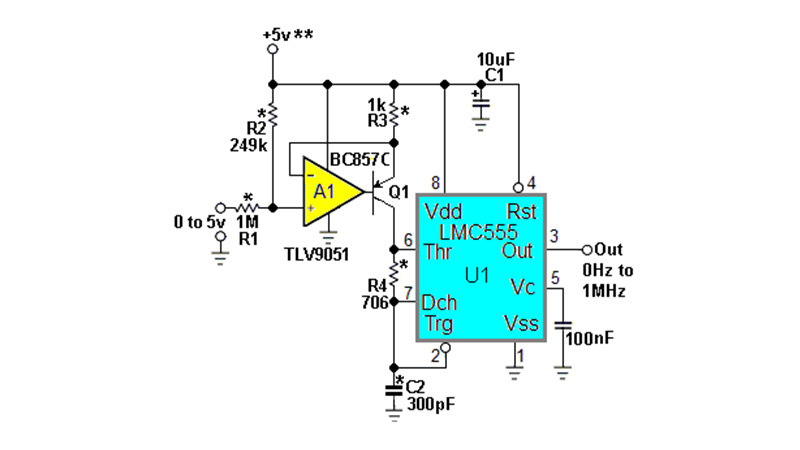
The humble NE555 has been around for over five decades now, and while during that time we’ve seen a succession of better and faster versions of the original, the circuits which surround it are pretty well known. There can’t be anything new in the world of 555s, can there? [Stephen Woodward] claims he’s made a novel 555 circuit, with his 1 MHz linear voltage to frequency converter. Since he’s been in love with the 555 since 1974, we’re inclined to trust him on this part.
It’s visibly the 555 astable oscillator we’re all familiar with, given the addition of a current source in place of the normal charging resistor. This makes for a much more linear sawtooth waveform, but it still doesn’t fix the linearity of the voltage to frequency curve. The novel bit comes in adding an extra resistor between the threshold and discharge pins, with a value calculated for a time constant with the capacitor to match the 555’s own switching delay. This provides the necessary compensation, and gives the circuit its linearity.
This is so brilliantly simple that it’s almost a shock that it’s new, but it’s also a great example of the old-school electronic engineer’s art. We can’t think of an immediate need for a 555 voltage to frequency converter on the Hackaday bench at the moment, but you can bet we’ll come back to this one if we do.
We had someone pushing a newer 555 variant to its limit, when we ran our component abuse challenge.












Combine this with a phase comparator and a loop filter and you’ve got yourself a discrete PLL.
I like the way you speak!! Novelty is a wonderful tool!
Well, if you use a smoothing capacitor and resistor, you could make pwm-controlled frequency convenrter. If you made a frequency to voltage converter, you could have frequency controlled frequency converter, which would be as usable as a voltage controlled voltage converter aka fet transistor, but for frequency. Now, you can build a spiking neural network out of such elements.
very interesting
Stephen Woodward and EDN have a comments section on this very circuit, at
https://www.edn.com/1mhz-555-vfc/
Why don’t you log in and leave a version of your comment there?
Mr Woodward would be glad to hear from you.
Smile
A place where it is best to be seen, not heard.
“… cuts short the duration of the positive-going timing ramp and thereby the sawtooth period by the same amount that the delays lengthen…”
The tradeoff is that the amplitude of the signal will vary with the frequency, because it’s essentially moving the switching thresholds closer together to kill off the switching delay.
Oh wait, it wasn’t outputting the sawtooth ramp but the square wave. Nevermind.
Part of a DIY analog to digital converter?
This, exactly. BTDT and a fundamental improvement is certainly appreciated.
One of the beauties of a V to F converter is you don’t need an analog input on your cpu to measure voltage. You just count the number of falling or rising edges in a fixed length of time and that corresponds to the voltage. The precision of the measurement depends on the period of time you count the edges.
Could this be used as a voltage controlled oscillator…. Y’know , synths?
That thought crossed my mind, too.
But I recall synth VCOs… at least the Moog-compliant kinds…. are not linear but exponential, I.e. 1 V/octave.
A great many of them are linear VCOs with an exponential converter at the input.
The upshot is that since you’re controlling the conversion anyways, you can fudge the non-linearity of the VCO away by overshooting the exponential. Since you have to tune the circuit anyways, you simply tune it so it results in the right frequencies coming out, and never mind the fact that all the parts in the middle are a bit wonky.
Just tossing this in here for posterity.
https://www.eddybergman.com/2020/12/synthesizer-build-part-37-thomas-henry.html
https://github.com/gerb-ster/TH-555-VCO
https://www.youtube.com/watch?v=wnXtOu3ljA8
And for the truly deep dive: https://electro-music.com/forum/forum-148.html
Hackaday- giving the people what they want to see.
In some cases, as in this example, it takes us back to the root of the matter.
A new VFO for synths, hell yeah!
Could be used at the core of a Widlar Hassler implementation. Peak detector on the front end and a little audio amp on the back into a speacker.
Use the cmos version as the old 555 is good to 100 kHz or so.
It’s kind of unfair to the guy to post this on April 1, the day you can’t trust anything on the Internet!