
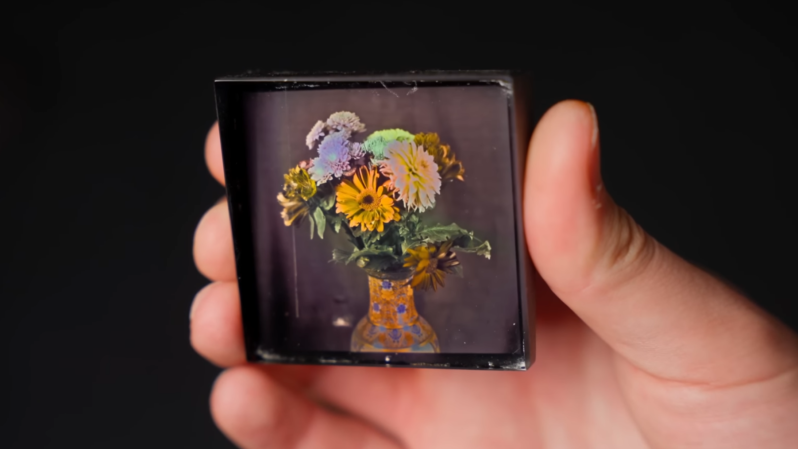
Although modern cameras can, with skill and good conditions, produce photographs nearly indistinguishable from the original scene, this fidelity relies on the limitations of human vision. According to the trichromatic theory, humans perceive light as a mixture of three colors, which can be recorded and represented by cameras, displays, and color printing; a spectrometer, however, can detect a clear distance between the three colors present in a photograph and the wide range of spectra in the original scene. By contrast, one of the earliest color photography methods, Lippmann plates, captured not just true color, but true spectra.
A Lippmann plate, as [Jon Hilty] details, starts with a layer of photographic gel containing extremely fine silver halide crystals over the back of a glass plate. This layer is placed on top of a mirror, traditionally a mercury bath, and put in the camera. When light passes through the emulsion and reflects off the mirror, it interferes with incoming light to create a standing wave. The portions of the emulsion at the wave’s antinodes absorb the most energy, converting local silver halide crystals into reflective silver. The spacing of the silver particles depends on the incoming light’s wavelength, and is fixed in place during the development process.
This creates a matrix of vertically-stacked diffraction gratings, each diffracting back the original wavelength when illuminated with white light. Unlike normal diffraction gratings, the wavelength of diffracted light doesn’t depend strongly on the viewing angle; since the interference structure here is vertically-arranged, it refracts a narrow range of wavelengths across all possible viewing angles. The viewing angles, however, are limited; unlike with dye-based photographs, you can only view the colors nearly straight-on. This, along with the necessity for long exposures, the chance of producing washed-out colors, and the impossibility of creating reprints, kept Lippmann plates from ever really catching on. The basic concept lives on in holograms, which encode spatial information in a similar kind of photographically-formed diffraction pattern.
For a more conventional method of color photography, we’ve also seen a recreation of the autochrome method. Alternatively, check out this homemade silver halide photography emulsion.
Thanks to [Stephen Walters] for the tip!












This was an extremely funny time to check this site.
Woah! Thanks for all you did to revive this art. I would love to try to make my own Lippmann plates. Seems expensive to get into though.
Hey there, thankyou!
I guess the definition of expensive will vary from person to person, but they’re not super bad – probably cheaper than wet plates even when figuring in equipment (which, to be fair, aren’t exactly cheap either).
Silver nitrate is probably the most expensive chemical that gets regularly consumed. But you only use 1-1.5g per 200mL of emulsion, which gets you a good 50-60 plates if you shoot in tiny 6×6 format like I do.
The spectral dyes have a large upfront cost, but you use them at 1:1000 dilutions, so 1g of each will last you a solid decade (as long as you don’t drop a bottle and leave one of the most expensive stains of your life on the basement floor like I did).
You can skimp on the lab equipment and get by with thrift store kitchen supplies, but you’re just shifting monetary cost over to time investment considering all the extra babysitting you need to do to keep the temperatures in range.
I give it an overall expensiveness rating of “Not great, not terrible”.
Makes sense to me, thanks for the encouragement. I’ll probably get into it in a few weeks once a few paychecks go through. I was reading about how people aren’t using mercury anymore. But is it really as simple as having an air gap instead?
Yeah, you can get by with an air-gap. The one in the video thumbnail was made that way. They tend to come out with cooler tones than metallic-reflection plates, and are way more susceptible to processing-induced shrinkage, so you need to swell the plates with glycerin or citric acid after development. During development, there’s a tradeoff between brightness vs. saturated colors, and I found air-gelatin plates are a bit harder to get just right.
Last summer I did a lot of work with rubbing reflective mica powder onto the back of moistened plates before exposure, and then cleaning it off with IPA before development. This seemed to work pretty well as a mercury alternative, and overall seemed to give you a much wider “goldilocks zone” during development. Most of the other ones Steve showed off were made this way
You can use Galinstan instead of mercury perhaps, and have no airgap.
I actually have a fairly old video on that!
https://www.youtube.com/watch?v=d0amad5OZf0
I will say, though, I was a lot younger and much, much worse at designing/building stuff back then, and I think this is worth a second look.
The issue with galinstan is the oxide layer that rapidly forms on contact with air. The video largely covers the difficulty in removing it from the plate without damaging the emulsion, but I regret never actually designing a back to fit into the camera and shooting one. I used to have concerns that whatever gallium oxide in contact with the plate wouldn’t produce a good enough reflection either so it would be really “spotty”, but the success with mica seems to indicate you can still get really good results with a fairly imperfect reflection.
I’ve thought about using EGaIn, which has a bit higher freezing point than galinstan – the thought being that I could shoot the plate with it as a liquid, and then freeze it and pop it off in one chunk.
I did also try pure gallium, by melting it and pouring it against the plate in a mold, and allowing it to solidify. This actually kind of worked – I got super bright colors, but they were all “wrong” compared to the rest of the scene, and I couldn’t figure out a pattern to explain them. The plate took on a lot of fog too, which may have been from the gallium expanding as it froze.
The success with mica made me pump the breaks on liquid mirror systems, but before that I was really considering mercury-indium systems. It’s not perfect, but it does cut down significantly on the amount of mercury vapor that gets released. I’m interested in trying it still just to see how it performs, but I don’t plan on ever having mercury be a part of my normal workflow. I imagine in the process of designing such a back for mercury, I’ll be testing it out with galinstan beforehand, so I’ll definitely shoot a few plates with that just to see.
For the liquid metal mirrors, there’s some non-gallium non-mercury alloys, although most of them involve lead. The best non toxic one is Field’s metal, which I’ve made. It seemed as if it was a little less keen to have oxide problems than gallium, but it still had a bit. Maybe the way to go would be to fill the container first with a safe liquid like whichever of water, alcohol, or oil would not interfere, then squirt in the denser metal displacing the original liquid. Would have to all be done hot though, for these types.
That could work. I’ve kind of considered looking into those alloys – I’m not keen on working with the ones with cadmium/lead, so I think Field’s would be the way to go. It’s just a bit too hot to make me worry though – traditional film can take on fog when exposed to heat. 62C should be low enough to get away with, especially for a shorter period of time, but that really is getting close to the upper limit.
The Lippmann emulsion seems like it is overall, just, less robust than your typical AgX emulsion. I have kind of conflicting results, so I’m not 100% on this, but it seems like they might be sensitive to contact pressure on the plates itself. That reason alone may mean that the heat could cause fog. That being said, I’m wrong more often than I’m right when it comes to these things, so I think it’s undoubtedly worth a shot!
I’m curious, because I’ve never talked to someone who has worked with it before. If it solidifies against a flat surface, do you think it would be reasonably shiny / mirror-like?
I’d say it’s shiny, yeah. I’ll try and remember to get a picture or video.
When it solidifies on something smooth like glass, you get a good shiny result as on the left side of the picture. When you reuse it enough times you get crusty stuff that can be separated by taking it off the top if melted in a tall narrow container. Also it can cool too fast and be matte if poured onto cold metal in a thin layer. https://usercontent.irccloud-cdn.com/file/tGOesh5n/P_20260508_200325.jpg
Thanks a lot for sharing that – there’s a fair chance that’ll work! I’ll pick some up and try and play around with it!
Seems well worth it to try to find a way to do this with a modern method, something electronic or electronically readable and resetable at least.
Addendum: We have nanometer chips and stacked chips with hundreds of layers, perhaps there is a way in with modern technology because of that.
Although, perhaps we could somehow ‘read’ the silver particles instead, using quantum based phenomena perhaps and capacitance to get the capability to do so, while suspending them in some gel or something?
Addendum 2: it would be a very small sensor and a shitload of data of course, perhaps transferring the result directly to some static medium would be better than digitizing it, but if you can digitize it then you can relay it, and then you can get the research and development financed by the promise of interest from the defense industry. (or do we have to call it the ‘war industry’ now too?)
What is it with you and Musk and Kanye? Just take the medication in a timely manner and you stay out of trouble! Благодаря предварително.
Lensless imaging.
Obtaining the image via diffraction isn’t too difficult, having the connectivity to get the data out of the chip is the tricky part.
Chemical photography, essentially molecular level pixel quality in some cases, will probably always surpass digital silicon chips.
IS there one method that does this? As far as i know, it was always some sort of micrometer-sized cristal, efffectively resulting in HD or FHD resolution max.
The spectrum captured will depend on the illumination spectrum at the time of capture. Ideally, the spectrum when viewing the photograph should be the same as during the capture time.
I was already dealing with a bout of insomnia, and thinking through this comment made it so much worse…
I think this isn’t true — with the caveat that I might totally be missing something obvious. But if you were to shoot a scene at, say, golden hour, with disproportionately strong warmer colors, then the longer fringes would form disproportionately strongly in the medium. To accurately replay that scene, you would want to illuminate it with as even as a spectrum as possible. Viewing it with a spectrum of light similar to your original scene would result in the warm rays being doubly represented – first from just being brighter in your illumination source, and then from the extra corresponding fringes in the medium.
There are also bandwidth issues that causes ringing across the captured spectrum. I saw a study about this a while back where they took spectra of the image and the photograph(?). Though there’s a close correspondence there’s some post processing required to get it back into shape.
I just saw a headline of an article which was about people wearing bathing-suits/bikinis to watch a classic painting of bathers in a museum, supposedly to experience it more authentic.
So don’t forget the appropriate outfit too with your full spectrum images. :)
No. In that case the parts of the spectrum that are half as bright as the rest would appear at only a quarter of the brightness.
Ideally you want a completely flat spectrum.
Correct me if I’m wrong.
It seems like a fascinating process and no doubt difficult to dial in.
If the ingredients ever happen to be in my possession at the same time, I may well have to give that a go. There’s definitely some deal of experimentation to the process. Until today I’d not come across Lippmann photography, it’s certainly been a good introduction. It’s good to learn something new every day.
New to me too, but I read:
Invented by French scientist Gabriel Lippmann in 1891
and:
Lippmann won the Nobel Prize in Physics in 1908 “for his method of reproducing colours photographically based on the phenomenon of interference”‘
Won the nobel prize and somehow I don’t recall ever hearing about it.
I would not be surprised Einstein congratulated him, he was into pondering on and researching light too.
Also, on wikipedia, and posted because it is so interesting:
Other sources of Lippmann plates
The Kodak Spectroscopic Plate Type 649-F is specified with a resolving power of 2000 lines/mm.
A diffusion method for making silver bromide based holographic recording material was published.
Durable data storage utility
Because the photographs are so durable, researchers have reworked Lippmann plates for use in archival data storage to replace hard drives.
Work began on the project after they were made aware data storage on the International Space Station (ISS) requires daily maintenance because it can be damaged by cosmic rays and they recalled that silver halide would not be significantly affected by astroparticles (or even electromagnetic pulses from nuclear explosions). 150 standing-wave storage samples placed on the ISS during 2019 showed no signs of data degradation after exposure to cosmic rays for nine months.
Gotta wonder when we mix paint or create video with red-green-blue if another animal would simply see these as separate intensities of three colors instead of purple, orange etc.
That is probably the case. Our eyes are far from the best and our brain does a lot of post processing. Even making up colours that don’t exist or combining them in odd ways.
Think about purple, it has a wavelength shorter than blue yet we can make it with a combination of blue and red (if you averaged the wavelength you would get something like green) basically because our brain turns the visual spectrum into a loop rather than a spectrum. So if blue and red are activated with no green is knows it can’t be green and instead goes the other way joining the red end of the spectrum to the purple end.
My explanation likely isn’t the best but it is something worth looking into.
It’s not (only) our brains that turn the colour spectrum into a loop. Our red and green cone cells both have small sensitivity bumps near the peak of sensitivity of the blue cone cells, so something that’s violet actually does send more red to our brains than something that’s blue.
That’s interesting. I wonder if that is deliberate (assuming evolution can be deliberate) or if it is just a flaw.
Evolution does not do design optimisation. If something works, it sticks around unless there’s a reproductive advantage to changing it.
That was what I was badly trying to ask. Does the blue sensitivity have any advantage or is it just a flaw that isn’t bad enough to be removed through natural selection?
I imagine this would please the tetrachromats among us who for the first time would see color photographs that agree with how they see the world.