Although modern cameras can, with skill and good conditions, produce photographs nearly indistinguishable from the original scene, this fidelity relies on the limitations of human vision. According to the trichromatic theory, humans perceive light as a mixture of three colors, which can be recorded and represented by cameras, displays, and color printing; a spectrometer, however, can detect a clear distance between the three colors present in a photograph and the wide range of spectra in the original scene. By contrast, one of the earliest color photography methods, Lippmann plates, captured not just true color, but true spectra.
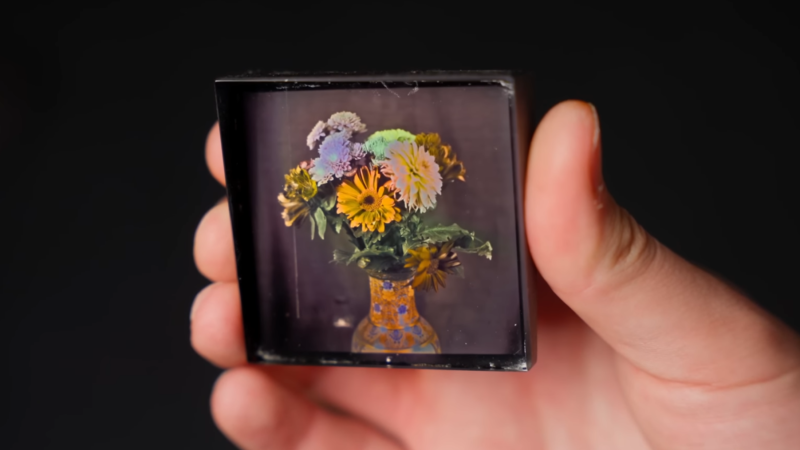
A Lippmann plate, as [Jon Hilty] details, starts with a layer of photographic gel containing extremely fine silver halide crystals over the back of a glass plate. This layer is placed on top of a mirror, traditionally a mercury bath, and put in the camera. When light passes through the emulsion and reflects off the mirror, it interferes with incoming light to create a standing wave. The portions of the emulsion at the wave’s antinodes absorb the most energy, converting local silver halide crystals into reflective silver. The spacing of the silver particles depends on the incoming light’s wavelength, and is fixed in place during the development process.
This creates a matrix of vertically-stacked diffraction gratings, each diffracting back the original wavelength when illuminated with white light. Unlike normal diffraction gratings, the wavelength of diffracted light doesn’t depend strongly on the viewing angle; since the interference structure here is vertically-arranged, it refracts a narrow range of wavelengths across all possible viewing angles. The viewing angles, however, are limited; unlike with dye-based photographs, you can only view the colors nearly straight-on. This, along with the necessity for long exposures, the chance of producing washed-out colors, and the impossibility of creating reprints, kept Lippmann plates from ever really catching on. The basic concept lives on in holograms, which encode spatial information in a similar kind of photographically-formed diffraction pattern.
For a more conventional method of color photography, we’ve also seen a recreation of the autochrome method. Alternatively, check out this homemade silver halide photography emulsion.
Thanks to [Stephen Walters] for the tip!