
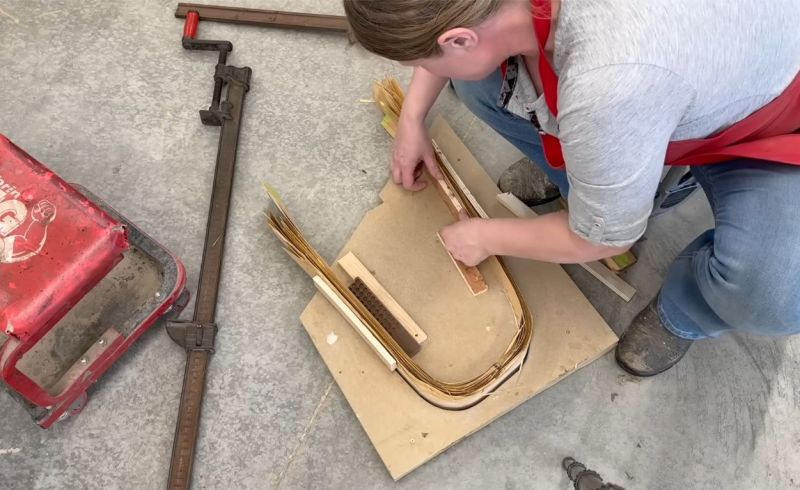
Everyone loves those rather bouncy wooden lounge chairs that got popularized by a certain Swedish seller of furniture, but as tough as they are, the laminated wood can still break at some point. The chair that [John’s Furniture Repair] got in for repair had cracked right around where a bolt hole had been drilled, apparently creating a weak spot that over the years turned into a crack.

The way to fix this issue is to recreate the one piece of curved, laminated wood as demonstrated in the video. This starts with tracing the contours of the original part on a piece of MDF, which then gets doubled up by a second plate of MDF. After cutting out the contours this then creates the two halves of a mold for the laminated part.
Next is preparing the layers of wood that will become the new part, making sure to keep the same final thickness as the original. With everything glued up the layers are put into the mold, clamped down and the glue left to dry.
Finally, the part is freed from the mold, cut to its final size, and sanded down to prepare it for final treatment and installation on the lounge chair. Perhaps the only negative one can say about this kind of fix is that after you’re done, you really get that itch to sand down and re-lacquer all of the other parts as well so that they also look new and shiny.












I thought those chair frames have a lifetime warranty. Where I work if one breaks we take it and exchange it.
Maybe the owner is a long way from an Ikea and/or wanted the challenge.
If the grain are all in the same direction, this new leg is not going to have the strenght of the old one.
It’s in the right direction for the load it’ll get. It might split lengthwise, but that’s gonna be a problem for the next restorer.
Well yea, but theres strain on the screw holes, so its likely the split there, rendering the leg useless, with much less load than the old leg. I’d be interested to see someone throw their butt in the seat, like some older teenager might do.
If this was real wood, how do you think the grain would go around the screw holes then?
I mean, natural wood.
That sort of leg is usually steam bent plywood, so every other layer will have the grain perpendicular, giving it strength in both directions.
You can even see it in the way the old leg broke; it’s definitely steam bent plywood.
It is probably NOT “steam bent plywood” but purpuously created plywood. The sheets are bent in this form (easy because they’re thin sheets) and then glued and put into a mould.
In such a lamination all the grain runs the same direction.
Source: Being a cabinet maker and having built a chair with a lamination like this myself (although not out of individual sheets of ply, but out of 3mm slats, which were soaked in lukewarm water for an hour, then formed (without glue) and dried, then glued in the same mould. All the grain in the same direction.
It doesn’t look like it. It would have more distinct layering, because the end grain soaks up the stain a lot better.
It is steam bent plywood, but it’s the same sort of lamination as the repair.
FWIW, when I’ve made this kind of thing I have never tried to pre-bend the layers, just glue them up and clamp them onto a former. You do get a bit of springback but it is nicely calculable.
Wood expands and contracts along the grain depending on seasonal humidity. When constructing large thin sheets of laminated wood alternating grain makes the piece quite a bit stronger. For a piece like this alternating grain makes it weaker not stronger as the layers become prone to delamination as they expand and contract in different directions. Having all the layers running in the same direction causes the piece to function more like a solid piece of wood grown in a more complex shape than nature usually allows.
The issue with the original design is that the screw hole was drilled too close to the end of a curve. This region is subjected to more tension and flex, the screw rigidly preventing that flex from spreading along the form results in crack formation. If the screw was set another in or two higher, in the straight section it would be less likely to cause crack propagation.
Look at the break of the old leg, that is definitely not a solid wood break. It’s plywood. You can clearly see the delamination on the back. And the way it broke indicates grain in both directions, otherwise the crack would have travelled along the the piece instead of across it.
Source: worked with furniture and steam bending (and we did chair legs, not exactly like this, but for the same kind of load and the material was birch plywood).
I didnt say it was solid wood. Its also not plywood. Its Laminated Veneer Lumber (LVL) where grains run parallel for maximum structural load. The direction of the break does not indicate that the grain runs in both directions. It merely indicates that the forces on the wood was unable to dissipate due to the screw causing it to stress crack from repeat flexure.
Source: Also have worked with furniture. NOT steam bent but the same bent lamination construction that was used here in which sheets of veneer are molded into the desired shape,
You cannot effectively steam shape standard plywood. The moisture and heat will cause the glue in most commercial plywood to delaminate, and the cross-grain construction will cause it to split or warp. Standard plywood must be kerf bent.
Specialized bending plywood, commonly called “wiggle wood” or “wacky wood” can also be used but this material is designed with thin veneers where the grain runs in a single direction, allowing it to flex easily around a form. This material is often formed by steam heating softening the adhesive between layers, then clamping it to a form and allowing it to cool and resolidify.
There’s no load here to split the wood lengthwise. Nothing is trying to cleave it in that direction. At 1:25 in the video you can see that the break started by delamination of the glue at the outer bend and the front 1/4 of the material acted like a hinge under compression that snapped off when the piece rotated. There’s 3/4 delamination and 1/4 clean break. No cross-lamination can be seen in the closeup of the broken pieces.
If the wood was cross-laminated, it would be up to 50% weaker against bending, because the cross-grain layers do not hold up against tension, and that’s the main failure mode here.
Trena is a real artist when it come to all kind of furniture repair. The stuff that blows my mind is the tinting and colour matching that she does. Quite often I’ll be following along, thinking, “Yeah, I could do that.” (Actually, I couldn’t). Then she’ll whip out some rattle cans and beeswax and completely elevate a piece to somewhere that I didn’t even have the imagination to see coming. A highly recommended channel.
Trena and Tom Johnson are the tops when it comes to showing us how to get work done, and not jabbering too much about it.
90% of restoration Youtube is total rubbish, so it is lovely to have some good channels to enjoy.
Interesting for sure. I have yet to get deep into woodwork but ply/laminate is certainly some interesting stuff. The tinting was cool too I had not seen that done so it definitely opened my mind a bit and my youtube feed is now full of ply repair lol. Thanks HaD :)
Here’s an interesting bending technique: cut slots into solid wood, fill the slots with strips of wood, then steam bend and glue the stack.
https://www.youtube.com/watch?v=A23QNvVfKts