

Normally, when you think of a radio transmitter, you want the strongest signal and range. But if your radio operator is secretly operating as a spy, broadcasting their position isn’t a feature; it is a liability. This fact didn’t escape World War II radio designers.
In late 1942, the British realized they needed a way for Special Operation Executive agents, resistance members, and other friendly forces to communicate with an aircraft without attracting undue attention. Two engineers from the Royal Corps of Signals developed a pair of transceivers — the S-Phone — operating around 380 MHz just for this purpose. Frequencies this high were unusual at the time, which further deterred enemy detection.
The output power was below 200 mW, and the ground equipment consisted of a dipole strapped to the operator. No transistors, so with rechargable batteries, the rig weighed about fifteen pounds and reused some parts of a paratrooper radio, Wireless Set Number 37. The other side of the connection was installed in an airplane.
Close Air Support
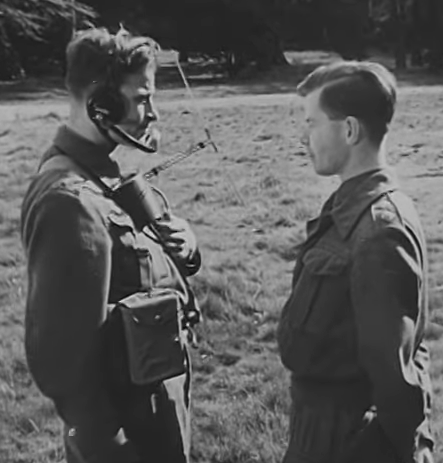
The low power and directional antenna meant that it was nearly impossible to pick up any signal on the ground if you were more than a mile away. The airplane that the operator was facing, on the other hand, could pick up the voice signal up to 30 miles away. Unfortunately, they also had to be under 10,000 feet, exposing the plane to enemy fire.
The highly directional gear could give the pilot a clue that he was closing on the target, and when the signal suddenly went out, it indicated that the aircraft was directly overhead the transmitter.
The Special Operation Executive had a lot of cool gear, and you can learn more about their gadgets and methods in the 1943 film “School for Danger” that you can see below. Look for the S-Phone at around the 7-minute mark. Interestingly, the two main characters are actual Special Operation Executive agents who actually did the things that are fictionalized in the movie.
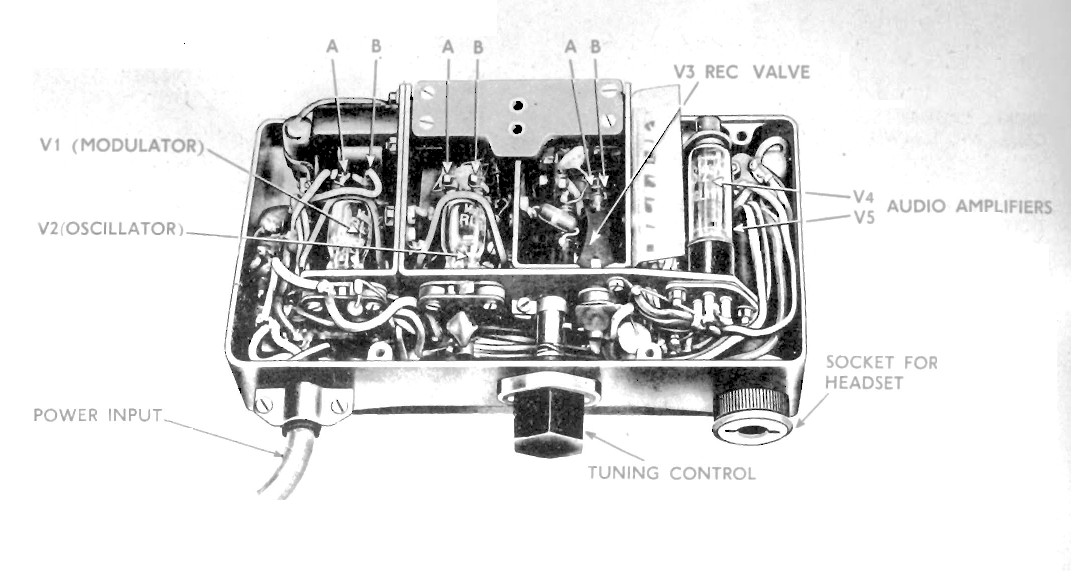
The CryptoMuseum has a scan of the S-Phone manual. There are many interesting tidbits there. For example, the set came with a lamp that could show if the transmitter was working. These radios used early NiCad batteries. The manual goes to great lengths to explain that you should not try adding sulpheric acid to the batteries.
Joan-Eleanor
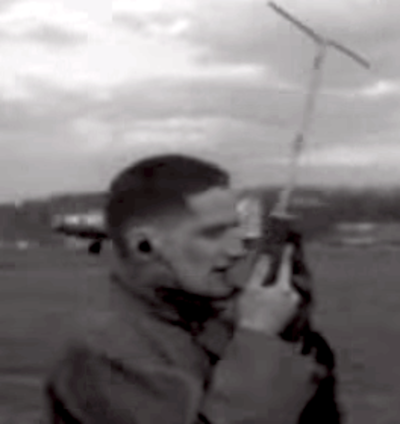
Where the British had the Special Operation Executive, the United States had the Office of Strategic Services. Working at RCA laboratories, OSS engineers along with [Al Gross W8PAL] who would become a pioneer in the development of walkie-talkies, pagers, and cordless telephones, designed the Joan-Elanor, named after the engineer’s wife and a WAC member.
Joan was the field transceiver, technically SSTC-502, while Eleanor, SSTR-6, was mounted in the aircraft. Joan weighed less than four pounds, using a super-regenerative dual triode that doubled as the transmit oscillator. Originally, the radio was set for 250 MHz, but when it was found that the Germans had the ability to receive at that frequency, they pushed Joan-Eleanor to 260 MHz.
The radio had a range of about 20 miles and, unlike the S-Phone, the aircraft could fly overhead at 30,000 feet. It also took ordinary batteries, so you didn’t need a charger as the S-Phone did.
The system recorded transmissions on a wire recorder in the aircraft. The intent was that agents behind enemy lines could secretly transmit intelligence reports to aircraft flying what appeared to be routine reconnaissance flights.
The radio gear was usually jammed in the rear of the host aircraft, usually a DeHavilland Mosquito, along with an operator aft of the bomb bay. The operator entered the position through a side hatch and remained there the entire flight. You can see an OSS film about the system, which was classified until 1976, in the video below.
Tech
These radios had a few things in common. Both used frequencies that were uncommon at the time, making it less likely the enemy could overhear or even detect conversations. This made it less risky to speak “in the clear” so agents didn’t need incriminating code books and cumbersome encoding and decoding steps.
Similarly, both systems used voice, meaning that agents didn’t need to learn Morse code. They probably needed a little training to use the equipment, but that was far easier than expecting a resistance fighter to study Morse code for weeks.
While the S-Phone depended on directionality, Joan seemed content to rely on being high in frequency. Both had to be lightweight, easy to conceal, and quick to set up and take down.
The Joan radio was critical for agents going behind enemy lines. They’d be brought to an airbase in a car with blacked-out windows to prevent them from knowing where they were leaving from. They’d be given forged papers, an entrenching tool, local money in a belt, a pistol, a food package, a silk map, and, of course, a Joan radio.
We wonder if any Joan radios were captured during the war? A lot of wartime high-tech was highly protected, and we’re sure the agents were instructed on how to destroy the radios. Spies were also famous for using suitcase or even shoe radios.












I wonder why didn’t they go for FHSS instead of pushing the frequency higher and higher. A properly designed spreadtrum comms system would be pretty much impossible to real-time decode if seed used for hopping isn’t known. Nowdays it’s so common because it’s used for RC transmitters.
Frequency hopping requires PLL, which was developed 1950-1960s. First PLLs had long locking times and are unusable for hopping purposes.
Your statement is like “why haven’t they just used an iphone”.
Actress Hedy Lamarr and compose George Antheil filed a patent for frequency hopping during the war.
[My first reply here did not show up, so I am posting a better one.]
Indeed, Hedy Lamarr and George Antheil were awarded US patent #2,292,387 on August 11, 1942 (LaMarr filed it under her married name, Hedy Kiesler Markey.) Their patent describes a way to use frequency-hopping spread spectrum to reduce the jamming of radio links to “radio-controlled torpedoes.” It does not invent frequency hopping. In 1903, Tesla had already been awarded US patent #723,188 for what we call “frequency-hopping spread spectrum” today. Frequency hopping had already been used successfully by the Germans in WW Ⅰ. Frequency hopping is described in Jonathan Zenneck’s book 𝑊𝑖𝑟𝑒𝑙𝑒𝑠𝑠 𝑇𝑒𝑙𝑒𝑔𝑟𝑎𝑝ℎ𝑦 (1908 edition, translated to English by McGraw Hill in 1915, p. 331). This URL takes you directly to that page: https://archive.org/details/wirelesstelegrap00zennrich/page/330/mode/2up . Observe the footnote that the German company Telefunken had already used what we call frequency hopping today.
No known working prototypes of LaMarr’s and Antheil’s idea exist. (NB. The US Patent Office has not required working prototypes since 1881: https://en.wikipedia.org/wiki/Patent_model .) Despite Antheil’s heavy lobbying for it, the US military never used their idea, which relied on punched paper and piano chords—not very suitable for a combat environment. Not to mention that radio-controlled torpedoes did not exist (how deep do radio waves penetrate into the water?). The US military 𝑑𝑖𝑑 have anti-jamming frequency- hopping technology in WW Ⅱ, used on glide bombs. You can read about it in the November 1943 issue of 𝑅𝑎𝑑𝑖𝑜 𝐶𝑟𝑎𝑓𝑡 magazine, p. 110, bottom right column: https://archive.org/details/sim_electronics-now_1943-11_15_2/page/110/mode/2up .
Inspired by that original digital tech the player piano. Holes in a roll switches the frequency all over the place. Put on the same “tune” and run that in sync at both ends.
Operational-grade FHSS could be easily implemented with electro-mechanical parts available at the time. You’re only trying to hide and scramble your transmissions from Abwehr staff who are equipped with basic radio receivers and maybe fox-hunting gear. WW2 came before the era of FIB guys in smart suits and black sunglasses who operate from a van filled with $12 000 000 of Rohde & Schwarz gear.
Several of the spy localizers were effectively just passive receivers (with post-detector gain) fed via crossed antennas into oscilloscopes or mechanical displays. They were not inherently frequency-sensitive (there was a filter pack that was sometimes used to locate “unexpected” emitters in areas with expected rf emissions), and were sensitive well into UHF (although the Germans apparently didn’t make much use of this).
They could detect and localize FHSS just as easily as anything else (they were wideband and only cared about energy, not modulation), although they couldn’t intercept and decode the transmissions.
The same portable systems could easily be used to detect radars, but there was little cross-fertilization between the various areas of responsibility in the German military, so the u-boat division continued to suffer ambushes until they came up with their own solution (which was never fully-satisfactory and never fully-deployed).
The one I am most aware of appears to have been ad-hoc manufacture during the late-war period (few pictures, no surviving units, but fairly widespread oral history). It appears to have basically been just a crossed-antenna direction finder using uhf-sized wireframe bicones for the antennas, and no selectivity at all. Easy to build, easy to operate, not terribly useful in the presence of many transmitters. There are reports that one of them was captured and attached to a watson-watt crt display, and proved able to track uhf transmitters mounted on airplanes, giving realtime bearing updates, without any need to tune. Of course, it’s range was quite short, and it combined all of the signals in the area, making the display very noisy and hard to interpret. But easily enough to find a spy in a residential or rural area, and some variants apparently only required passive components.
None of them appear to have made it into widespread production due to late-war logistics issues, although they were apparently locally fabricated from time to time when needed.
At least one version was truly passive and eschewed the display, replacing it with a meter; it used crossed bicones again, combined to create a cardioid pattern, and a simple rf (milli)voltmeter. It apparently had provision for a crystal earphone as well, useful for identifying ignorable transmissions.
I once spent time trying to find details of the “squirt” transmitter, but came up short. There was a system where they assembled conductors and insulators on a rod so sweeping a conductor along the rod to complete a circuit would send Morse code very fast. That system came with its own risks and I couldn’t tie it to the “squirt” transmitter.
“go for FHSS ”
Wow…… Guess they should have just used the internet?!?!
BTW…Just because something is patented does not mean it is practical.
Or even possible.