
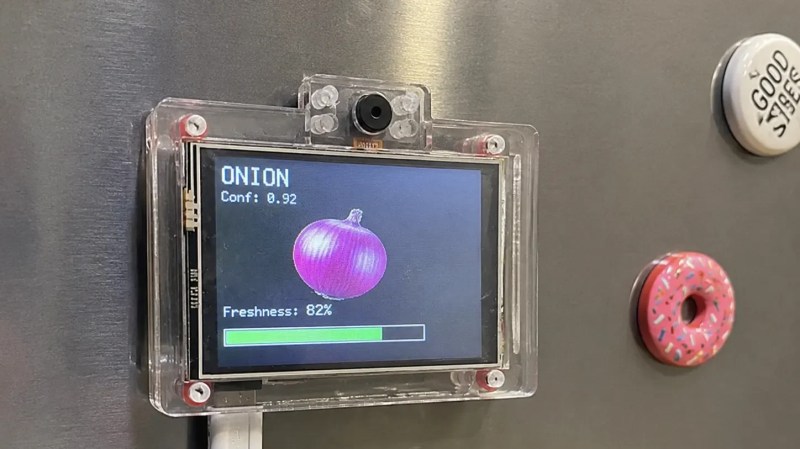
Many of us have suffered the common experience of buying a great deal of (now very expensive) food, only to have it go off before it can be consumed. [ptallthings93] has whipped up a simple device to try and tackle this problem.
The result is DecayDock, which lives on a fridge and tries to keep track of what’s going on inside. It achieves this with the use of an ESP32-CAM module, which combines the capable microcontroller with a camera for image detection work. With the aid of an Edge AI model, it’s able to detect common food items that are held in front of the camera, which are in turn added to an internal inventory. The items are tracked over time based on expected shelf lives, and the freshness of various items in the fridge is displayed on an attached LCD screen with a green/yellow/red color coding system.
The system is only making estimates—it’s not able to actually identify when the cheese has gone moldy or the milk has gone sour. Still, if you struggle to remember what you should be prioritizing to use in your fridge, it might be a handy aid.
Ultimately, we never really saw smart fridges dominate the market, even though the idea has long been a popular one in futurist circles. Perhaps none of them thought that nobody really wants to stand staring down at a screen on the fridge all day. In reality, some areas of the home are best left unsmartified.












I’ve a smart fridge that yells at me each time I open the door to figure out it’s empty. Since it doesn’t auto fill, it’s not smart enough for me.
Nobody believes me but one of the most liberating things I’ve ever done is to stop using a fridge, this was way back in 2009.
My level of food waste is very very low because I’m always aware of what I need to eat up. I eat fresh vegetables every day and have a decent diet. Being vegan helps to avoid food spoilage.
I have a cupboard that gets cooler than the rest, in there I put a big marble slab which acts as a heatsink for the pans I put on top of it to keep my cooked food cooler. Also I put pans outside in the winter to keep food cool that way.
I line the drawers with foam mat (dirt cheap on AliExpress) to let air circulate so vegetables last longer.
The only thing I feel I’m missing out on is cold drinks in the summer, but frankly the less beer I drink the better. I can always get cold cans from the local shop.
People forget that we are part of only a time minority of the human race ever to have had access to refrigeration. Our ancestors managed and so can we.
Finally an application for AI models that can recognize bananas. A giant step for hurbmanity.
what other sensors might improve this? one that weighs the refrigerator (of course, that would include magnets and whatever you pile on top!), internal gas sensors, and a switch on the door to count every time it was open and for how long, perhaps with weight logged before and after. it would be useful for me to have an remote-illuminateable camera to see the interior of the refrigerator at my adirondack cabin as needed, but a log of what goes into it and other data would also be the basis for useful data.
The problem with most inventory control systems is the inconvenient requirement to log what is added and removed. Data entry is a nuisance, even with barcode readers. If the machine could not only identify objects reliably but track their arrival and departure, that would be more useful.
Unfortunately, doing that directly would require a great deal more instrumentation.
It might be possible to simplify some of that by having the machine read shopping receipts, but that only handles stocking, and handles it badly since not all items that can be refrigerated are immediately refrigerated (some may be shelf stable, some may be used immediately) nor are all items purchased (leftovers and such).
Vision might help — we rely on it — but our own experience is that things do get buried. Combining vision and weight (overall or per shelf?) might do better. Of course, if you are going to use weight you have to allow for evaporation… And for overall weight you would have to worry about things being put on top of the fridge. Or hang on the sides with magnets.
Despite the receipt shortcut, and despite how cheap machine vision has gotten, I still don’t see an affordable solution.
So, you’re preparing a soup. You take out some almost rotten vegetables and put back a non obvious colorless liquid in a bottle or a bowl. How can a sensor knows that both are linked and the usability date shouldn’t be extended for your soup? How can it determine that the grey soup you put back at 20:30 is the same as the grey soup you took out at 20:00 and not extend the date? How can it make the difference between the soup you’ve just finished from the new soup from the can you’ve just open and wanted to store the leftover (and the date should be extended) ?
While it looks obvious at first glance, an inventory system for a fridge is a hard problem without having information from the outside of the fridge. I claim it is not solvable without a spectrometer that’s performing complete analysis of all elements in a fridge for live activity, but even that can will be defeated by the 0.1mm of transparent plastic you usually have on food.
Are there seriously people who put onions in the fridge?
What do you do with the other half of a diced onion?
I don’t dice half onions. I always use whole ones.
Isn’t that what a dice tower is for?
You do not dice half an onion. If you need less than the full onion you peel as many layers as you need and dice those. Keeps the juices where they stay fresh.
And still some people believing that hoax that onions become toxic if stored in a fridge ?
An half onion, properly wrapped, keeps fresh way longer in the fridge.