
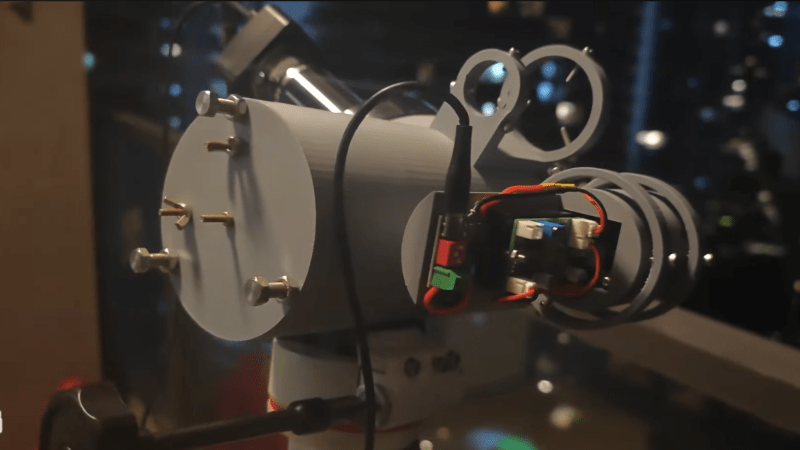
Most consumer-grade night vision devices are basically a standard camera without the usual filter to block near infrared (NIR) light, which are then paired with a NIR light source that’s not visible to the human eye. Unlike the passive night vision provided by an image intensifier tube, these can’t resolve objects beyond the beam of their illumination source. On the other hand, if, as [Project 326] did, you use an infrared laser to illuminate the scene, you can still get a very long range out of these devices.
[Project 326]’s device consists of a previously-built reflecting telescope focusing a distant scene in to a webcam with the infrared filter removed, with the infrared laser illuminating the scene. Finding a suitable laser took some effort: the first option, a secondhand fiber-coupled industrial laser, was accidentally over-volted and destroyed during testing. The second had a fiber output which proved extremely hard to terminate, and a third laser couldn’t be collimated correctly. The final laser was a Vertical-Cavity Surface-Emitting Laser (VSEL) diode array element driven at about two Watts and collimated by a small lens.
This illumination setup is safe at a long range, but only at a long range. The laser was strong enough to burn cardboard at close range, but out at about 500 meters, the beam had spread until it was less than a hundredth of the standard safety limit. To make sure that nothing else would get in the way of the beam, it was shone down from the top of a tall building. Testing with a power meter also showed that at a long range, the beam was weaker than expected. It turned out that the wavelength used (940 nm) is attenuated by water vapor, to the point that up to 70% of the beam’s strength was lost before reaching the target. Despite this, and despite a rather linear beam profile, a somewhat dark image was still visible at 650 meters.
If you’re looking for a somewhat more versatile long-range night vision device, check out one based on an image intensifier. Another approach is to use a very high-sensitivity camera.
Thanks to [Keith Olson] for the tip!












So, miles, rather than a kilometre would be possible? How about from a satellite? – You can run, but you cannot hide!
Maybe if you take the IR filter off the Death Star!
Work it out: This one is operating near the limit of sensitivity with an illumination power density of 74 mW/m^2. The field of view of a satellite imager is a few hundred million square meters…
That inverse square law bites hard.
How about the experiment that bounces a laser off the moon (granted there is a reflector, so it is not the surface that is acting as a reflecto)r:
https://wtop.com/science/2019/07/the-experiment-still-running-on-the-moon-and-tv-re-runs-50-years-later/
Same physics, but different “imaging” task. In the moonbounce case, you’re looking with a single pixel that gets a signal from just a single incoming photon. To do this it uses a laser with a power of several megawatts to a gigawatt (depending on implementation). From this it gets a single ping (“frame”). Often, for a given shot, zerophotons are detected, so this is the minimum you need for it to work.
Now, repeat that for a few million pixels in an image, and each pixel needs to receive at least few hundred photons to make an image, and now do that at 30 frames per second. How much power do you think you need? Is there enough electrical generating capacity on the planet to provide it?
(To the physics and imaging pedants: Yes, approximating with spherical planets.)
Are you are saying that all pixels are active at the same time, instead of the possibility of a beam doing a rasta scan?
You could raster scan, and sometimes that makes sense.
At 30 frames per second, each pixel integrates photons for 33 milliseconds. In a normal camera, all the pixels are integrating at the same time and the whole image can be acquired in a thirtieth of a second.
If you raster scan, you do a single pixel at a time. At 33 milliseconds each, how long does it take to scan a 1920×1080 frame?
I assume that your question about how long is rhetorical. But for fun, here are the numbers:
A 1920×1080 frame has:
1920×1080=2,073,600 pixels
If each pixel takes 33 milliseconds to scan:
2,073,600×33 ms=68,428,800 ms
Convert that:
68,428.8 seconds
1,140.48 minutes
19.008 hours
So it would take about 19 hours to scan a single 1920×1080 frame, one pixel at a time at 33 ms per pixel.
Could perhaps be useful for research/investigation or searching for a body in an area an at night whilst accepting that the results may take a long time.
just use moah powerrr! :)
That beam would make a nice target for someone wearing an old-school night vision device… Unfortunately the primary use I can think of is military.
Using lasers specifically for the purpose of blinding people is prohibited under Geneva Convention protocols. However, collateral damage to people from lasers specifically directed at combat equipment is exempted.
Professional military will respect those rules. Indeed, prior to my deployment, command had my entire unit review the “Laws of War”. This is what separates civilized people from savages – you know, the kind that uses human shields (after they’ve committed documented atrocities against civilians and are cowering against retribution).
Interesting observation is how someone comes up with the idea of using a laser against another person’s eyes, then says it’s a “military” use. Revealing of the intrinsic barbarity of people who despise the military (“Freudian Slip” as it were). Irony is, professional military organizations do not want such barbarians in their ranks. Ever see “Breaker Morant” ? (great movie) – his euphenism of “rule 303” was adjudicated as a war crime, and justice was swift.
I think you misinterpreted him. The laser would be highly visible to any passive night vision. The laser user would be the target.
He means that somebody with proper night vision would see exactly where you’re sitting immediately. Also the Geneva convention only applies if you lose, I know that’s an unpopular interpretation but it’s basically true.
Depilator lasers and beam expanders are your friend.
Please share a link for a depilator laser than can put out a continuous (not pulsed) beam.
Though, if one can fire a joule or so synced to a 30-Hz camera frame rate, that would work too.
@Aaron Beckendorf: This article seems to confuse an image intensifier tube with a photomultiplier tube. The former converts light to visible light and preserves imaging information; the latter converts photons, even individual photons, to electrons which end up at the anode usually with no imaging information. The night vision device you are suggesting we check out (in your last paragraph) is based on an image intensifier tube, not a photomultiplier tube. You could say that in the early days of television, the iconoscopes preserved imaging information; however, they still converted photons to electrons.
https://en.wikipedia.org/wiki/Image_intensifier
https://en.wikipedia.org/wiki/Photomultiplier_tube
Thanks for the clarification, I’ve fixed that now; I’m not sure why I mixed up the names, but I’m glad you pointed that out.
If a laser is burning cardboard at close range, you are definitely not EYE SAFE at 500 meters.
What are you basing that opinion on Scott? Anything at all?
It seems that the calculations and even the measurements don’t agree with you but I guess you know better…