

Few things are more satisfying during a Summer night than hearing the crackle and pop of another mosquito hurling itself against a bug zapper and knowing that it won’t be trying to suck your blood any more. The only problem with those bug zappers, whether the mounted or hand-held type is that you cannot get every single attacking mosquito. Unless you were to put the bug zapper on yourself, of course. This is basically what [Dani Cruster] of the aptly named ‘DiWHY’ channel decided would be the right course of action.
The video is apparently dubbed over from the original Russian – with the team claimed to be based in Moldova – which probably explains a lot of the reasoning behind this engineering. At the core of the whole-body bug zapper is galvanized mesh, with a big question being how close you can get it to the body before said body gets zapped too. With about a millimeter of clearance between both layers of mesh required at 1 kV, this was another design consideration.
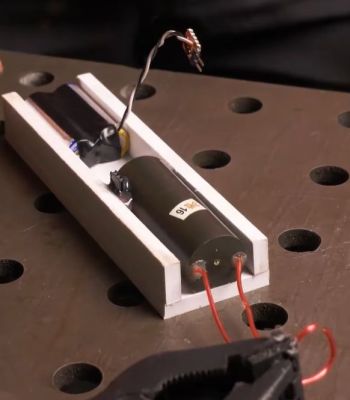
Ultimately the guts of stun guns were used, which output around 10 kV and thus require a 1 cm gap between the mesh layers. PVC plates were used to create the structural elements of the walking bug zapper suit, using a heatgun to form it into a body-appropriate shape. That’s when human testing started, to try and not make it zap the wearer.
The final suit of bug zapping armor uses six stun gun modules, each powered by a 3 V power source created from two 1.5 V alkaline cells that are good for an hour of zapping. One issue found during a human trial run was that the zip ties used turned out to actually cause arcing, which had to be addressed first before heading to the mosquito-infested woods. In the video these are said to be near Tarkov in what appears to be the national park in Russia’s Tver Oblast and clearly a prime mosquito breeding ground.
During the real-life test run many mosquitoes and apparently even some ticks find their electrifying demise, before for some reason they seem to clear out after an hour or so. Overall it seems to work well, even if it’s not that ergonomic and things get spicy when it starts to rain.












Interesting
Interesting idea (ignore the above – I hate these entry systems).
Glad it works.
But mosquitoes aren’t attracted to bug zappers unless they use CO2, warmth, and scents.
Of course carrying all those underneath the zapper is not something that I ever thought about – thanks!
At one point I had an aquarium air pump inside the house with a small tube from that leading to the garage bug zapper. Worked really well. We even did a control test with another bug zapper just outside and it seemed to only catch other flying insects. What gave me the idea was that there were swarms of mosquitoes around our closed windows outside. Maybe an outdoor bug zapper with a heater instead of a bulb and the same pump idea could work
Maybe the total collapse of the ecosystem isn’t such a bad price to pay for the extinction of mosquitos…
Far better for the future of evolution of the mosquito, as far as humans are concerned anyway. It’ll be an evolutionary advantage to avoid biting humans. Either that or they’ll end up being immune to electrocution. It’s surprising how quickly flies can adapt to not buzz when the hand held rackets are in use.
They encountered sparking at the zip-ties holding the panels, I really wonder what’s going on there. The dielectric constant of nylon is more than twice that of air. It’s clearly visible at 10:29 and mentioned at 10:56.
Through bulk material yes, but across the surface maybe not, especially if it’s not totally clean. It’s like surface tension on water, the molecules line up differently at the boundaries. Plastic contains a fair amount of carbon. Electricity can seem a little counterintuitive when the voltage gets higher.
Perhaps the carbon black dye in the plastic?
Many zip ties are made UV resistant, and adding fine carbon particles for a filler is one way to accomplish that, because it absorbs the UV harmlessly without letting it penetrate past the surface. That also makes the plastic slightly conductive.
Purity isn’t critical either for zip ties. Likely a mix of a lot of scrap materials and contaminants.
The thing to remember when looking at nylon spec sheets is that it’s an absolute water sponge and I expect damp nylon is a significantly poorer insulator.
I wonder which kinds of insects were caught.