
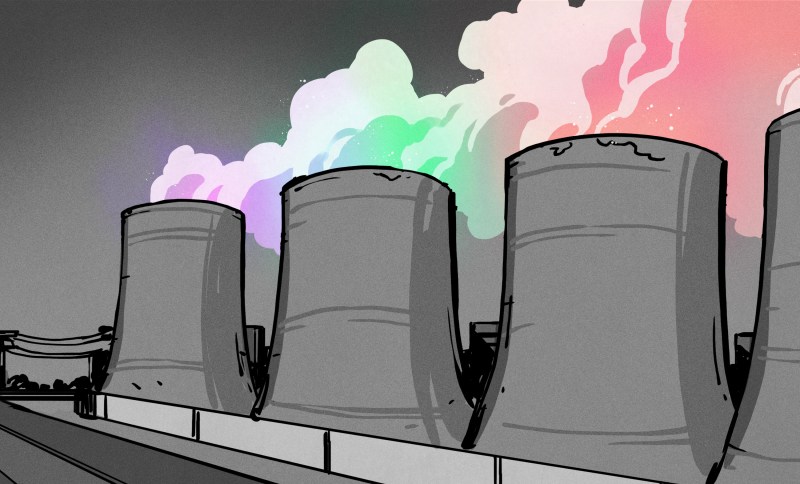
Recently thermal power stations have been in the news quite a bit, mostly in the context of them being throttled back or shut down due to the river water used to cool them either getting too warm or said river having dropped to a level where it can no longer provide cooling water. Obviously this is a problem, but it helps to understand how we got to this point and what can be done to fix it.
Thermal power stations – also called power plants – come in a wide variety of shapes and sizes, ranging from old-school coal- and gas-fueled power stations to modern nuclear power plants. Something like a concentrated solar power (CSP) station is also a thermal power station, as all of them have a heat source that’s used to generate electricity from, whether that’s a boiler, nuclear reactor core or a big vat of sodium heated up by the Sun via massive mirrors or oil-filled tubes in parabolic throughs.
Except for open-cycle gas turbines (OCGTs) – which are basically jet engines connected to a generator – this thermal energy is then used to generate steam that drives a steam turbine. Once most energy in the steam has been depleted, it has to be condensed back into e.g. water, so that it can be led back to the steam generator. How this condensing step is performed is the question here, with a number of methods available.
Passing That Buck
The cheapest option of all is of course to use once-through cooling from a nearby body of water. This can be a local lake, river or reservoir. The obvious disadvantages here are that you have little control over what debris and contaminants may want to slip in along with the water, nor do you get to control what temperature the water is going to be at the intake. Fortunately you can filter out wild life for the most part using systems like screens that physically block entry.
Between the 1950s and 1990s when there were a lot of new thermal power stations being constructed, there was no real problem when it came to river temperatures, with generally high river flows and especially in Europe relatively mild summers. Yet if we look for example at historical discharge flow for the Danube river, as well as the water level time series for 2008 – 2026 measured at a single location, we can see that the past few decades there are fewer wet periods, more dry periods and overall the water level drops more often to lower levels.
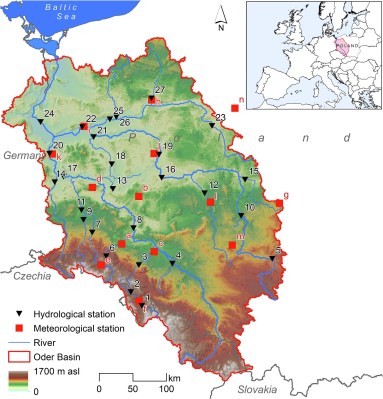
Perhaps unsurprisingly, water temperature is directly correlated with air temperature, with recent studies such as a 2024 research paper by Jiang Sun et al. showing a clear warming trend, as demonstrated for central Europe’s Oder (Odra) river basin. The warming rate differs per location, varying from 0.229°C to 0.720°C per decade, creating a slight but ultimately noticeable difference that in other locations that experience even more severe heatwaves like Spain or France will be more pronounced for its river systems.
It’s hard to fault the 1960s and 1970s engineers for not taking this warming and low rainfall into account as they would have had no control over it, but it’s not like we don’t have literally decades of climate science predicting what would happen with the continued burning of fossil fuels.
Being Hot Is Good
An interesting question that one may ask here before getting into the gritty details of power station plumbing, is why it seems that it are basically always nuclear power stations that appear to be affected by rising temperatures, rather than other types of thermal power stations. The short answer is ‘light water reactors are pretty terrible’, with the longer answer entailing a detailed explanation on the Rankine cycle, thermal efficiency and why even a pressurized water reactor (PWR) version of a light water reactor (LWR) runs at an abysmally low core temperature that results in a lot of waste heat having to be dissipated.
We can see the effect of this with the efficiency numbers of e.g. a typical modern LWR like the VVER-1200, which is about 35% despite being already a PWR with correspondingly higher efficiency than a boiling water reactor (BWR) that operates at atmospheric pressures. The older VVER-440 design – of which four units have been operating since 1982 at the Paks Nuclear Power Plant in Hungary – has an even lower efficiency of just below 30%.
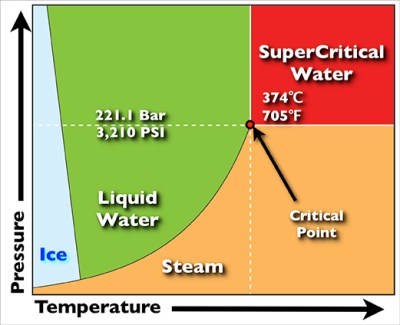
Ideally, what you want is a supercritical or even ultra-supercritical pressure and temperature for optimal efficiency. This realization is what has pushed the thermal efficiency of coal plants up by increasing the temperatures and pressures of the steam that reaches the steam turbine. With the average LWR running in the subcritical regime, their thermal efficiency is fairly low and thus the waste heat (Qout) is relatively high, almost all of which ends up being dumped into the condenser.
This Qout parameter follows from Carnot’s theorem. The derived, steam turbine-focused Rankine cycle can be used to describe the typical steam turbine-based heat engine, thereby also placing an upper bound on the achievable efficiency when converting heat into work.
Although this knowledge does not immediately provide a solution to such subcritical thermal power stations being forced to throttle back or even shut down during heatwaves, it adds important context to the problem that has to be solved.
Retrofitting Cooling
The upshot of all of this is that back in 1979 nobody was batting an eye at the idea of using once-through cooling using river water for a nuclear power station, because nobody figured that we’d be having this much climate change within its project lifespan. This thus leaves those of us in 2026 with the question of what the options are to fix this temporal oversight.
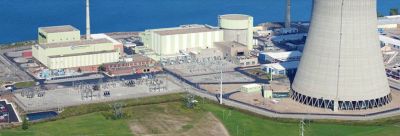
The good news here is that it only concerns some plumbing and the construction of some additional structures. The bad news is that it’s a pretty extensive retrofit that so far has seen little uptake, even if there are historical examples. One is the twin General Electric BWR unit Nine Mile Point Clean Energy Center (NMP) in New York, whose Unit 1 features once-through cooling from Lake Ontario, while Unit 2 uses a natural draft cooling tower (NDCT).
Interestingly, originally both units were intended to draw their cooling water from Lake Ontario, but in February 1976 the Nuclear Regulatory Commission (NRC) received a request to change the cooling system for the then under construction Unit 2 to be changed to use said NDCT. The NRC environmental and technical report for this change can be found as a scanned-in PDF of the original document.
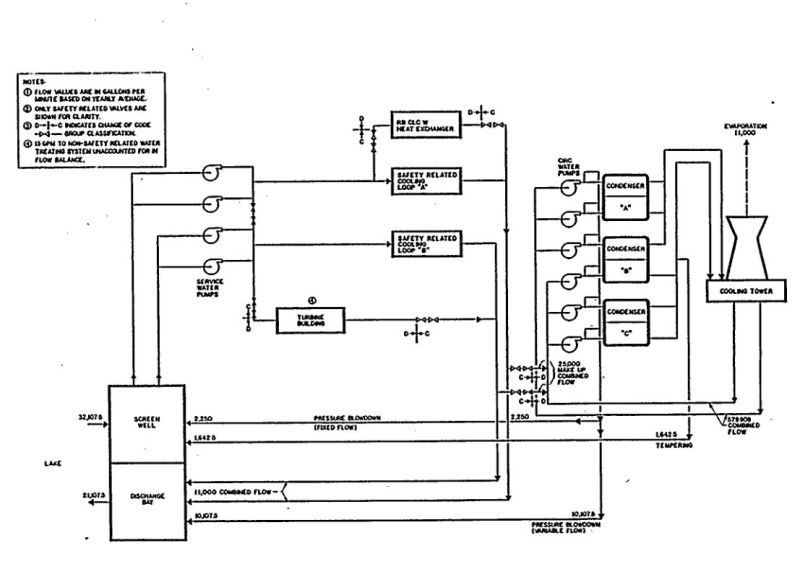
The main changes are probably the increase in system complexity, the size of the NDCT and the impact of the water vapor from said NDCT, none of which posed an issue at the time per the report. At the time of the report’s publication, construction of Unit 2 was already more than 37% complete with approval for this change pending during the intervening years.
The station owner indicated that building the cooling tower would take 32 months, which presumably would also include all the piping and related components.
Not Just Big Towers
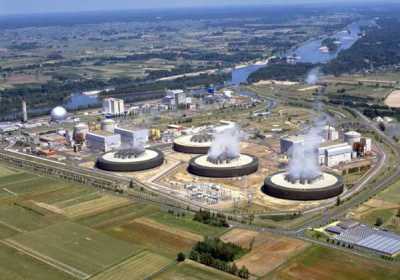
Although one might get the impression that the only options we have here are to either use once-through cooling or to build massive cooling towers, there are many more options to choose from.
While natural draft cooling towers are nice in the sense that they use the chimney effect (‘stack effect’) to create the draft, forced draft and similar cooling towers are also very common. In HVAC systems especially the use of natural draft would be prohibitively expensive and large.
Spray ponds are another, more low-tech option that also happens to be low-profile, while dry cooling is slowly becoming an option. These either use essentially big radiators, or capture the cooling water for the condensers again to create a closed system, with no water lost to evaporation.
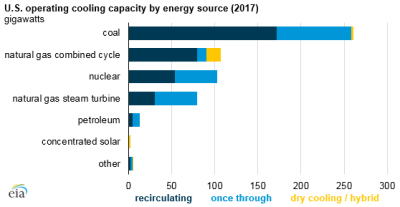
Obviously not losing any water at all would be ideal if the restricting factor is a lack of water. This is the case especially in water-restricted environments, such as desert environments and heatwave-stricken continents with drying-up rivers.
The other aspect is of course that of effective cooling capacity, as we have established previously that air and surface water temperature are strongly related. This means that if you’re dealing with a heatwave that has raised surface water temperatures, then air temperatures are also going to be similarly brutal, with a similar drop in cooling capacity.
Thus, ideally our thermal power stations would all use ultra-supercritical steam turbines, with modern Generation IV nuclear reactors like China’s helium-cooled pebble bed reactors hitting a cool 750°C, and molten salt reactors hitting a similar reactor outlet temperature. This makes it quite feasible that the future is ultra-supercritical, with potentially dry cooling systems.












RBMK was a good design with in-situ refueling allowing for variable load. Sadly the design was soiled for the rest of the world by a bunch of irresponsible soviets who wanted medals, not reason. If it wasn’t for that test, we wouldn’t need to waste $$$ building giant fans out on the sea or cover our houses with fugly solar panels.
ahh. the simple solutions, we always crave the simple solutions. pity the Real World ™ does not work like that. :(
I was not familiar with RBMK, so I did some online searching. Apparently, RBMK is Russian for “high-power channel-type reactor”). It’s a class of graphite-moderated nuclear power reactor designed and built by the Soviet Union.
Wikipedia has a LONG entry with lots of history and illustrations. Here is an excerpt:
“The RBMK is an early Generation II reactor and the oldest commercial reactor design still in wide operation. Certain aspects of the original RBMK reactor design had several shortcomings, such as the large positive void coefficient, the ‘positive scram effect’ of the control rods and instability at low power levels—which contributed to the 1986 Chernobyl disaster, in which an RBMK experienced an uncontrolled nuclear chain reaction, leading to a steam and hydrogen explosion, large fire, and subsequent core meltdown.”
All the worst ideas for a nuclear reactor in one place.
PHWRs like the Canadian CANDU design are much superior to RBMK, though. Sure, they need heavy water, but they too allow for constant refueling, have a very wide cross-spectrum and quick response time.
So you think a dark blue window pane that produces power from nothing is “fugly” but apparently giant industrial/nuclear plants aren’t? And then of course there’s the quixotic tilting at literal distant windmills…
Shall you use a buch of frozen jugs to cool a room… welp that is just funny. Your t-shirt would be soaked and have the fan blow directly on you for a better cooling effect. Note: this does not work in Lousiana or other places that have 120% humidity during the summer.
Yeah they look cool
I find it funny that we’re in the 21st century and we’re still making energy by “boiling a kettle” like was done in the 19th century. I know it still works, I was just expecting dilithium crystals by now.
Anyway we will end in cupola cities covered by solar panels and with turbines in adjacent deserts. Nuclear we will export to Mars and beyond.
On perception
https://phys.org/news/2026-08-naturalness-emerges-key-driver-climate.html
Growing older (and hopefully wiser) includes the realization that most things are public relations
Green means durable
https://techxplore.com/news/2026-08-green-durable-sustainable.html
I wonder if you could adapt a little mini cooling tower to cool an engine and have one stick out of a hole in the middle of your car’s hood like a blower. Would be a good mad max build