

There are plenty of stories about inventors who see a problem and decide they can do better. But Van Phillips had a little more motivation than most. The problem was his own leg. In 1976, Phillips was a 21-year-old college student when a water-skiing accident cost him his left leg below the knee. If that wasn’t bad enough, the prosthetic leg he received afterward wasn’t exactly a technological marvel. Prosthetic limbs of the era were generally designed to look and act something like a biological leg and foot, but “act” might be giving them too much credit. They were passive structures that provided something to stand on and roll over while walking.
Phillips wanted to do more than walk. There was just one problem: he wasn’t an engineer. Before the accident, he had been studying business. So, if he was going to build a better leg, first he was going to have to learn how.
Back To School
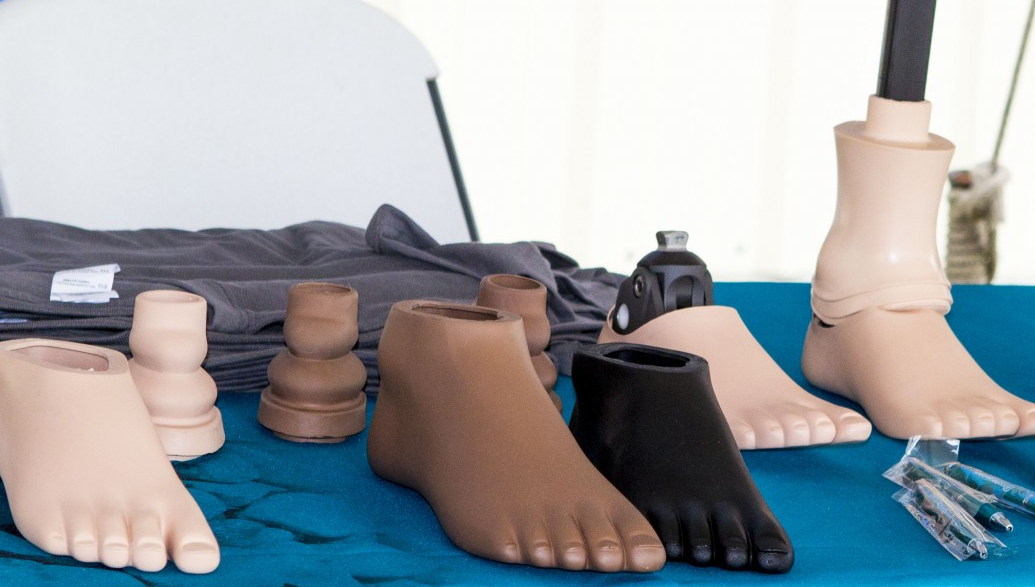
Phillips became fascinated with prosthetics and eventually studied prosthetic design at Northwestern University’s Prosthetic-Orthotic Center. He also worked at the University of Utah’s prosthetics laboratory, where he had access to both the people and equipment he needed to experiment.
The conventional wisdom was that a prosthetic foot should imitate a human foot. That seems perfectly reasonable — evolution has had quite a long time to work on the design. But there’s a problem with simply copying the shape. A real foot isn’t just a foot-shaped object attached to the bottom of your leg. Muscles, tendons, and ligaments store and release energy as you walk or run. Your Achilles tendon, in particular, acts very much like a spring. A conventional prosthetic foot might look right, but it didn’t have anything corresponding to that spring.
Phillips eventually stopped worrying so much about making something that looked like a foot. Instead, he decided to make something that worked like one.
Spring In Your Step
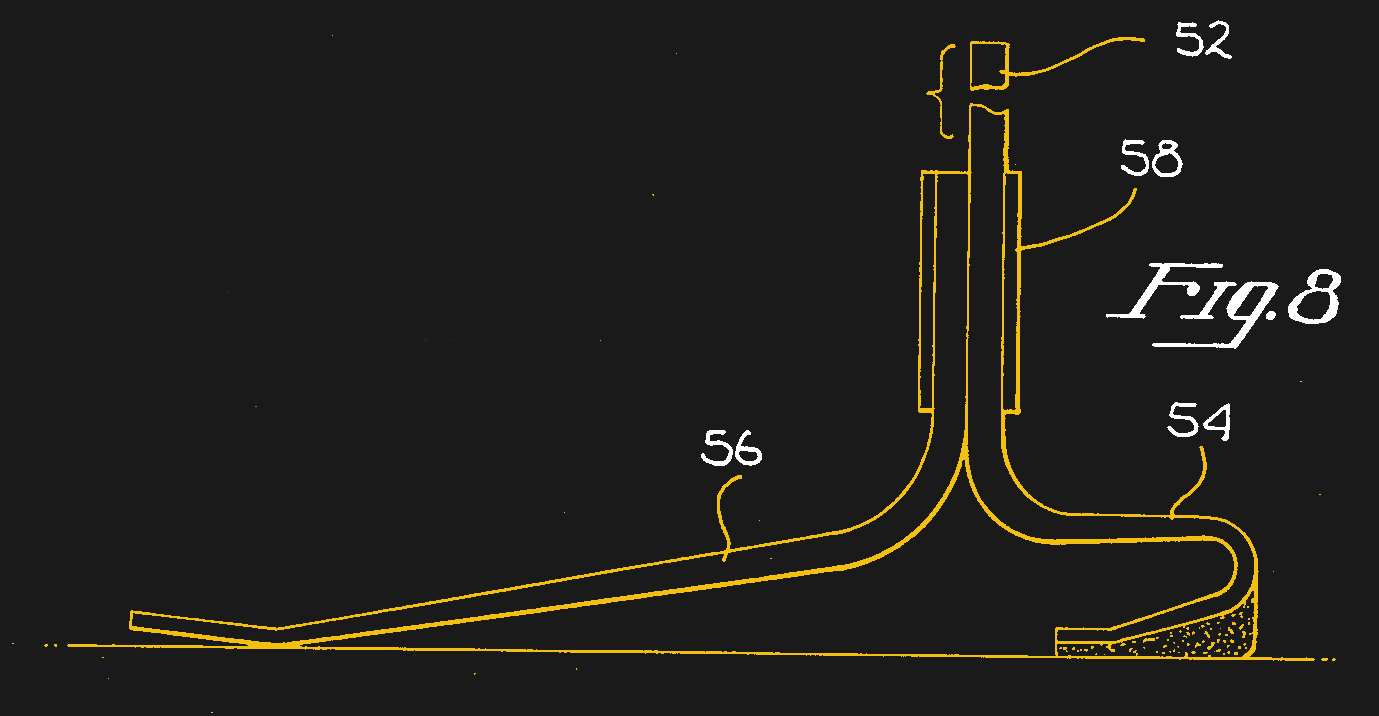
The basic idea behind what became the Flex-Foot is simple, but unobvious: use a spring as the foot. As is often the case, the concept is the easy part. Making a spring that will repeatedly support the weight of a human being, flex the right amount, survive millions of cycles, fit into a practical prosthesis, and not occasionally snap and dump its owner onto the pavement is considerably harder. The answer was carbon-fiber composite.
Today, carbon fiber turns up everywhere from airplanes to bicycles to suspiciously expensive automotive trim. In the late 1970s and early 1980s, though, it was still an exotic material, and the design problem was genuinely nasty. A prosthetic foot spends every waking hour of its owner’s life under cyclic load — tens of thousands of flex cycles a week, millions over a product’s lifetime — with a full body weight snapping through it on every step and several times that on every stride of a run. Get the fiber layup or resin choice wrong, and you don’t get a gentle failure; you get delamination or a sudden snap, with the wearer still attached. Tuning it added another layer: the same blade has to feel right for wildly different body weights and gait styles, which meant iterating on the curvature, the laminate thickness, and where along the blade the flex was concentrated, rather than just picking “carbon fiber” off a shelf and calling it done. Phillips wasn’t merely drawing this stuff on paper, either — he tested prototypes on himself, and by his own accounts the early ones failed more than once before the layup and geometry held up to real use.
Instead of a rigid ankle and artificial foot, the Flex-Foot used a curved composite member extending down the leg and underneath it. When the wearer put weight on the prosthesis, the carbon-fiber structure flexed and stored energy. As the wearer moved forward and unloaded it, the spring returned some of that energy — much closer to what the biological machinery in your lower leg actually does.
Form Follows Function
Phillips founded Flex-Foot, Inc. in 1984, and the design evolved into a family of prosthetic feet. One particularly interesting development was that once you abandon the requirement that a prosthetic foot has to look like a foot, you have quite a bit of design freedom. That’s where the familiar running blade comes from.
The later Cheetah running foot, made by the Icelandic company Össur after it acquired Flex-Foot, takes the idea to its logical conclusion. There’s hardly any pretense that it is an artificial human foot. It is a long, curved carbon-fiber spring, generally shaped something like a J. Load it and it bends. Release the load, and it springs back. If you’ve watched the Paralympics, you’ve almost certainly seen them.
There is something particularly satisfying about the design from an engineering standpoint. Your first instinct is to mimic the original device — in this case, a human foot and leg. Phillips, instead, identified what the system actually needed to do. That’s a lesson that applies well outside prosthetics. Nature’s solution isn’t necessarily the only solution, and copying the appearance of a biological system doesn’t necessarily reproduce its behavior. Airplanes don’t flap their wings, either.
Too Good?
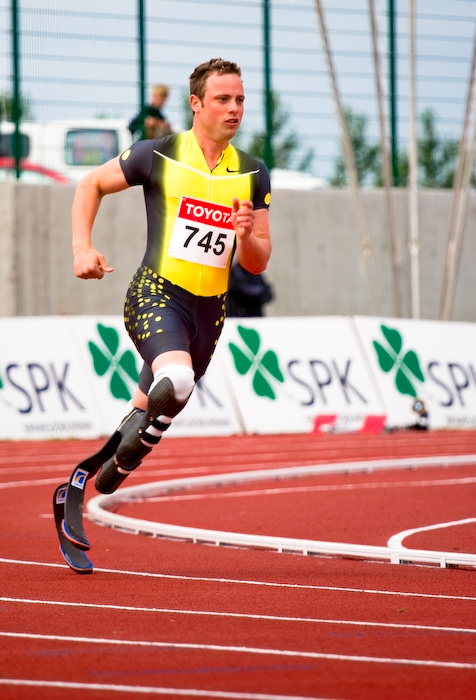
The IAAF’s case leaned heavily on research from German sports scientist Gert-Peter Brüggemann, who argued the blades were mechanically efficient enough to constitute an unfair aid under the federation’s own rule against springs, wheels, or other advantage-granting devices. Pistorius’s side countered with independent testing led by MIT biomechanics researcher Hugh Herr, arguing there was no measurable edge. When the case reached the Court of Arbitration for Sport in 2008, the panel sided with Pistorius: it found the IAAF had not shown sufficient evidence of a metabolic advantage from using the Cheetah Flex-Foot, and overturned the ban.
That ruling didn’t settle the underlying biomechanics so much as expose how messy the question really is. Running blades are light and return a meaningful share of stored elastic energy, but they aren’t motors — they can’t give back energy that wasn’t put into them, and they lack the active muscle contribution a biological leg supplies, particularly out of the blocks and around a curve. Depending on which variable you isolate — limb mass, ground-contact time, force production, or acceleration mechanics — the prosthesis can look like an advantage or a disadvantage. It’s a genuinely open biomechanics problem dressed up as a sports-eligibility ruling.
The controversy eventually became as much a question about what constitutes a “normal” human body as it was an engineering problem. That’s a pretty remarkable problem for an invention to have. In a few decades, the question had gone from “can we make an amputee walk better?” to “is this prosthetic leg unfair to people who still have legs?”
Better Than A Fake Foot
Flex-Foot was acquired by Össur in 2000. Phillips received the Lemelson-MIT Prize in 1997 and was inducted into the National Inventors Hall of Fame in 2008 — the same year the CAS ruling put his design at the center of a sports-eligibility debate. Descendants of his original design are still in use today: energy-storing-and-returning feet are now an ordinary part of modern prosthetics, and specialized running blades have become almost synonymous with amputee athletics.
Even if you never design a prosthetic, the lesson is a valuable one. When solving a problem, it is natural to mimic something that already exists, either natural or an earlier design. But real innovation often comes when you stand back and consider what you actually need. Not every hole has to be made with a drill.
If you aren’t big on springs, you could 3D print a foot. We think it is cool to be able to create your own prosthetics.












This is lese an article about genius, but more about having the resources to work on such a problem.
Most people loosing a leg will have existential problems to pay for rent and food. Instead having access to a research lab and the funds to start a company is a huge privilege only few people have.
Did you read the article, Frank? Or did you just find a place to put your soap box? The word “genius” doesn’t appear in Al’s post at all.
Al’s point in the article is that Phillips succeeded because he thought outside the box (function over form) and then didn’t quit until he had a working device. Kind of the essence of hacking, isn’t it?
Forgot the assorted labs and related technical places that helped refine the device. Definitely not something the neighbor who lost his foot during ‘Nam has access to
Sure, invention generally depends on privilege. Go look at the history of the steam engine, or the lightbulb. Or nails (historically, iron was often nearly as unavailable as precious metals in many contexts, making a sword a large fraction of a warrior’s net worth).
The genuine question is not about privilege. Some form of structural inequality is in practice unavoidable (if only because, by removing one form, you almost always create a different form, even if it’s not immediatley obvious). The real question is: if privilege was available, what was it used for? And, not all answers were created equal.
This is a good take on the situation. A lot of people use their privilege to stare at social media as they walk into oncoming traffic. I believe we should try to increase privilege for everyone, and the sky should be the limit. Instead of tearing/holding each other down, we should be pushing each other up.
Do we really need to pre-requisite everything that someone does as being, at least in part, a function of luck and privilege/access to resources? Because that’s universally true, including your ability to write your comment. We could say both Van Phillip and yourself are lucky to not have been born 10,000 years ago, probably.
They intend to level everything into a perfectly flat, mirror-smooth surface around the entire earth so that no thing stands proud of any other thing, and there are no valleys or divots either. They’re obsessive-compulsives deep down
I disagree with OP, but no that isn’t the goal.
It’s not black and white.
We can fight against hero worship and the unreasonable expectations it causes without demanding every person be considered equal in every way.
Privilege must be taken into account. Especially so when the point of an article is about someone’s accomplishments that set them apart from ‘the Masses’
This article is fine. It is about the methods used, not worshipping some person’s genius.
The real divot wrote the original comment.
Wow you’re such a good person!
💪🏼 🤖
Compared to 1997, access to custom parts is so much better and cheaper now. The makers of prosthetics are certainly making use of this already.
It’s not free and it’ll cost more than food. But it’s accessible.
A working social security net will take care of that at least.
There’s plenty of privileged idiots who disprove your theory by doing nothing of any worth whatsoever.
Being at university is a privilege but not exactly a rare or unobtainable one, and if you have a good idea and some drive to pursue it a university is the place that can help make that happen.
Are these comments testing whether I’m a Replicant or a lesbian, Mr Deckard?
Clearly you have a need to tell us about your Mother….
Or maybe you need to see the movie and read the Philip K Dick novel. You know, BLADE RUNNER?
I know, I love the article banner as well. But you struck me more of a Leon than a Rachel…. ;)
I now expect to see a clickbait listicle of “This one weird trick … Which Replicant are you?”
Dodged the uncanny valley prosthetic and leaned into the cyberpunk post-human image instead. Very smart thing to do. Its performance characteristics are just another plus
The cyborg carbon-silicon form of matter future is the most probable. The disadvantage is an advantage in changed general conditions.
Refined:
The future with cyborg carbon-silicon form of matter organisation is the most probable future. The disadvantage can be an advantage in changed general conditions.
Damn no-edit reality.
“Oscar Pistorius, a double amputee” – and murderer.
Both are true. Neither changes the other. Several of the technologies we are both using were created by multiple-mass-murderers, and modern lifejackets are the result of torture-murder. One should not deny reality, and one should focus on avoiding contributing to a worse reality, but that doesn’t make every mention an endorsement.
Does the world of Cyberpunk have an Olympic Games?
A video from 2011 show Philips (56) without glasses, fit as a fiddle. Guess it’s too much to hope for Cheetah for the eyes…
Sadly I don’t think that’s a problem we’ll solve anywhere soon. We can make cameras small enough, but hooking anything up to the optic nerve in a way the brain can make sense of is still extremely difficult. Not to mention wiring it up to be controllable. Designing a spring you can walk on might be easy by comparison. My own vision is garbage, but I have more hope in a solution involving CRISPR, stem cells, and artificial retroviruses. (if only because eyes produced by a for-profit company feel like an idea extremely ripe for all sorts of dystopian scenarios)
I wish this idea would permeate fully to all the other areas of prosthetics.
When I’ve looked at different areas, they all seemed to be rather hard focused on trying to exactly model and follow after the thing they are replacing.
For example:
Artificial Knees, last I checked, are still metal knee-bone shaped nubs rubbing on a plastic replacement for cartilage.
Artificial Hearts, also seem to mostly focus on duplicating the pulse. Though there was one valve-less back in the day and a new one being worked on now.
While I can respect that the first instinct is to attempt to duplicate what you can see, and that sometimes exact duplication would be the preference (see: hands), it feels like we are sticking with that too long.
Some of these feel like if we rephrased them as pure engineering problems with some strict requirements, then we would have different designs that might similarly be debatable if they outperform the originals.
Ok, but a blood pump without pulse causes long-term problems in the body.
Long term problems ain’t got shit on heart failure. Newer ones vary the flow to counter the long term problems. It really is amazing how much longer medicine allows you to live compared to what nature intended.
With demand, technology gets better. That’s why I’m going to keep smoking otherwise there won’t be enough people with heart problems to progress the technology. Hopefully the future will have some robo lungs with continuous flow in case my body decides to go that route.
“Is there a pulse?”
Nope
“Is he breathing?”
Uh maybee?
” Well he is dead right?”
Uh let me check the app
Smoke em if ya got em.
You’re ok in my book. Funny too!