
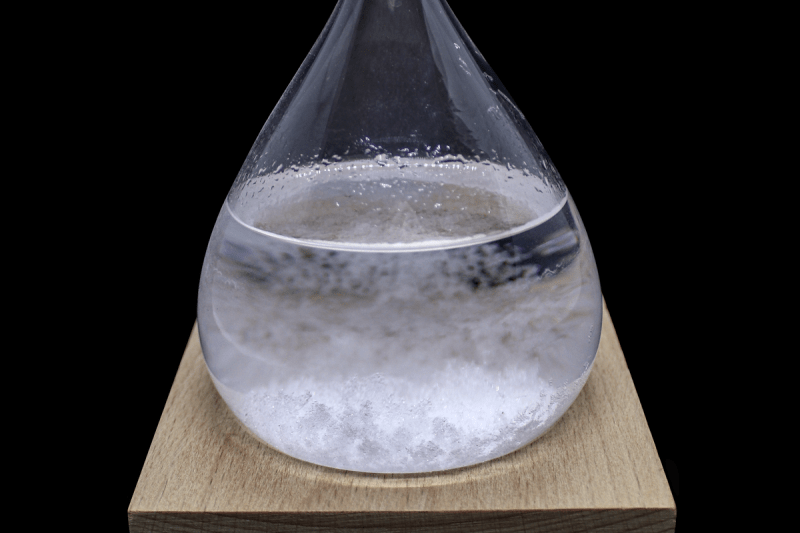
Everyone talks about the weather. This is doubly true for sailors, where bad weather could mean a very bad day. So it isn’t surprising that navies around the world have had a keen interest in weather forecasting. But how did you predict the weather before modern instruments, radar, and satellite images? Vice Admiral Robert FitzRoy had great faith in “storm glasses,” a glass chamber containing some chemicals that he didn’t invent, but did document and promote heavily during the 1860s.
Did it work? Apparently not, but the device is still interesting in its own right. FitzRoy was a pioneer of meteorology, replacing folklore with actual observations and attempts at scientific rigor. While he did arm observation stations with conventional things like thermometers and barometers, he was also a proponent of the weather glass.
What is it?
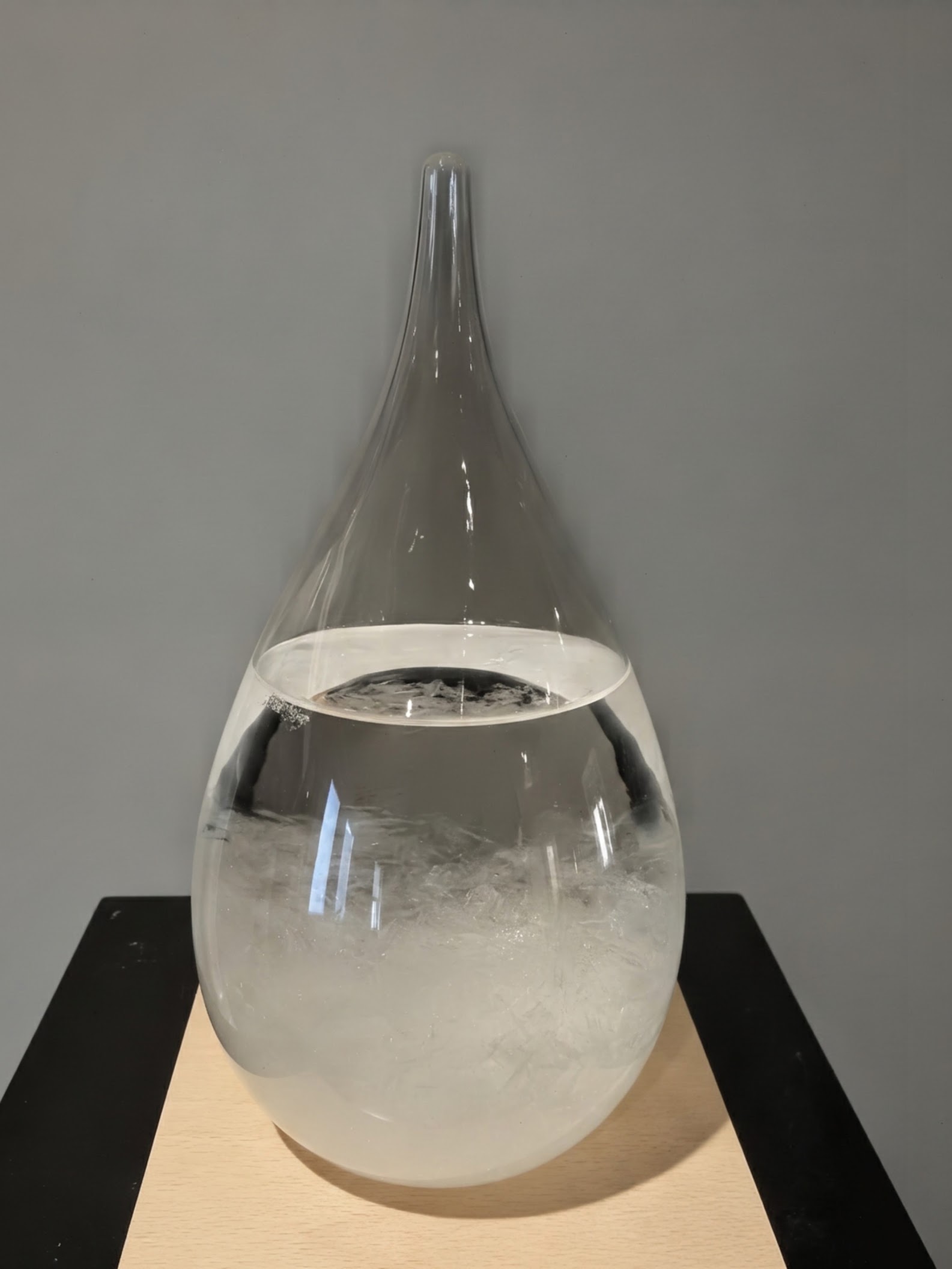
The glass itself was a sealed glass vessel, often a tube, that contained a mixture of alcohol and water. In that mixture were camphor, saltpeter, and sal ammoniac.
The camphor will precipitate out or dissolve into the solvent, forming amazing crystal patterns. According to FitzRoy, the liquid will be clear if the weather is clear, and cloudy if it is cloudy outside. Different sizes of particulates indicate rain, snow, and other weather phenomena. FitzRoy thought the wind had “electrical tension” and that was responsible for the device’s ability to predict weather.
Scientific studies showed little correlation between the state of the glass and the weather. However, it is still a great conversation piece.
Despite the salts in the recipe, the spectacular crystals in a storm glass are primarily camphor. Camphor dissolves readily in alcohol but poorly in water, while potassium nitrate (saltpeter) and ammonium chloride (sal ammoniac) have roughly the opposite preference. The mixed alcohol-water solvent accommodates all three, but the camphor sits close enough to its solubility limit that temperature changes cause it to crystallize and redissolve. The salts appear to affect the form of the growing crystals, helping produce the elaborate dendritic structures that make the glass look so dramatic.
Maybe it Works?
FitzRoy was convinced the glass was effective. However, in 1863, Charles Tomlinson wrote in The Philosophical Magazine that the instrument was little more than a crude thermometer. This was later suggested in a 2008 article, as well.
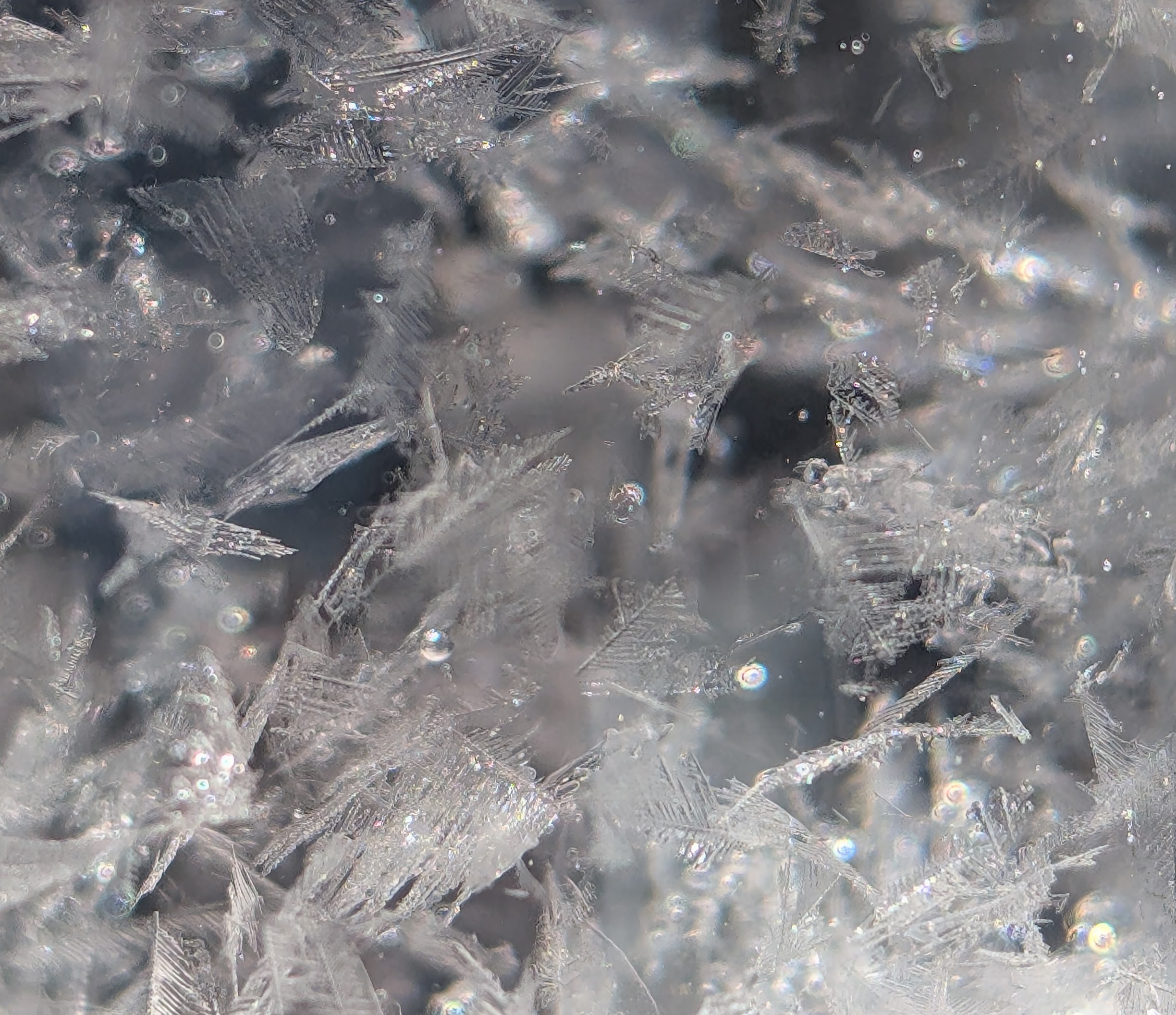
Proponents of the glass will tell you that they need to be placed very carefully, out of climate-controlled areas. They also, apparently, say you have to initially heat the liquid until the crystals are totally dissolved. After a few weeks to adapt, they swear the Storm Glass is a perfectly good weather prediction system.
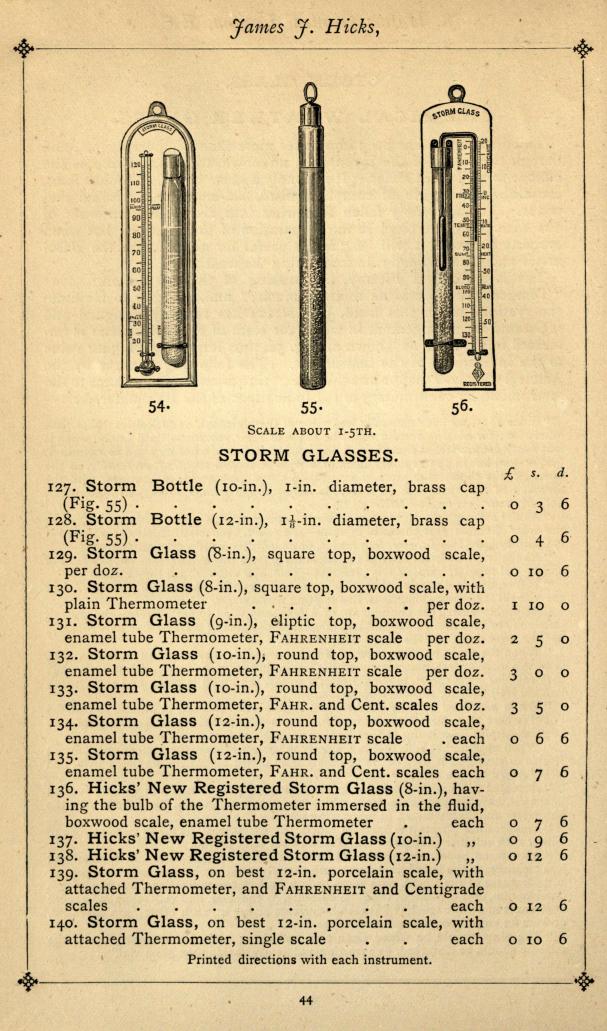
Despite their unreliable nature, the storm glass was a popular item, and you can even find them today, more as decor. But in 1863, you could find a variety of choices with and without thermometers attached, as you can see in the James J. Hicks catalog page.
Before the Glass
Of course, people were interested in the weather well before the late 19th century. Even FitzRoy admitted that the storm glass was at least 100 years old by his day. The game changer was the electric telegraph.
The telegraph allowed for widespread real-time observations. FitzRoy was a pioneer in that game, as was his mentor Sir Francis Beaufort, famous for developing the Wind Force Scale, sometimes known as the Beaufort scale. If you read his writings, he was, for the most part, on the right track for weather observations. But the storm glass that is most closely associated with his name wasn’t really the thing you wanted to be remembered for.
You can make your own storm glass, as you can see in [NightHawkInLight’s] video below. Maybe you can determine whether it really works. Or take your weather station into the modern era.
Featured image: Baromètre de Fitroy ou ou verre-de-tempêtes by [Anja]








As a side note, looking at the frost crystals when it is close to 40 centigrade outside is entertaining : = ]
Fun demo but it shows how science was once nothing more but skeumorphic superstitions.
I think you have misunderstood the term “skeumorphic”. Skeuomorphism is a deliberate human design practice where a non-functional design element mimics a previously functional one. E.g. a polymer shoe having moulded in fake stitches mimicking what would be holding a leather shoe together. You may be thinking of pareidolia or apophenia, combined with the representativeness heuristic.
Yep yep, all applied science way back when started as astrology (generic term used by me) and eventually forked into astronomy. Astrology is still around, being proactively developed, etc, but, imho, became more of noetic studies than applied science.
Alchemy to chemistry. Nukes will change mercury to gold…uranium turns to lead or something on its own…with time.
Old tube TVs might pick up tornado ‘sferics
Franklin wasn’t just known for kites..he might have been one of the first (landspout) chaser.
Rumor has it the original Star Trek: TMP (later TNG Battle Bridge) set was wrecked by one late last century.
Astrology did one thing right – accumulated a huge body of observations, which helped astronomy, once superficial/irrelevant things were left out (analemmas are not caused by the intricate/divine wobbling of the Sky Spheres coupled to Earth, rather expected outcome of precession, so while the mechanics of such are not simple still, they are much simpler than what it was mostly mistakenly assumed).
Alchemy, too, had formidable accumulation of facts that helped forking chemistry, once anthropomorphic projections were left out. In that sense it was good at accumulating potentially usable knowledge, but was lacking the framework to make proper use of it. It sure did a lot of discoveries along the way, and I am not dismissing these as unimportant.
(on the topic of framework, astrology, too, eventually started using simple/naive math, and at some point acknowledged some parts of the astronomy as their rightful discovery, but it still came up short – the framework proved too rigid for it to grow out of; the basic assumptions of humans being affected by the events that are just too distant, and mostly irrelevant, when compared with, say, seasonal changes, one example; but astrology also helped to fork other relevant applied science, one example out of many, celestial navigation, and in a way continues living elsewhere – NASA’s use of Standard Candles).
As a side note, and it is quite appalling to watch, that we are (in the USA) witnessing a gradual erosion of astronomy and replacement with astrology. I suppose folk science was always at about that level, ie, observations lacking proper/usable framework, but so were other things, palm readings, iridology, etc.
“little more than a crude thermometer”
It’s both a differential thermometer and an integrating thermometer, which has some predictive value.
The pattern of the crystal growth depends on the recent-ish rate of temperature change.
It’s a pretty interesting instrument to watch. I’d compare it to a very slow-motion lava lamp. And because it’s powered by outside temperature, depending on your local climate and season, it can be somewhat useful at prediction.
It works about as well as writing down the temperature every hour and calculating both integrals and derivatives, and then comparing to past experience, which is to say it can be extremely accurate in some areas with a skilled observer or little more than performance art in some areas or with an unskilled observer.
Since the 1980s they’ve always been about the cost of dinner and they’re always sold to noobs with very attractive interior use only decor whereas you actually want one durable enough to sit out on the patio in the shade. I don’t see the point of installing one indoors assuming you have a working HVAC system.
Speaking of shade there’s a huge debate about how placing one in the sunlight gives you cloud data whereas placing one in the shade limits it to strictly temperature data; I’ve only done the latter but the former might be useful? You should keep it in the rain yet out of the sun (aka against a north facing wall) then you get valuable dew point data. That is probably why mine is fairly useful.
Observations will be fairly subjective based on crystal mass, change since last time, and shape/fluffiness of the crystals. Its not nearly as simple as “clear jar means clear skies and cloudy jar means cloudy skies” its more like it clears when the dew point is rising (before a storm) and gets cloudier at a constant rate when the weather is constant-ish. Also, the hotter it is, the clearer it is, the more violent the soon arriving thunderstorm, at least in my local climate.
You could probably write an attractive phone app that draws (and erases) crystals based on a graph of recent hourly temperature or maybe dew point. It would probably look cool. But the glass jar object looks cooler.
So the prediction boils down to guessing that if the weather has been warming up or hot for a while, it’s probably going to cool down next, or vice versa.
Another good weather prediction algorithm is to guess that tomorrow is going to be similar to today. You’ll be correct more than 50% of the time and you can call yourself a weather prophet.
Hardly that primitive a guess – crystal growth can be very sensitive to conditions so that temperature change you will not notice even watching a thermometer is likely to have a noticeable impact on it. Unless you have really high precision logging with time you just won’t yourself be able to tell that this morning ramped up to hell on earth heat/humidity levels an hour earlier in the day either, which would probably be quite visible in one of these. And that would let you know the weather pattern is/isn’t moving much and build that intuitive picture of what the weather is doing beyond your LOS.
I’ve never played with one of these so I have no idea how informative it could become with a little practice, but in theory it aught to be way better than your two primitive extreme guesses of its warm now so it will be cold next or tomorrow will be like today. Quite possibly the equal to a barometer and thermometer that are precision instruments but hopeless at prediticing the weather if you lack the art/local knowledge to extrapolate that local measurement into the bigger picture. Plus at least with recent months you’d be wrong every single day with the former – its been darn nearly a constant heatwave for months, the nearest to a change in the weather being a few more of less wisps of useless cloud… And that latter guess is inevitably going to be very very very wrong when the heatwave really breaks, as such extreme out of the ordinary weather for a prolonged period pretty much never fades slowly back to more seasonal norms…
In that case, if a tiny temperature difference is enough to drive dramatically different behavior, it means the system is on a tipping point between states and driven to saturation one way or the other outside of that point, making it rather erratic as an indicator.
Historical accounts and reports of the use of these “storm glasses” indicate that they’re pretty much bunk science and useless as weather predicting tools, and as thermometers they’re much less accurate and much more difficult to read than actual thermometers. Judging on the different crystal shapes, amounts, orientations, etc. by eye is nothing more than reading tea leaves – an exercise in self-deception.
Not really crystal grow over time so tis potentially very like Dendrochronology if you have the knack to read it you can infer from the crystal branching/clarity/size etc way more information than just an accurate read of the temperature at this moment a thermometer will give you. Which is also bunk at predicting the weather in its own right – without logs and local knowledge or large network of sensors spread over a wide area.
It doesn’t take much to make a visible impact in crystal growth as a rule anyway, but it is far from binary on off crystals present or not etc. Not played with one of these and it certainly won’t suit my preference for precision measurements but if you have master the art of reading it…
It’s funny how you assume the idea to be plausible first and then try to convince yourself that someone must be able to predict the weather using these things.
Not only do you need a lot of data and local knowledge to correlate temperature changes over time to weather, you also need to be able to accurately judge the past temperature record from tiny crystals floating in liquid without knowing how the two relate to each other. The signal to noise ratio is so tiny that the whole exercise becomes intellectual homeopathy.
That’s an interesting point that it probably also encodes something about the rate of change in temperature as well. Like with barometric pressure, how it’s not so much the level as the change that lets you know that a new front is coming in.
(Rabbit hole alert!) Turns out that the barometer is only reasonably correlated with weather changes in northern lattitudes, and basically useless at the equator. There is more going on there than I thought. https://www.noaa.gov/jetstream/atmosphere/air-pressure
Excellent write-down, thank you for sharing.
I own one, paired with another interesting kind, Galileo Thermometer, and then there is a cheap clock in the middle as well. Entire contraption doesn’t look like it would do well outside, so its value is questionable, since our home temperature/humidity are reasonably constant to noticeably affect anything.
Is this the same Fitzroy who was captain of the Beagle; who hired Darwin to join him on the Beagle simply because he wanted a a companion to talk to during dinner; and who eventually committed suicide?
Great curriculum vitae.
I’ll take two.
The very same.
Kikkerland makes a Storm Glass Admiral Fitzroy Weather Predictor.
I bought it and it did nothing really. They say it can get messed up from shaking it, so I heated it up to reset the crystals, but it still did not do much of anything.
Reminds me of old barometers that have silly forecasts, although better ones used rate-of-change of pressure for a bit better forecast. People’s lives, seafarers depended on any forecasts, so I can understand the urgency.
Old cheap desktop barometers usually have this rotating arrow that’s set at current pressure and then looked at later and reset again. The delta would give one an idea of the change, given one is diligent and does so (ie, checks delta) at regular intervals.
Having said that, almost all budget barometers are made from rather simple materials (usually two sealed brass plates) and are not really meant to be terribly accurate, but good enough for average household. I’ve opened and looked at few some decades ago, and their common problem (in addition to gradually loosening seal) seem to be over-compensation, ie, driving the tuning screw too far and basically ripping hole in one of the plates, basically, rendering it useless.
I still own few “desktop barometers” I picked at flea markets, and most of them work, just not very accurately. (same goes for the thermometer/hydrometer that are usually added as well).
There are also old high school barometers that are slightly better, and some come with proper dry bulb wet bulb thermometers that should reflect temperature and relative humidity reasonably well. I don’t own one, but saw few around, and they look well-made.
In Bermuda there is an old tradition of Shark Oil (from, I think, the shark’s liver) “barometers”. It’s shark liver oil in a sealed bottle (nowadays often the small liquor bottles you get on airplanes which are sold in souvenir shops having had the labels removed, the shark oil added and affixed to a board but bigger bottles in the old days which were said to be “more accurate”). The shark oil was said the get cloudy as the sediment rose up when a hurricane was approaching. Some people even would say that the sediment rose first on the side nearest the approaching hurricane. Not sure if any science has been done but hurricane prediction has always been dear to the hearts of people living on a small archipelago in the middle of the Atlantic Ocean.
I prefer my “weather stone,” i.e., a rock dangling from the end of a string.
If it’s wet, it’s raining. If it’s dry, then it’s not. If it’s swinging, it’s windy. Still, then it’s not. It even detects snowfall by turning white.
I made these with the nephews using methanol and camphor via and instructable. They actually work pretty well vs the original purchased one. You can also tune the recipe to your area’s climate so they change more often. It is really more of a thermometer from what I saw but it is realllllly neat when you get the cloud snowing the crystals down. Window sill seemed to be the best place for mine :) Very cool and timely article, HaD :) I love these kind of gadgets though that put the magic back into science and make it fun.
The saying “Red sky at night-“ is really only for sailors, what with Cape Verde’s storms coming from East to West.
In (inland) North America, where storm fronts frequently move West to East (tornadoes often SW-NE) the saying should be:
“Red sky at night—farmers take fright.
Red sky at morning, there should be no mourning.”
On the East Coast—who knows?