
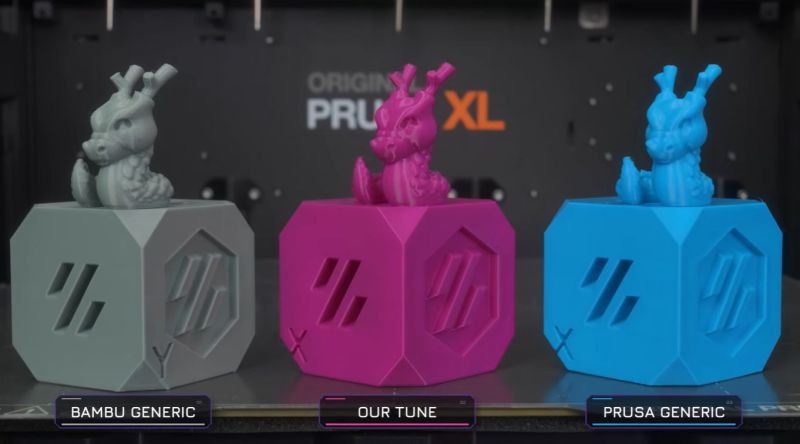
In this era of consumer-grade FDM printers that have automatic bed levelling, automatic pressure advance tuning, automatic temperature regulation and so on buttoned away behind bullet-proof presets and automation, something as archaic as manual filament tuning does seem a bit out of place. Unless you’re running that hot rod Voron FDM printer, does it make sense to ‘waste time’ with manual tuning your off-the-shelf FDM printer? In a recent video [MandicReally] argues that it still makes sense to unlock more performance.
Up front it’s made clear that these auto-tuned configurations are perfectly fine for the average user, who will be perfectly happy with something like a ‘generic PLA’ preset combined with whatever auto-configuration the printer did. That said, not every filament is the same, nor is each heating element, nozzle and feeding system. In that sense it can be worth it to take a deeper look.
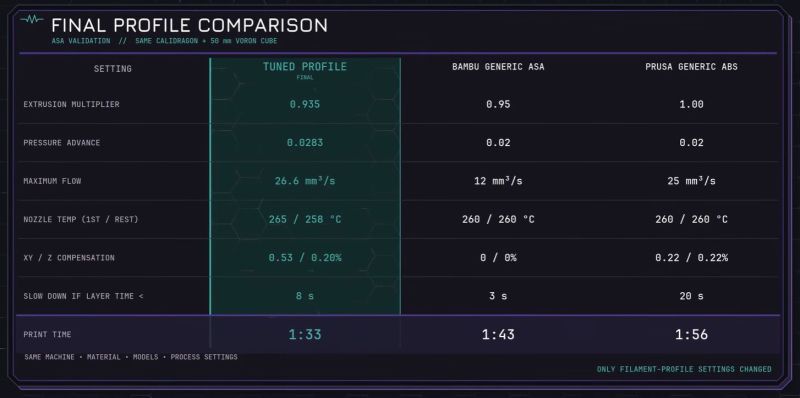
In the video basic aspects like preparing the material, such as properly drying, are looked at, before running through tests for temperature, flow ratio and rate, pressure advance, retraction speeds, material shrinkage etc. before doing a test between such a tuned profile versus a generic preset for ASA filament.
Although the difference isn’t night and day, the tuned profile was faster due to less conservative settings and had better accuracy on the final print due to taking the target FDM printer’s performance into account. Even if not something that the average hobbyist would be interested in, if you’re doing something like production runs with FDM, this might be something you’d want to look at.












if you modify your 3d printer you need to. If you have a voron you pretty much have to, if you have a bambu (even though i dislike the company) they do have their filament profiles dialed in pretty dang good i’ll give them that. I’m not even sure why this is a video other than clickbait.
The default presets simply don’t always work well, so yes, depending on the filament you’re using it definitely can be worth it. For example, some filaments ooze more than others, or may require a different temperature to produce good results.
PLA PETG and ABS sure.. more advanced materials usually require tuning.
Default profile don’t work with silk filaments, I have two dialed in profiles. One for smooth surface metallic shine and one for a more rough finish.
Als made modifications for regular PLA and PLA+. Especially when printing models ar 0.1 mm layer height or lower this can make a lot of difference in quality.
But I don’t have a Bambu (and never will) and I like to tinker..
I’d say yes, yes, yes. Unless you really want to get locked into the manufacturers slicer and cloud printing bullshit. Or if you really only wanted your figurines to sand and paint.
Everything is connected. Printer tuning, slicing, CAD design, etc. is all part of the same process. If one leaves one of those things out, the rest becomes harder to understand. A small change in model design may yield MUCH faster and MUCH better looking or stronger parts. For example: I tend to design stuff without sharp outer corners. A tiny fillet here and there reduces the need for extreme pressure advance tuning. It still matters, but it’s just not that critical for that part. It may also speed up the printing time a bit.
heh, i always do manual tuning from a totally different angle…i don’t care about getting the best “performance” (hatever that is), i just don’t ever want to learn how to use anything else. so i have just been continually tuning one Slic3r.ini for 12 years.
I’d argue that learning how to tune/tweak your printer and how to slice and orient parts for best results, is a crucial part of the hobby. Consumer electronics companies obfuscating or outright blocking efforts to do this, are a blight on the community.
I’m also skeptical of someone who claims expertise but then (ab)uses extrusion multiplier and XY scaling settings. The old wisdom tells us those are settings of last resort. Ideally, you’d measure your filament diameter, and set your steps per mm based on first principles.
I attempted to fine tune my prusa XL and despite a through testing regimen and multiple test prints I could not get a big difference over the stock settings. The biggest difference was from switch to high quality filament and throwing away all the cheap stuff.
We don’t print in the same environment. Different temperature, humidity will affect the print.
It’s kinda over done process if your your printer can do that automatically