
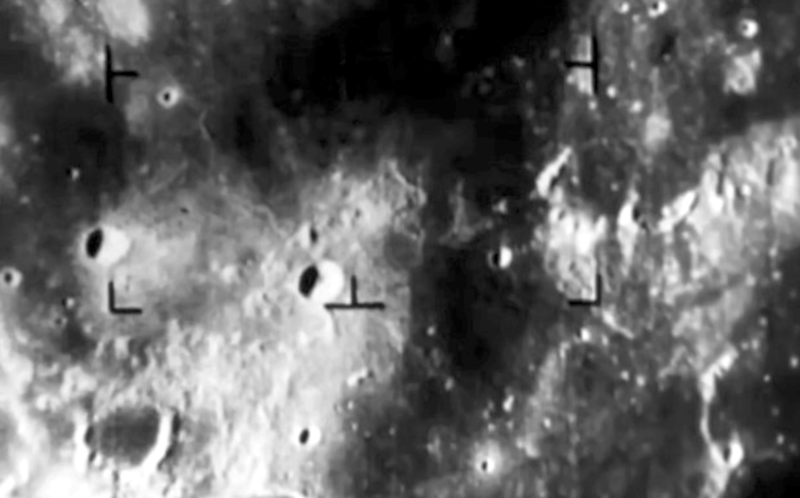
If you didn’t live through it, it is hard to understand how excited the general public was about the race for the moon. You can capture some of it by watching “Lunar Bridgehead,” a film about JPL monitoring the Ranger spacecraft as it hit, rather hard, on the lunar surface.
The Ranger program had been plagued with problems. The first five didn’t make it to the moon. Ranger 6 hit the moon, but failed to start its cameras. Ranger 7 was the first successful mission. There would be two more successful missions before the end of the program.
Honestly, given the state of technology and computers in those days, it is a miracle they could do it at all. Even more sobering to think that a scant five years later, Neil Armstrong would set foot on the lunar surface. In fact, Ranger 8 would land in the Sea of Tranquility, just like Armstrong’s Eagle.
The video has a lot of cool shots of old tech: magnetic tape drives, teletypes, paper tape readers, and giant dish antennas. The six onboard cameras even had to warm up, something unfamiliar to those who have only used modern electronics.
Of course, the cameras didn’t survive the crash, and that was expected. By today’s standards, the images are crude, but in 1964, they were nothing short of amazing.
Turns out, landing on the moon is harder than people think. Even with modern tech.












Hackaday used to be site where all manner of cool stuff was posted. It still is, but used to be, too!
Enjoying a pint a block from the theater where I saw what must have been the last newsreel which gave me a big screen view of crashing into the moon, from then on it was the little TV screen.
Not exactly a good video in my opinion.
The narration has too much drama, too much sensationalism and superlatives in about every sentence.
It’s less about science and research than tapping on the own shoulder.
“Look at how great our people are!”
A calm, quiet interview with one of the engineers or scientists would have been nice.
“Look at how great our people are!” – yes, this was largely the point.
With emphasis on “was”. Especially considering that almost nothing happened for some 40 to 50 years after that. It’s only very recent that the whole space thing is being taken seriously enough to become sort of common and mainstream.
One of the biggest blunders (apart from Hubble, and the Mars Climate Orbiter) was that space plane the us attempted to make. On itself a marvelous achievement, but the attempt to make a “reusable” spacecraft in an era when the technology to make it reusable and reliable spacecraft simply was not developed yet turned it in an exceptionally expensive turd. It’s an excellent example of what happens when you trow infinite money to a project.
Only very recently a very rich facist realized that “the general state of technology” has progressed far enough to make a decent reusable spacecraft, and used that to scale the whole space thing up and bring down launch cost (per kg) by a factor of 10 or more. And I do ( of course) give him credit for that, but along those 50 earlier years my interest in space (apart from reading SF) has severely chilled.
The STS? I think it was kind of sad for a starship to never have left earth orbit.
In films such as 2001, shuttles flew to orbital stations and the moon.
On other hand, at least, the STS was very good at being a repair vehicle (robot arm etc) and a being a small space lab (lab in the cargo bay).
An advanced version of the STS was the Buran, I think.
It noteably flew successfully in automatic mode, for example.
But due to geopolitical reasons, the Buran never got a real chance to fly to space with a crew.
Which is very sad, I think. It seemed promising.
https://en.wikipedia.org/wiki/Buran_programme
The “classic” view of space travel, from my favorite 50s/60s/70s SciFi stories, is that a complete shuttle-type system would have three parts: an Earth-to-LEO shuttle, a LEO-to-lunar orbit shuttle, and a lunar lander. Each would be optimized for its specific mission. The Earth shuttle wouldn’t ever leave LEO, except perhaps to go a bit higher.
They finally get these new pictures and they still make the wrong conclusion! Lava surfaces. Confirmation bias is a powerful thing
Found the Musk fanboi.
The simpler the tech—the more fully the mind can understand and master it.
As if the Krell brain could comprehend the secrets of the Ape.
It also can quickly get overwhelming. You need tech to dumb the data down, calculate stuff.
Generally speaking, yes.
But there are exceptions, too, I think.
For example, I knew a boomer who had a faible for very flat jokes.
Trying to understand the punch line hurt my brain, because it kept searching for something that wasn’t there.
It was no fun but pure stress to think on such a low level, in short.
It’s like with Marvin from The Hitchiker’s guide to the galaxy, basically.
What, so the punchline is that the joke has no punchline?
:-S
That guy was making kindergarden jokes, basically.
Example: What’s the difference between a baker and a carpet?
The baker stands up and 2 ‘o clock in the morning but the carpet keeps lying.
Sounds harmless at first, sure.
But if you have to play a guessing game for each bad joke it causes headaches.
Especially if the joke was dressed as a serious, witty question.
It’s like one of these bad, illogical puzzles/riddles in point&click games of the 90s, basically.
You try to make sense of it, but in the end it was something absurd that’s not even funny.
Perhaps more notable was that the USSR was a real contender with- as an example- the Lunakhod rover, despite being a long way behind the USA in electronics and having hardly any computers.