
Trains and the railways they run on are a great way to move lots of stuff, or lots of people, a long way. Steel wheels on steel rail can shift great loads at good speeds and railways remain a backbone of logistics for this very reason. The only problem is that they require a great deal of initial investment to build and plenty of maintenance to keep them functional over time.
These concerns can make a railway a difficult proposition when it comes to getting large amounts of goods in and out of remote areas. It’s a problem that Australia faces, with settlements far off the beaten track that are nevertheless in need of high-throughput freight connections. And if you can’t go rail, you go road… in a big way.
Heavy Haulers
The simple fact of Australia’s geography is that there are towns and cities separated from each other by thousands upon thousands of kilometers. It’s often desirable to move goods to and from these places, along with remote mines and farms buried in the country’s vast, dry interior. However, it has never been practical to link all these disparate locales by permanent railways. The distances have always been too vast, and the freight volumes not quite high enough to justify the expense. At the same time, relying on trucks alone was seldom economically convenient.
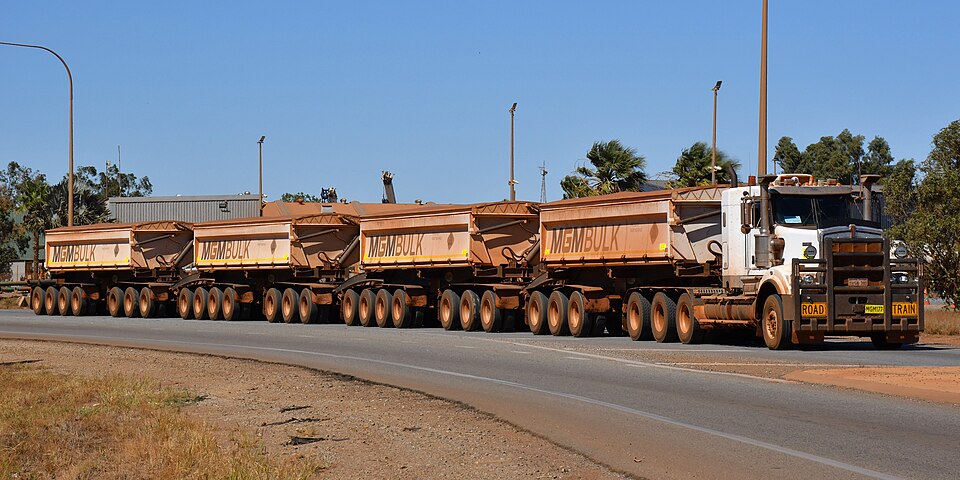
The solution was straightforward, and surprisingly simple—bigger trucks hauling more trailers. In the local parlance, a road train consists of a prime mover (or tractor) that hauls two or more trailers.
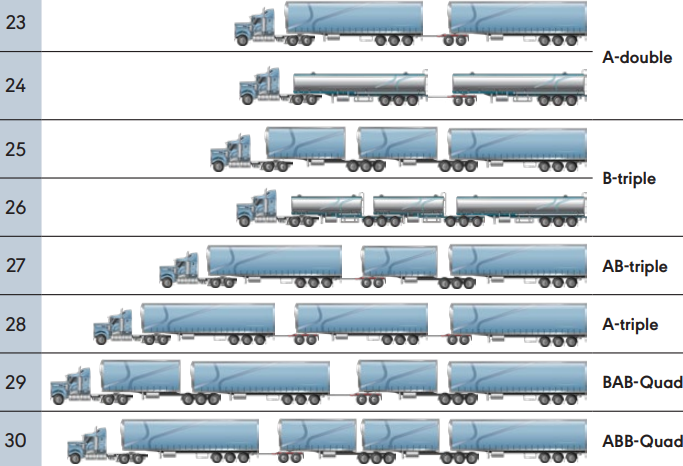
The official definition from the Heavy Vehicle National Law excludes the standard B-Double configuration that is regularly seen across the country. Instead, a road train could be a longer A-Double configuration, or even one of a variety of combinations involving three or four trailers being hauled by a single prime mover, like a B-Triple or a BAB Quad. The A and B designations refer to the type of coupling used. A-type refers to drawbar-based couplings, while B-types are fifth-wheel or turntable-type couplings. A truck or road train setup is thus referred to by the couplings that make up the consist.
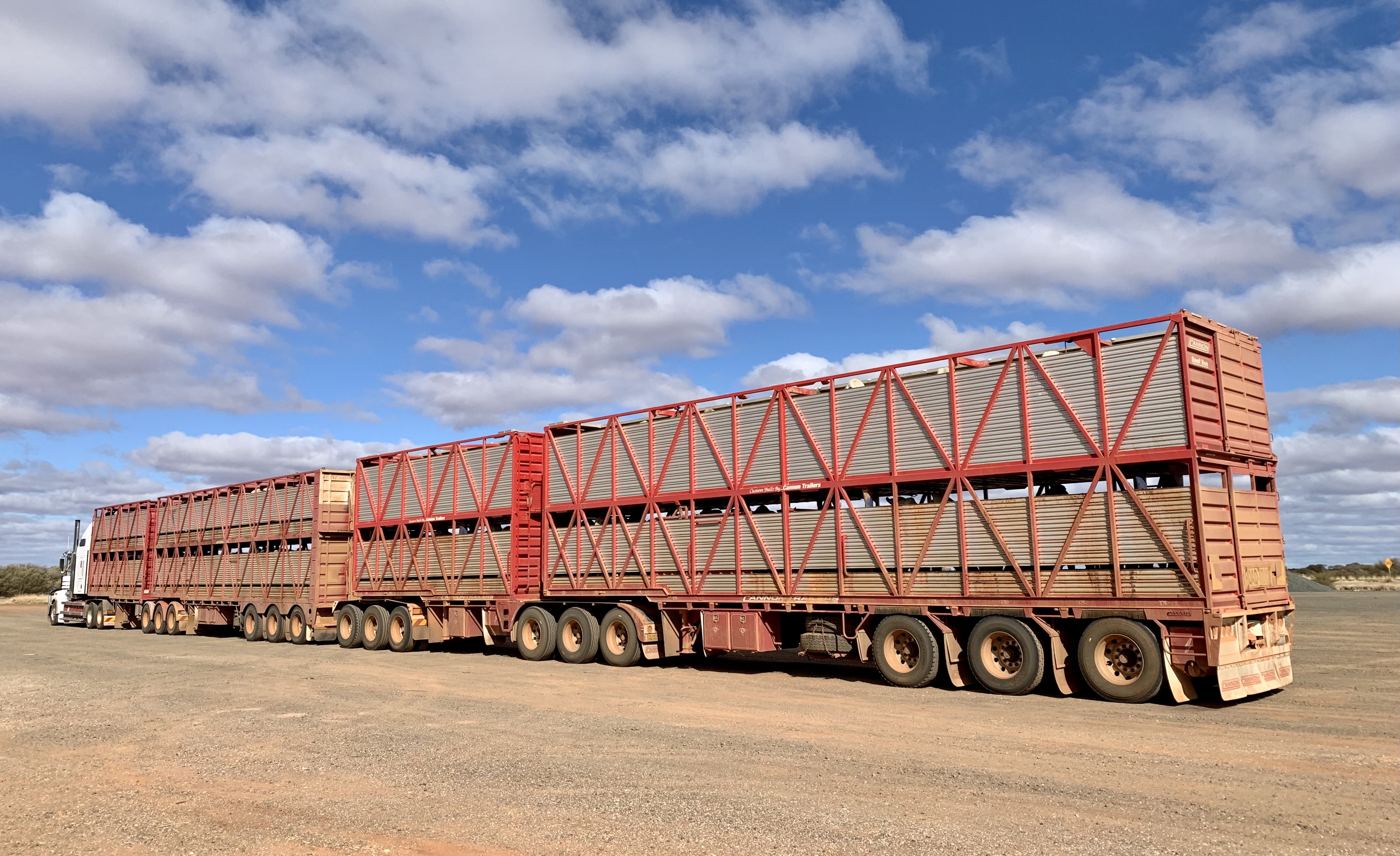
The longest road train configurations of three or four trailers typically range up to 53.5 meters in length and over 135 tons in weight, per the rules laid down by the National Heavy Vehicle Regulator, though even longer configurations are used in some specially-permitted or off-highway roles in mining or agricultural industries.
These long consists are typically pulled by large prime movers with anywhere from 500 to 700 horsepower and 1500 to 2000 pound-feet of torque. Ultimately, it doesn’t actually take a grand amount of power to get even a very heavy load moving; it’s the torque that helps the most, anyway. The bigger challenge is actually stopping, and that takes great care and makes road trains unsuitable for crowded roads. As far as applications go, road trains are used for hauling all sorts of goods and material across Australia. Common loads include livestock, ores, and general freight, as well as long chains of tankers for hauling bulk amounts of fuel.
Road trains also wear large signs front and back to indicate their status. Typically, this consists of large black text on a yellow background reading “ROAD TRAIN” or “LONG VEHICLE” depending on the jurisdiction. Classified nationally as heavy vehicles, road trains are limited to speeds of 100 km/h, except in NSW and Queensland where they are limited to just 90 km/h (except for B-Triples in the latter state). These regulations in part help to ensure that motorists know what they’re dealing with when coming across a large road train on the open roads in the Australian outback. It can take quite a long time to pass a road train at legal highway speeds, so motorists need to be aware when attempting such a manuever.
Largely by virtue of their length alone, road trains are restricted in where they may or may not travel. For example, in South Australia, B-triples that measure up to 35 meters long are only allowed to travel via specific routes to industrial and import/export hubs, to avoid them causing chaos in built-up metropolitan areas. Similar rules exist in other states and territories, too, where triple and quad configurations are allowed to operate at all. Notably, Darwin, capital of the Northern Territory, is unique in allowing triple and quad roadtrain consists to operate within a kilometer of the central business district. The city’s limited size and density, with a population of just 140,000, means that this isn’t the same practical disaster that it would be in other major metropolitan centres around the nation.
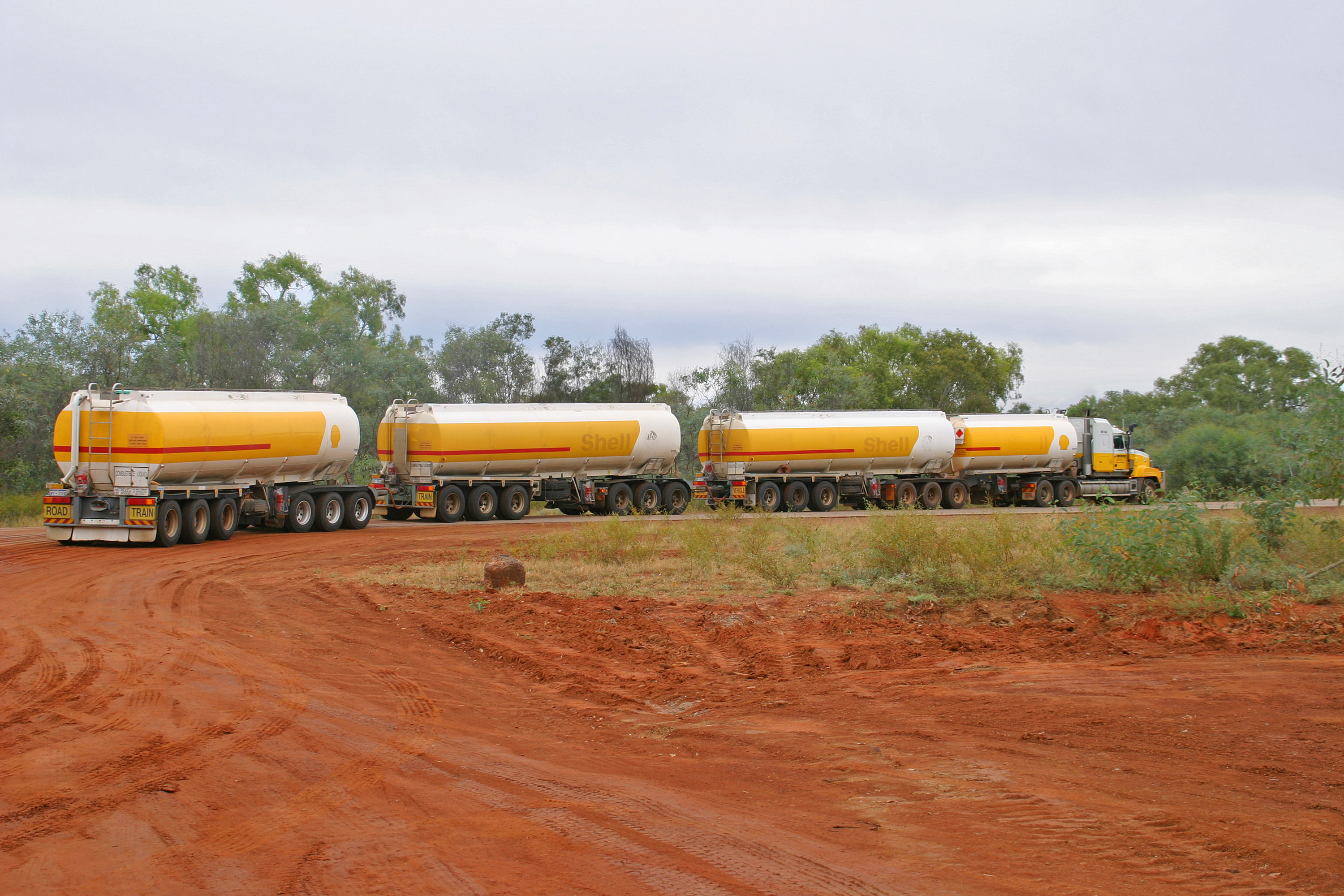
The “road train” terminology does have some purchase in other parts of the world. However, it generally refers to B-Doubles or other smaller consists compared to the Australian norm, where it only refers to the very largest configurations.
For example, countries like Spain, Sweden and Germany allow truck-trailer combinations up to 25 meters long, while trucks in the United States are largely limited to two trailer configurations up to 19 meters maximum. In these other jurisdictions, there is seldom the same economic incentive to haul excessively long trailer loads to maximise the efficiency of freighting to and from far-flung destinations. Greater traffic and other road network considerations also limit the practicality of extra-long consists in more densely populated regions.
However, in the outback of Australia, where the roads are so empty and the distances so great, the three- or four-trailer road train starts to make a whole lot more sense. Road trains aren’t going anywhere as long as Australia maintains its low population density and needs to haul goods to and from distant rural and regional areas. If you go far enough beyond the cities, or to the right freight terminals, you might just see some of these rolling behemoths ploughing their way across the landscape!












Since 2019 Finland allows up to 76 tons and a maximum length of 34.5m. B-doubles and A-doubles are the most common road train combinations in this order. Naturally straight trucks with an A-trailer and normal semis are the most common ones on the road.
Special transports are a different story, size and weight can be epic, but they need special permits and a bunch of pilot cars. Think windmill blades of 70-100 meters length or 400 ton transformers for example.
Personally I push a Volvo FH13 540 horse tractor mostly with a B-double, my tractor is not equipped with the cameras required for A-doubles.
This seems extremely unsafe.
Feel free to put more detail in your comment, do you mean that:
writing the comment made you feel unsafe, since “this” might just only refer to the comment itself.
the website Hackaday has security issues, so that “this” is referring to Hackaday.
the road train concept in general is unsafe.
If the latter, why do you think they are unsafe of more dangerous than other solutions? Keep in mind that mostly all forms of transport have some form of danger in them. And if it is the only viable option, what would you do?
Sarcasm is a cowards lie. The OP obviously meant that it seem unsafe to have such large heavy vehicles on the road. The roadways are much more uncontrolled than railways. Cars, multiple entry/exit points etc.
Hitched a ride in one. The driver laughed when a car coming the other way appeared to expect that he was going to deviate from the center of the road.
Why?
If you are driving towards one, you and your vechile get clear of the road, I suggest.
In Sweden 25.25m used to be the maximum length. It changed in 2023. Maximum road train length in Sweden is now 34.5 meter.
https://www-transportstyrelsen-se.translate.goog/sv/vagtrafik/yrkestrafik/gods-och-buss/matt-och-vikt/langd-och-breddbestammelser/34-meter-langa-fordonstag/?_x_tr_sl=sv&_x_tr_tl=en&_x_tr_hl=sv
An LLM ‘hack’?
Large load monsters. Inspiring, maybe?
I thought the “rocky mountain triple” i occasionally see in the western US was boss enough. Those Aussie rigs look positively insane.
As far as I know Australia is a flatish continent, for sure more than the North American one, so the aussies may not understand the question: “what is the maximum length of a road train?”. Another reason is the enourmous distances between two habitated places, so you want to haul as much as possible in one go. And the third one is the sharks and crocodiles and all other critters that want a bite out of you. You need a big thingie moving between them to scare ’em off.
Yes. These trucks are normally for coal mines, outback towns. Very small gradient hills and long straight roads with very little traffic.
Australia is mostly flat apart from the east coast where the population density is higher.
Yeah, those road sharks that come out nowhere? REALLY scary, mate.
RE “…want a bite out of you…..” or want to eat you …
If it’s regularly, maybe you’d want to build a rail.
TLDR;?
Mad max shit
Going from a dead stop has to be an ordeal for the clutch…
Indeed, an article on how the clutch works would be more in-keeping with Hackaday’s audience.
I’m just hoping the front doesn’t fall off any of these trains.
Doesn’t matter if it’s beyond the environment.
That’s what gearing is for.
In some areas, they often ship completed buildings on these, cut in half and you have to get off the road to let them pass. That and massive mining machinery.
It’s cheaper to manufacture and fitout the buildings near a major city or regional hub and then ship them out to a mine or community – even when they have to pay for a police escort to clear the roads.
Only idiots and caravanners try to overtake these below the speed limit – there’s not enough visibility in most areas to do that safely, and half of the truckers don’t listen to their UHF radios.
And what’s the hack? It’s a train, but on a road. It solves a problem using an unconventional solution that works.
yep, an article about how the braking works might be worth while here, else I don’t know why this is on HaD.
and by the way, nobody does the legal limit passing road trains… Particularly when there is a few in a row..
We (Australia, Mount Isa) might be getting cargo airships from a company called Flying Whales.
Was always fun passing a road train in Northern Territiory before they put speed limits in place.
Flying past the train at 150+Kph was normal, as was then being overtaken by a police car doing over 200Kph. Always felt weird to see, as anywhere else would see your drivers license confiscated on the spot.
But the real fun was coming up behind a road train that was snaking down the highway with a speed wobble at 100Kph, almost like it had a resonance going on making nice sine waves down the road.
Here in the UK a haulier tried to make a longer setup (25.25m 60-tonne B-double) that they claimed was still within the UK rules, there’s been years of legal wranglings and I’m not sure what became of it all:
https://www.denbytransport.co.uk/about_us/eco_trailer
Some U.S. States have 3 trailers, Oregon for example. They even drive through cities.
I hope someone down under builds a solar car/rig at the full monstrous size – would be quiet the sensation at the world solar challenge
Very common on the Stuart Highway
During a 4 year stint in Alice Springs, my wife and I became reasonably skilled in the art of passing road trains out bush, even the dead head tankers swaying from side to side. What got really sporty was passing while driving a LHD Studebaker Avanti back from Brisbane. There were plenty of straight stretches and the V-8 was willing, so I survived the technique of peering around the left side to see if the coast was clear and dropping the hammer.
I had the pleasure (not!) of driving north in Western Australia to a gold mine in Newman in the 90’s on an emergency breakdown (worked in industrial control at the time) and encountered multiple of these as they headed south to Perth…as a result there were multiple broken guideposts/marker posts in my wake on the side of road as I cleaned them up when pulling over in the gravel at 120kmh to let these behemoths pass…another reason why we have roo bars
Just heard a truck driver being interviwed on the radio (4bc) . He said, his 4 trailor truck , max weight is 248 tons. Max amount of fuel is 6000 litres. ( He mentioned it uses 70L / 100 Km – not sure if thats at max weight. ) He mentioned his brother drives a 6 trailor truck in Western Australia.