
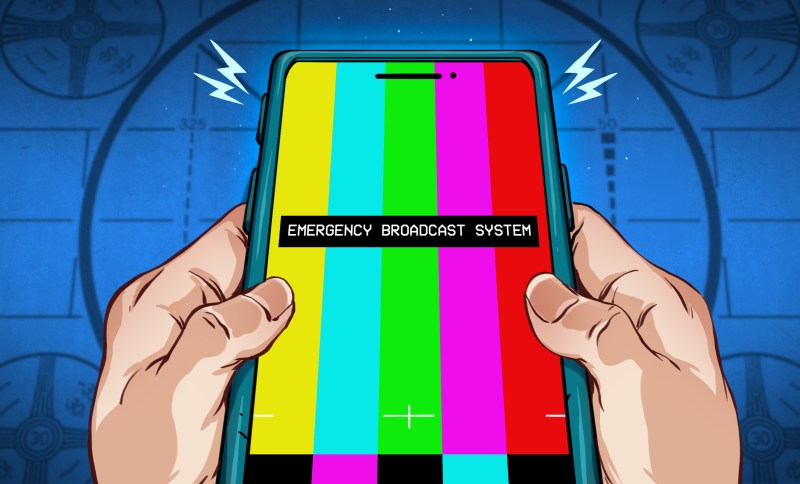
Once upon a time, telephones were primarily point-to-point communications systems. There were options for three-way and conference calls out there, but by and large the plain old telephone system was about connecting one handset to another for a direct conversation. For this reason, the telephone was seldom used for mass emergency communications, because it was simply not fit for broadcasting a message to a wide number of people.
However, technology has since changed. Our modern phones are all connected to a big digital over-the-air network, and large swathes of them can be addressed all at once if so needed. This has led to the development of emergency warning systems that use the cellular network, with Cell Broadcast being the most notable iteration.
Notification
Cell Broadcast technology has been a part of mobile network infrastructure for some decades now, having been included in various forms in 2G, 3G, 4G, and 5G mobile standards. The system was first demonstrated in 1997 in Paris, with the concept being straightforward enough—a way for cell networks and authorities to send rapid notifications in a one-to-many broadcast. The technology is sometimes referred to as Short Message Service-Cell Broadcast (SMS-CB), differentiating it from the more familiar Short Message Service-Point to Point (SMS-PP) that individual subscribers use. A Cell Broadcast message can be fired off to select cells of a cellular network, with the notification in turn popping up on the handsets of all subscribers connected to that cell. This allows for easy geofencing of emergency alerts and information, such that only individuals in the relevant area receive the Cell Broadcast message.
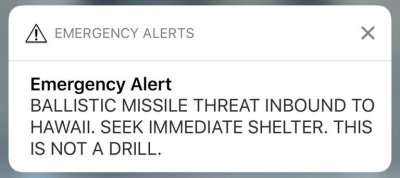
By firing a Cell Broadcast to entire mobile networks across a country, it’s possible for authorities to get a message out to millions of phones in mere seconds—a remarkably effective way of communicating critical information quickly.
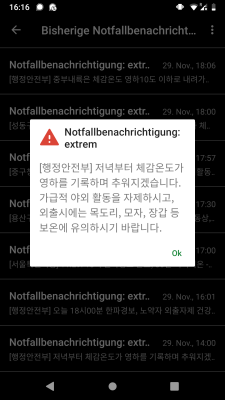
A typical Cell Broadcast emergency message will be announced by a special alert tone with the textual message content appearing on the phone in turn. Messages can be sent in a primary and an additional language and displayed according to a devices individual language settings to aid in accessibility. There is also generally no need for a given device to have a SIM card installed, since the Cell Broadcast messages are not addressed to any given individual subscriber number.
Modern Cell Broadcast messages can be up to 1,395 characters long using Latin characters, or up to 615 characters in languages using UCS-2 character encoding. Messages can be set to refire from every 2 seconds to over 30 minutes, with handsets typically ignoring rebroadcasted messages that have already been displayed. In turn, new messages can also be sent quickly to reflect changing conditions or updated information.
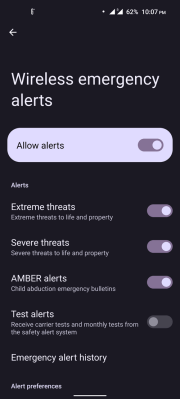
Cell Broadcast messages can come in several different levels depending on the intended severity of the alert. These are identified by hex codes laid out in 3GPP standards, though the exact alert levels vary across different national implementations of the system. In the EU, they are ranked from Alert Level 1 (most severe) to Alert Level 4 (least severe) with additional levels for “Amber,” “Test,” and “Information” alerts beneath. Levels below 1 can be “opted out” on certain handsets with the functionality to do so. Similarly, in the US, the highest level is “National Alert” which can not be opted out of and will always fire on handsets receiving the message. Below that, the levels step down to “Extreme Alert,” “Severe Alert,” and “Public Safety Alert,” with Amber Alerts and test levels beneath that.
Many nations have built emergency communications systems around the Cell Broadcast infrastructure. Since a high percentage of populations in developed countries own cellular phones and keep them close at hand at all times, it serves as a highly effective way to distribute emergency warnings. Many countries simply name their systems after their own nation—such as FR-Alert and DE-Alert in France and Germany, to T-Alert in Thailand. Others get more creative, such as S!RENEN in Denmark, or more descriptive, such as the Disaster and Emergency Warning Network (DEWN) in Sri Lanka.
Despite Cell Broadcast having existed in various forms across previous generations of mobile networks, some nations are still yet to fully implement emergency warnings over this infrastructure. Notably, Australia is in the process of rolling out AusAlert in 2026, with the first national test of the system firing off on the 27th of July, 2026. Authorities noted that 94% of targeted cell towers broadcast the message succesfully, though there was some controversy around some phones not displaying the broadcast message, and concerns around secret phones being revealed by the test which would sound regardless of silent or “do not disturb” modes. Other countries still developing Cell Broadcast emergency systems include India, Poland, Ukraine, Sweden, and Brazil.
There are limitations to Cell Broadcast. Namely, as a one-to-many broadcast message, it’s not directly possible for authorities or telecommunications operators to determine how many or which subscribers may have received the message. The technology is effectively a “push” message system with no backchannel for confirmation of receipt. This is somewhat by design, however, as thousands or millions of devices sending a read receipt via the network would create huge network congestion. This would be particularly undesirable during an emergency situation.
Regardless, the Cell Broadcast methodology has key benefits for emergency and mass notifications compared to other methods of reaching out via the mobile network. Most of all, it’s a message that is broadcast rather than sent to individual subscribers. Sending the same notifications via SMS or MMS would require huge amounts of network capacity as each individual message for each individual phone number was sent out.
There are also logistical difficulties in such a method, wherein a list of valid phone numbers must be maintained and updated at all times. It can also be more difficult to do things like geofenced messaging, since individual subscribers and their phones tend to move around a fair bit.
Hopefully, you’ll never find yourself wrapped up in a major weather event or other serious emergency. If you do, though, you might just find that critical information you need to survive thanks to a timely Cell Broadcast message. Expect such systems to become a baseline part of emergency management efforts in future as long as cellphones remain a ubiquitous communication tool across the population.











No, expect such systems to be abused by politicians, advertisers and scammers.
Much of the world is still pretty miffed that the top-level alert level loudly broadcast “PRESIDENTIAL ALERT” with no way to stop the alarm sound. Thankfully the powers that be saw fit to change that to “National Alert”, so there’s one fewer reason to be pissed off at the USA now.
Considering cellular is going LEO this reinforces the nature of emergency management.
I’ve learned recently that some people are accustomed to getting 3-4 of these alerts per day.
In my area we maybe get 3-4 a year, 300k population center.
I still don’t understand how the perceived way to use this system could be interpreted so differently
In the ~30 years of owning and for the most having on my person at least one mobile phone, I don’t think I’ve ever seen a single one of these.
Here in the UK they’re vanishingly rare – we had a national test of the system a while back and quite a lot of us didn’t even get the message then.
What? You don’t get your phone vibrating and alerting you at 3am that a mom 600 miles away has taken her kid and the dad reported her to the police as part of their custody battle? I wish I could silence these useless kinds of alerts.
Otherwise, how would you know to be on the lookout for a grey Toyota?
With many Android phones you can. I have AMBER alerts and Test alerts turned off.
I turned mine off because of so many useless alerts. I really don’t need to know about a thunderstorm 200 miles away or a missing person in another state.
A few years ago, they tested the Presidential Alert and something like 50% off the phones didn’t get the message.
Ironically, France adopted cell broadcasting only recently.
Instead we choosed (and paid) for a mobile app that had to be installed.
Guess what ? Nobody did.
The few who did it suffered from fake alerts and bugs.
This was supposed to save money compared to cell broadcast. Of course it didn’t.
This was supposed to save lives ; when the Nice killings occured (86 dead, 450 injured), messages were received 3 hours after the event.
Is there some code for type of event (flood, missile, chemical, terrorism…) ?
So that you could “guess” what to do even if there’s no message in your language
no denying the efficacy or efficiency of broadcast…but anecdotally it seems like we’re in an era where ‘just throw more bandwidth at it’ is remarkably effective. just like what happened to cable tv.
locally, the school district has some setup that lets them send simultaneous SMS and 30 second robocalls to every parent in the district. which isn’t quite all cell subscribers but is still impressive. especially if you’re in a room with other parents, it’s always surprising to see so many phones blow up at once. it probably helps that the robocalls mostly go to voicemail and don’t wind up on radio. seems like the world is slowly progressing to enough bandwidth for simultaneous communication with everyone individually addressed
No. If life matters, that’s broadcast or nothing.
Sure you can send sms to a middle-sized audience (we send some to warn parents about schools being closed because of strikes) and you can get them quick (if you pay a premium fee ; we didn’t, it takes 6 hours to send 10.000 sms) but that’s for not vital issues.
France used a mobile application rather than cell-broadcast to warn its population. It was a total failure
I received two alerts this year warning about major fires nearby (south of France).
I found these useful to avoid the danger zone during my road trip.
This is cell broadcast. We dumped the mobile application.
“locally, the school district has some setup that lets them send simultaneous SMS and 30 second robocalls to every parent in the district. ”
The high school my kids attended had a similar set up. The problem is that my kids have finished HS, graduated university, and have their own places. And we still get the damn alerts from the HS… Can’t explain that to the school, because they refuse to (or simply can’t) remove our numbers from their DB. I finally ended up blocking the number.
If no SIM card is required, presumably there is no secret key that the phone would use to authenticate the message. I wonder how easily a malicious person could transmit false broadcasts?
You have to be able to spoof the local cellular infrastructure with more power than what the phone is receiving. While possible, and proven at Blackhat in 2006 (I think), it’s not practical outside of a very small proximity to your transmitter.
Not so easy. The phone only listens to cell broadcasts on the cell it is connected to. If you have no sim card, to the one with the strongest signal. You could setup your own 2G cell tower and send a broadcast, but the vast majority of phones will be connected to their own cell towers (of their respective sim card operators) and therefore ignore your message. Maybe 1 in 10000 people has a phone without a sim turned on all the time. Probably even less.
The phones simply don’t listen to all cell towers in range, all the time, simultaneously. That would be a waste of battery power. In a real emergency all towers (in the respective area) are instructed to send out the emergency message anyway, so there is also no need.
To effectively maliciously send a broadcast you would need to create a working cell tower with proper connections to outside world so people can make phone call and surf the internet, and wait until a large enough number of phones connects to your fake tower.
Might be easier on a ship or plane outside regular coverage areas.
No, the phones only listen on the tower they are connected to. Otherwise they would need to listen to many simultaneously, which would unnecessarily drain battery.
If you set up your own system to spoof a message, no phone with active subscription will get the alert, since no one will be on your tower.
There are quite a few projects that involve creating a bts with the hackrf. Point of fact, you can force people to connect to the bts you create.
I haven’t seen anything on emergency alerts though.
To force ppl to use your bts you’ll have to put some type of jamming on neighbouring bts’s which will for sure get the attention of the network operators.
In a controlled setup, on your desk, you might use something like a faraday isolation cage, jam other bts’s (but only locally to your desk) or change the sim card settings manually. But with phones in the wild and your tiny sdr bts, I see no way to get your neighbourhood to connect to your bts.
Please point me to some instructions if there is a viable way that does not jam all the operators.
UK Alert. You should avoid central London. Right now
I’ve always disabled that nonsense. If you want to tell me something then email me.
I disabled all but the most importants. I don’t want to be waken up in the middle of night because some kid disappeared 1000km away.
The bad ole days
http://conelrad.blogspot.com/2010/09/code-word-hatefulness-great-ebs-scare.html?m=1
More fodder for EAS Analog Horror…A24’s next project.
In Spain there is major controversy because the politicians did not send the ES‑Alert warning during severe flooding, and the official in charge was reportedly out drinking with a journalist. In that situation, many lives could have been saved.
For the past year I was wondering why these alerts were triggered so often in Spain, it’s alarming to walk down the street watching everyone reach their pockets just to read there’s a risk of a heavy rain. Back in Australia there was a cyclone approaching the coast and literally zero broadcast warnings.
This is one of those firsy world problems.
Ugh here they don’t use them enough. We mainly get silver and amber alerts, but never once have I gotten anything about a local hurricane or tornado or even when there is a boil water notice in effect or say a pandemic mask ordinance. I would think those are things that should be mentioned to the local populace without following the local govt on twitter. It would be a great system if implemented.
Should have been a mesh system, that propagates over all availlable channels (wifi, bluetooth, 5G/LTE/GSM). Good enough for a few text warnings, while antennaes are rather suspectible to failure in environmental disasters.
The alerts I get are generally useful and provide advance warning of hail and heavy thunderstorms. Other areas got messages about drones, urging you to stay inside until it was shut down. The one exception was a red alert during COVID, sent at 3am, warning you not to go outside. Such abuse will only make people search on how to disable them.
Here in the Netherlands, I think we get about 1-2 real ones per year (mostly big fires or weather events) and 4 test messages/year, first monday of the quarter at midday, same time they test the sirens.
Somehow, with my work sim, I sometimes got the same message up to 30 times in a half-hour span, while my private sim usually gave only one measage (in the same multisim phone).
With regard to the cell broadcast alerts, in the USA called Wireless Emergency Alerts or WEA, a popular myth it that it is easy to cause an AMBER Alert merely by claiming to police that your ex-spouse abducted your kid. In fact almost the opposite is true, which is why there are so many attempts to get around the restrictive criteria by creating new kinds of alerts at the state level.
Agencies tend to send AMBER and Blue alerts (cop down) to the entire state. So, people far from the incident receive the alert, get annoyed, and turn off all alerts in their phone. Not a smart move at all, in my opinion. The overwide dissemination of alerts is a policy and political issue and not a defect in the technology. To my knowledge there have been no attempts to rein in that aggravating practice, which may not increase the chances of recovering the missing child or finding the persons who attacked an officer.
Sometimes even the allmighty feels a need to turn off Emergency Alerts
https://www.youtube.com/watch?v=f-XVo6y2kQw