
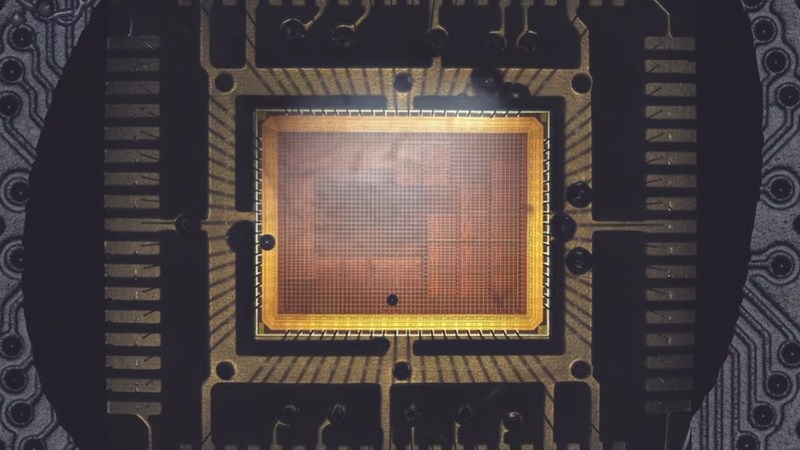
For a while now we’ve followed the slow progression of affordable integrated circuit fabrication, and through the likes of Tiny Tapeout we’ve seen impressive strides made. But they’re not the only player in the space, and [Breaking Taps] has a video showing their microprocessor built using wafer.space.
The microprocessor itself is a little unusual, being a transport triggered architecture design with two busses. The whole thing might better be described as a system-on-chip than a microprocessor, as like a microcontroller it contains both memory and peripherals. He’s used Spade to design the thing, and we get an in-depth look at all the steps involved between design and fabrication. It’s a level or two more difficult than passing the DRC standards for your PCB fabricator. The result is a chip carrier with the chip itself visible under clear epoxy. It’s using an old fabrication technology so the silicon is surprisingly big, but unlike Tiny Tapeout’s cell based fabrication the whole chip is the one circuit. Mounting it on a PCB and using a breadboard, he’s able to demonstrate it running simple programs.
It’s clear that having your own IC fabricated is not for everyone, as even though wafer.space has performed minor miracles it’s still a service for people with a few dollars in hand. But look at it this way, we’re still near the start of this particular curve, and we expect that further affordability breakthroughs will follow.












In curious how difficult is it to do mixed signal stuff like RF (FSK or FM or whatever) on something like this.
My understand is that the designers must be aware and work with the silicon fab to make all the little inductors and capacitors in silicon to get RF stuff to work. It’s very different from fabricating purely digital stuff
This is the case for specialized high end RF stuff, but consumer RF is almost entirely made of standard CMOS. You need a lot of realtime calibration circuits for that.
Generally the fab will have inductor, transformer and capacitor templates, and/or some model to simulate them.
For RF and analog you very rarely use a minimum size transistor, so using an older process doesn’t limit you much. Only the Ft of the transistors might limit your operating frequency.
and I’m curious and wondering if the govs will eventually put their dirty hands on private designs and regulating everything about this technology, banning chips or even making them illegal to produce/ design/ use. It happens you know. I mean the dreams of a free descentralized crypto currency is far away buried in the past, so I guess is easier for hardware, my current Gov just banned buying smartphones from abroad without being in a (expensive,not worth the cost for the average consumer) list of importers. Oh! the same gov that just banned smartphones,tablets and laptops from schools. Go figure! I think in some point govs of the world decided that we are not good enough to think and decide for ourselves.
It’s your fault for living in a EU. Don’t gaslight others into demanding a false political dichotomy.
Matter of time.
Crypto-goon disappointed with the reality that a currency needs a guarantor.
This is totally awesome. IHPs open PDK supports AMS designs. In my thesis I am working on design and taping out open-source AMS designs utilizing their PDK.
ok, but how much did it cost
Wouldn’t this be ideal to create “GUI-frameworks” in hardware?