
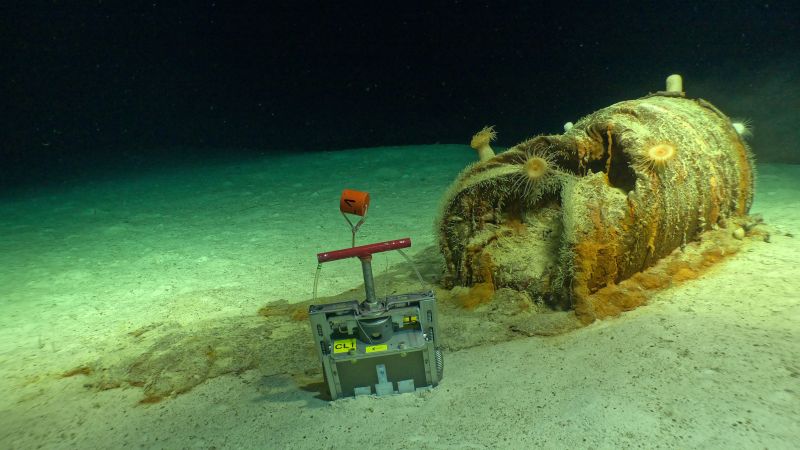
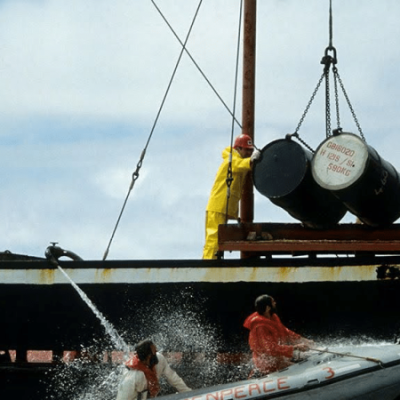
Recently French and international researchers took a look at the state of the thousands of barrels of radioactive waste that were dumped into the Atlantic Ocean between 1950 and 1990, trying to ascertain the state of this waste and its effect on the ecosystem.
Although a lot of fuss is made of the spent uranium fuel and high-level waste produced by light water reactors and fuel reprocessing facilities, the overwhelming majority of nuclear waste is low- and intermediate-level waste (LLW and ILW) churned out by hospitals, laboratories and various industries.
Due to the sheer volume of this waste over the decades creative ways have been sought to dispose of it, which include burying in landfills and incinerating.
For a while tossing such waste into the ocean was also deemed to be an excellent destination for LLW and ILW, with the latter especially encapsulated in bitumen or cement. This was the poured into the barrels that many people have come to associate with nuclear waste in general. Since the approximately 200,000 tons of such barrels and similar were tossed into the Atlantic Ocean decades ago the question was where they ended up and their state.
The Radiocean mission site lists the objectives, including the mapping of the sites and identifying the elements of the ecosystems in addition to any radioisotope levels and their effect on said ecosystems. As it turns out, although the barrels have definitely degraded and their contents are slowly collapsing, the local ecosystems seem to have adapted well, treating the dump sites more as convenient shelters rather than a hazard. Some more photos can be found on the Bluesky account of [Javier Escartin].
None of this should come as a surprise if you are aware of just how much radioactive material is already dissolved naturally in the oceans, with much more uranium present in seawater than can be mined on-shore. Although the introduction of isotopes that are not part of the normal thorium and uranium decay chains into the ocean is of course undesirable, it’s good to know that this rather haphazard treatment of LLW and ILW has apparently just resulted in some Atlantic Ocean floor critters ending up with an interesting reef.












Kaiju origin story
In the immortal words of Jeff Goldblum, “Life, uh… finds a way.”
This was a hard read
Much of the low level waste is a product of regulation, not contamination. There are double standards for what counts as low level waste for the nuclear industry – to the point that we’d be tipping the stuff into a regular landfill, or mixing it into concrete and making houses out of it, if it didn’t have something to do with atomic power. It is nuclear waste by name only.
https://www.sciencedirect.com/science/chapter/monograph/abs/pii/B978008102702800008X
This is the reason for the joke that if you bring a banana into a nuclear power station, you can’t take it out anymore because it’s now nuclear waste. It isn’t technically true, since a “banana equivalent dose” is 0.1 μSv, so you’d need a crate of bananas to represent a potential public exposure hazard at the level where it would need to be disposed as nuclear waste. However, since this is NORM the regulations don’t apply.
However, the point is that a great deal of the LLW that has to be treated as such is no more dangerous than a bunch of bananas. It’s just old jumpsuits, gloves, cleaning rags, water, etc. that have barely detectable levels of contamination.
With the difference being, that one can be reasonably sure of the radioactivity in that banana crate to be coming from the equally distributed potassium isotopes atoms in the bananas (that are fine to ingest, and you won’t eat a crate at a time); while that “equally low level of radioactivity” in the barrel of old jumpsuits may well come from a sprinkle of hot particles that are the opposite of well distributed (and that may turn out to be alpha emitters as well upon closer inspection) and consequently be not-so-fine to even risk ingesting as a consequence…
With the difference that the Potassium-40 in the banana is going to be incorporated into your bones when you eat it, while the “hot particle” isotopes don’t necessarily have any biological role, are not absorbed and become excreted after a while.
That’s an issue for the “hot particle” theory of nuclear paranoiacs: if it’s absorbed by the body or otherwise dissolved, it no longer remains a concentrated strong emitter. If it’s not absorbed the body tends to get rid of it if possible. Your lungs push out mucus to get rid of dust in the lungs, you swallow the mucus, and then poo it out.
https://en.wikipedia.org/wiki/Hot_particle
And on the point of what is the actual source of the contamination, there was that Smarter Every Day video where the guy went to a nuclear station and had troubles getting his camera equipment cleared out because it triggered the sensors. They suspected it was just radon gas that was clinging to the camera by static electricity, so they simply waited and measured again and again until the meter said okay.
If that was some random junk, they probably would have bagged it with other low level waste and treated it as such.
After all, you’re not supposed to have “sprinkles of hot particles” coming out of a nuclear reactor that isn’t dangerously broken. What does come out is gases like xenon, radon, tritium, helium, etc.
So your point is that a bunch of different possible wastes, that may or may not be individually dangerous, are all treated the same because a small percentage ARE dangerous?
And then you blame the regulation for it, instead of the actual culprit.
It is more expensive to build a whole system around identifying the actual dangers (meaning specific objects glove#96654987 not just “gloves”) than it is to label it all as “possibly dangerous” and cart it all off.
Your problem is caused by shoehorning it into a “business” (or at least a budget) rather than making it an engineering problem.
this is something that has always impressed me when i read about it!
like, a significant source of contamination at chernobyl is literally chunks of material from the reactor. chunks you can see and even collect manually. some sorts of contamination are diffuse and pervasive, but some is extremely specific. You touch it or you don’t. reminds me of a scene from Saint Leibowitz and the Wild Horse Woman, where a post-apocalyptic guy has to ritualistically spend an interval in a crater known as ‘meldown’ where survival is believed to be determined by the happenstance of the wind (you breathe the emitted gas coming from specific localized sources, or you don’t).
just one of the many awesome cases where the absolute specificness of a particle is put on display. the constant struggle whether to think of something as a population of individuals or as a rate, “___ per ___”.
What’s that bullshit argument? There’s also only so much sunshine on square meter, but the same amount on square centimeter kills you.
It’s probably equally stupid to dredge up low level waste, leach out the radioisotopes and drink it as it is to build a giant magnifying glass and concentrate a square metre of solar flux onto a square centimetre of skin.
Both are patently avoidable.
It’s so cool that critters make an ecosystem out of the warm waters product of radioactive decay.
You know what’s also cool with critters in the seabed? That nobody cares if they die prematurely or mutate to some horrible mess. That’s less cool when happens to people
We’re suppose to get superpowers out of it.
So, glowing lobsters ….?
After reading this article I can comfirm that I’m OK with dumping nuclear waste to the oceans…. no wait…
I would be more worried about toxic chemical contamination than radiological.
A pair of gloves worn once into a reactor containment structure without interacting with any radiological material is “low-level radiological waste”. The bar is set real low.
Be glad they didn’t stick former employees in them.