
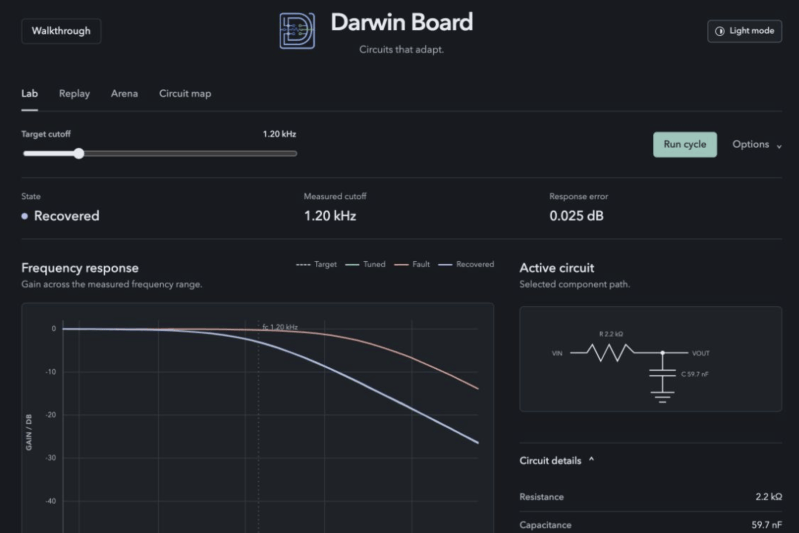
We are surrounded by evolving algorithms and AI models, and it feels like we have to evolve to them as well. Of course, the world itself is always evolving, and when we have to implement filtering circuits based on current environments it might not last all that long. [Saikarthik Ramakrishnan] realized that this phenomenon can easily apply to simple RC circuits, so why not make them adapt to the changing world itself? This is exactly what the Darwin Board is meant to do: act like an evolving simple RC circuit for whatever environment or signal you want gone.
RC circuits are normally considered to be relatively simple in the world of circuits; however, the real world isn’t always all that simple. This simple evolutionary algorithm implemented by [Saikarthik Ramakrishnan] attempts to apply similar principles used in other evolving models to the humble RC circuit. Based on an ESP32, the Darwin Board is a fairly simple model of 2040 possible combinations of genomes. Yes, each possible RC circuit is its own genome, which allows simple evolution from one to another based on current requirements.
You should certainly consider checking out the project’s GitHub repository here to try out the mutating circuit itself. While this project might complicate what is normally fairly simple, there is sometimes beauty in simplicity. So why not use a comically simple circuit for a smart home feature?












The amount of computation being thrown around for the most basic of filter circuits is amazing.
Yes, it’s amazing when someone discovers again Ohm’s law via SPICE simulation…
I could understand using AI to develop high order filters / impedance matching microstrip stubs for UHF (and higher) amplifiers.
But – a basic RC circuit?
Agree. Actually there are cases where RC circuits can require much more extensive modelling due to operating conditions – very high voltages and very low currents.
I don’t understand this project, can someone please explain to me?
I have been trying to design matching a network for my RF application which also have decent filter capabilities but I always seem to face disappointment when go beyond SPICE and I build stuff on my bench.
If your matching circuit uses inductors, I have a project that might help. Most inductor calculations don’t take into consideration a lot of useful details, and don’t allow you to construct an inductor specifically for your frequency. For example, the standard inductor formula doesn’t tell you what the Q of your inductor will be.
https://hackaday.io/project/193000-inductance-design-tools
For matching filters, I find that SimNEC works spectacularly well (free, and available online). SPICE is good for actual electronics, but SimNEC does a really better job for frequency dependent things like cables, antennas, and matching networks.
Maybe I’m just too stupid, but I don’t see the connection between genome, genotype and an RC circuit. It seems like a convoluted way to represent a Monte Carlo of RC parameter variations.
This is as insane as a school assignment.
Author is Copilot used by someone in India (probably in school), par for the courses coming from MSslop
There isn’t really much to check out here. There is no annotation, no meta-data, little explanation on theory, poor instructions on the experiment and the formatting is all over the place. It works, but it is a machine written mess and probably was just done hastily for a thesis on something like metaheuristics.