
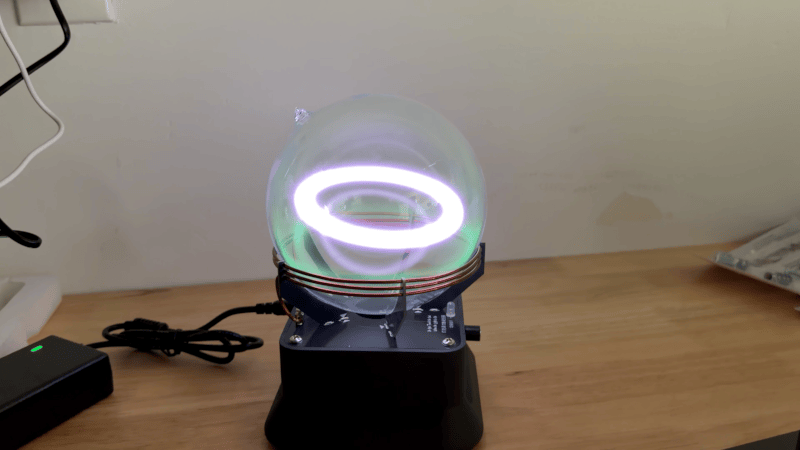
We know [The Action Lab] always has something hands-on. This time, the video shows a toroidal plasma demo and how it relates to nuclear fusion. Plasma has a high temperature, and if you use physical electrodes to excite the plasma, this high temperature tends to destroy the electrodes. But thanks to the relationship between electricity and magnetism, you can create plasma with an alternating magnetic field instead of physical electrodes.
The actual practical device is a 10 MHz source with a coil and a low-pressure globe full of xenon gas. It looks pretty cool. Of course, the little tabletop demo isn’t strong enough to drive a fusion reaction. But if you scale it up and make some modifications, including using hydrogen, you get a tokamak reactor.
The problem, of course, is that current reactors need more energy to operate than they produce. But we keep hearing that nuclear fusion is right around the corner. One day, that’ll probably be true.
Of course, you can build your own fusion device. Just don’t expect to generate net power.












https://www.entertainmentearth.com/news/wp-content/uploads/2014/09/DC658194.jpg
Cold fusion and dark matter are delicious nothing burgers
Makes me think I should look into inventing Dark Fusion Reactor powered by Dark Matter. I am sure there will be no global (aka “observable Universe-level”) shortage of fuel as far as eye cannot see. : ]
Compared to what, to ambient? Not neccesssarily, no.
And also, this should be two videos: about fusion power and about this toy. They are barely tangentially related.
As in playing with trains, it depends of the money you put in for your toys. And the bigger the better. So, if you have the dough and want a 2km “plasma” ball that outputs hundreds of Mega Watts, you can do it. But usually this kind of money is used for buying personal planes, islands and small countries.
fusion has been 10 years away for the last 50 years..
Yeah, but eventually somebody is going to be correct even if it is just pure luck. In the mean time it makes a cool looking lamp
agreed, the lamp is cool (or hot..).
I doubt extremely that we will have a fusion power plant in my lifetime. Or in my childrens. It’s a fundamentally hard problem…
I don’t think it’s a hard problem per sé. It’s more like an expensive problem. When you’re building a reactor, not really knowing fully enough what you’re doing, you might find something that will mean that you will have to throw away half of your reactor and rebuild it in a different way. And maybe more than once. Very expensive.
I’m not holding my breath either… Although some recent developments have been pretty promising. It’s still a very tough nut to crack.
Also I think some of the bigger political concerns actually want de-growth much more than they want limitless clean energy, but that’s a different story.
The answer is simple. However, it has not been tried. Normal Hydrogen in a Tokamak with an H-Beam laser traversing the inner edge of the plasma stream at approximately 10% from the inner edge. Pulse the beam and allow the created disturbances to be absorbed by the plasma stream. This insures the disturbance does not reach the outer edge of the Tokamak. The disturbances enhance the fusion of the Hydrogen, creating net positive energy. Simple and effective. It should work between the 16M and 20M centigrade temperatures. 100M is simply not needed.
Try it for a change instead of dumping a bunch of Deuterium and Tritium into the Tokamak so they will separate into inner/outer flows in the stream.
Great idea! Show us the research papers that probe that it should work, and won’t e.g. accidentally open a portal to Xen when the anti-mass spectrometer is pushed past its limits.
Or better yet, show them to Cern or whatever else research lab is working on a Tokamak.
This won’t attract massive government subsidy, so won’t fly with no need for a huge committee staffed by the politicians’ fruitless/pointless offspring.
Does xkcd read Hackaday ? https://xkcd.com/3313/ :-)
Gave me a good chuckle…
Thanks
I think we often ask the wrong questions about fusion. How far are we from break-even reactions? How far are we from getting more energy out than we put in? I think a better questions is: Can a fusion reactor make more economic sense than existing clean methods of generating electricity (solar, wind, nuclear, etc.)? I’ll bet fusion can be made to work. I’m just not sure that it’s the best place for research dollars. Would we be better off working on solar, wind, energy storage, current generation fission reactors and/or Generation V fission reactors? If we wait for fusion I think climate change will kill us before we get there.
I know that calling fission “clean” is controversial. Not trying to start that fight here. I think the question is valid whether it’s considered clean or not.